Casino marketing in 2026: why ads are closed and what works instead
Google Ads and Meta have closed gambling by policy. We break down which channels remain, why links outweigh content in this vertical, and why half of a link budget disappears into pages search engines never see.
If you market a casino, a sportsbook or any other iGaming project, you already know the standard marketing playbook does not apply. Google Ads campaigns get disapproved, Meta ad accounts get banned, influencer placements run into platform refusals. Yet the vertical remains one of the most profitable online — and somebody is clearly getting the traffic.
This article covers it without illusions: why paid channels are closed to gambling, what is left instead, and why the link profile matters more in this niche than in any other. It is not a vendor roundup — it is a breakdown of how traffic actually works in a heavily regulated vertical.
Why ad platforms reject gambling
This is not a moderator who "didn't like something". Gambling is a separate category with its own rulebook on every major platform, and those rules are stricter than for any other commercial vertical.
Google Ads
Gambling ads are allowed, but only when three conditions hold at once: the advertiser has a valid licence in the specific country of display, has passed Google's separate certification for that country, and the country itself is on the permitted list. That list is closed, and most markets are not on it. Creatives pointing to unlicensed sites are rejected automatically, no matter how the ad is worded.
Meta (Facebook and Instagram)
Here you need written permission from the platform, issued for a specific legal entity and a specific geo. Without it, any gambling-related ad is taken down, and repeated attempts get the entire ad account blocked — along with the business manager and linked assets.
TikTok, Twitter/X and the rest
Most platforms classify gambling as prohibited or heavily restricted. Some ban it outright; others allow it case by case under a direct agreement, which implies budgets at major-operator scale.
What is actually left
Once you remove the closed doors, the channel map for iGaming looks like this.
Affiliate networks work, but they have a ceiling: you pay for results, you compete on payout against other operators, and you do not own the source. The moment someone outbids you, the traffic leaves. Organic search is the only channel that stays your asset and gets cheaper over time.
Why links matter more in iGaming than elsewhere
In a normal vertical you can grow on content: cover informational queries, accumulate behavioural signals, gradually move toward commercial terms. In gambling that path is shorter than it looks.
- The SERP is occupied by aged domains. Commercial rankings are held by affiliate portals that are 8–15 years old. They have accumulated a link mass that content alone will not close in a quarter.
- Informational traffic converts poorly into deposits. A "blackjack rules" article brings a reader, not a player. The money sits in commercial queries, and there content is hygiene, not an advantage.
- Domains are almost always young. Changing domains is routine here, and every fresh start resets accumulated trust.
- Behavioural signals give you little. Until the site ranks, there is nowhere to collect them — a closed loop.
That leaves the link profile. And this is where the part nobody writes about begins.
The core problem: the link exists, but effectively it doesn't
A familiar story: a hundred links bought, a clean report, every URL live — and rankings do not move. The cause is usually not "bad" platforms. The cause is that between "link placed" and "link passes value" sit several filters, and only a minority make it through.
The key point: the vendor's report documents step 1, while you are paying for step 4. Free and user-generated platforms are crawled rarely and selectively — a new page there can sit outside the index for weeks, and some of those sites block whole sections from crawling themselves. So the first thing to demand from any link purchase is not a list of URLs, but proof they entered the index.
Why a single layer of links does not hold
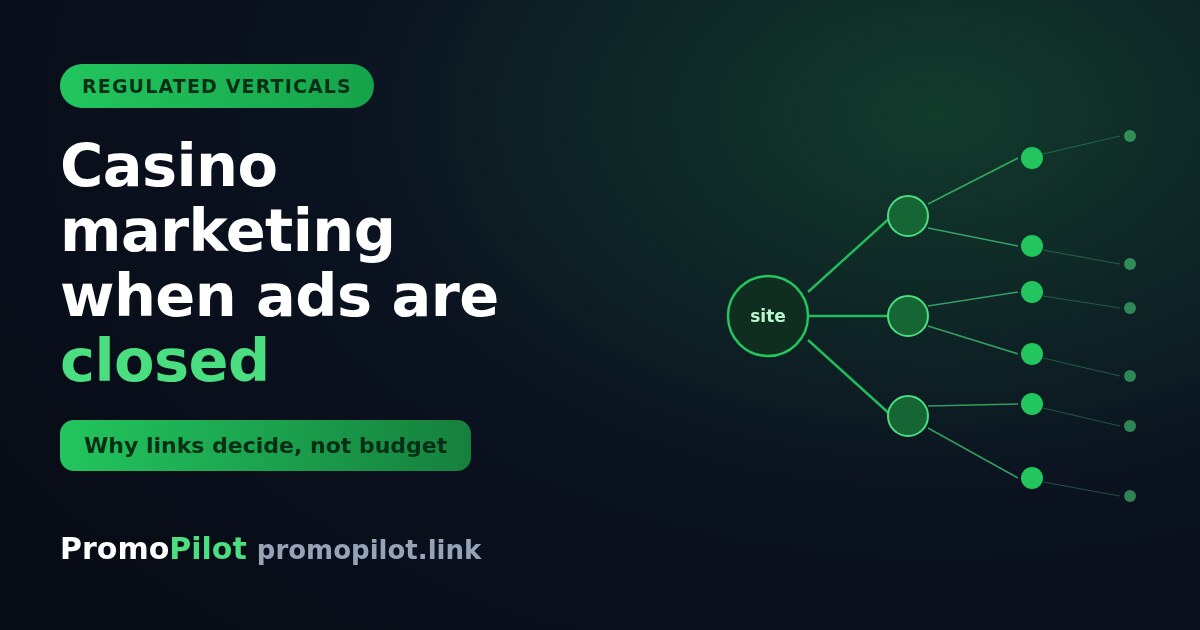
This leads to a principle that, in regulated verticals, separates a working strategy from wasted money. A page linking to your site is, in itself, just another page on the internet. For a crawler to reach it and come back, it needs incoming signals of its own.
The professional term for this is tiered link building: the first tier is pages linking directly to your site, the second is links pointing at those pages, the third is indexing signals. The point is not volume — it is that each tier makes the previous one visible to the crawler. In regulated verticals this is decisive: where you cannot buy ads, you also cannot afford half your link budget disappearing into invisible pages.
What it costs and how long it takes
Honest reference points, with no promises of page one in a week.
- First 2–4 weeks. Links get placed and go through indexing. Rankings usually do not move — that is normal.
- 1–3 months. Visibility starts growing on mid- and long-tail queries. This is where you can tell whether the strategy works.
- 3–6 months. Movement on commercial queries, provided links were built evenly and without spikes.
On budget, follow the principle "fewer pages, but taken to a result". Spreading a hundred dollars across twenty landing pages reliably achieves nothing on any of them. Better to take two or three pages, push them into the top, and scale what worked.
What not to do
- Bulk buying on link marketplaces. The same donors already point at your competitors, and the profile reads as a template.
- PBNs on expired domains. In gambling, networks get detected fastest — the vertical is under extra scrutiny.
- Over-optimised commercial anchors. The quickest route to a filter. The anchor list must be varied, dominated by branded and naked URLs.
- Sudden spikes. A thousand links in a week to a young domain is a signal, not a result.
- Cloaking and doorways. A separate conversation: even when it works, you are left with an asset that can be switched off at any moment.
Pre-launch checklist
- Pick 2–3 priority landing pages instead of spreading across the whole site.
- Build an anchor list dominated by branded and naked-URL variants.
- Make index verification part of accepting the work, not a quarterly review.
- Plan an even schedule instead of one-off bulk purchases.
- Count indexed links, not placed ones.
- Decide the geo strategy up front: each market needs its own link profile.
The bottom line
There is no easy channel in iGaming. Paid advertising is closed by policy, affiliate traffic is not yours, and organic demands patience and money. But organic is the only thing that compounds: a link bought today still works a year later, unlike a spent ad budget.
The one thing to take away: measure indexed links, not placed ones. In a vertical where every channel is a fight, paying for invisible pages is the most expensive mistake available.
See how tiered link building works
Frequently asked questions
Can you advertise a casino on Google Ads?
Yes, but only with a valid licence in the country of display, separate Google certification for that country, and only if the country is on the permitted list. For most projects without a local licence this channel is closed.
Why do links matter more than content in gambling?
Commercial rankings are held by domains 8–15 years old with accumulated link mass. Content here is mandatory hygiene, but it does not close the gap in link profile, and informational traffic converts poorly into deposits.
Why do bought links produce no result?
Most often because they never entered the index. A link outside the index does not exist for a search engine, and a placement report will not reveal this. Check a sample for indexing before you pay.
What is tiered link building?
A scheme where the first tier is pages linking to your site, the second is links to those pages, and the third is indexing signals. The tiers exist not to inflate volume but to make every link visible to the crawler.
How long until results?
The first 2–4 weeks go to placement and indexing, visibility on mid- and long-tail queries grows over 1–3 months, and movement on commercial queries typically takes 3–6 months with an even schedule.
Is link building risky in this niche?
Specific methods are risky: bulk marketplace buying, PBNs on expired domains, over-optimised commercial anchors and sudden spikes. An even schedule, a varied anchor list and index control do not create risk.