AI Overviews and traffic in 2026: what 14 months of data show
The CTR collapse took the whole of 2025, bottomed out in December, and by February 2026 had recovered 85%. What actually happened to clicks, what Google itself says about it, and what to do instead of "optimising for AI".
For a year and a half the whole SEO industry repeated one line: "AI Overviews killed organic traffic." It was true. The problem is that it was true in 2025 — and it is now 2026, with the most recent data telling a different story.
What follows is a breakdown of what actually happened to clicks, based on fourteen consecutive months of measurement. Plus Google's official position, which contradicts half the services currently being sold. And a practical order of operations that contains no step called "optimising for AI".
What actually happened to clicks
The most detailed public measurement of the AI Overviews effect comes from the agency Seer Interactive. Its value is not the conclusion but the scale and the continuity: 53 brands, 5.47 million tracked queries, 2.43 billion organic impressions, measured month by month from January 2025 through February 2026. This is not a one-off before-and-after snapshot but a fourteen-month line — which is exactly why it shows what single measurements miss.
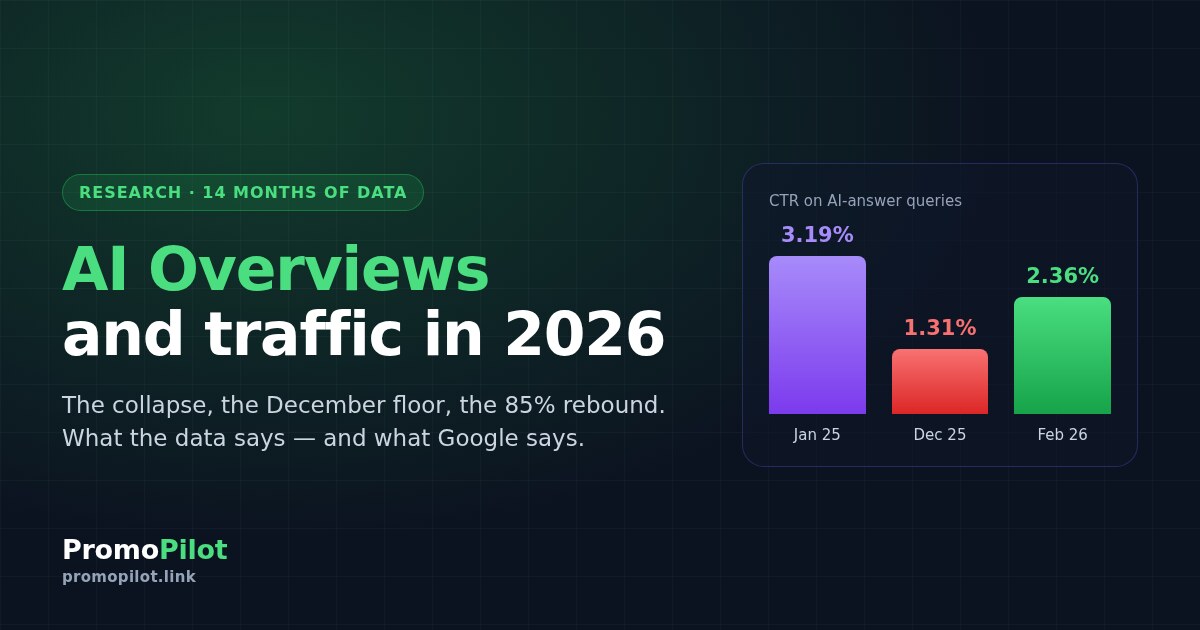
The first thing that breaks the familiar narrative: in January 2025, when AI Overviews were already showing, CTR on queries with an AI answer was higher than on queries without one — 3.19% against 2.75%. The collapse did not happen at launch. It happened over the course of the year, as Google widened the block's coverage, changed its layout and increasingly placed the answer above the first organic link.
The floor was in December, not now
Here begins the part almost nobody writes about. From the December floor of 1.31%, organic CTR on AI Overview queries climbed to 2.36% by February 2026 — an 85% recovery in two months. Over the same year, CTR on queries without an AI answer did not fall at all; it rose from 2.75% to 3.82%.
Two things follow, and both matter for planning.
First, the gap has not closed and by the look of it will not: a stable difference of roughly a third remains between "AI answer present" and "AI answer absent". That is the new normal. There is no point planning a return to 2024 numbers — it is not coming.
Second, the panic phase of the cycle is over. If your strategy still rests on the "minus 60% of clicks" figures that circulated at conferences in autumn 2025, you are optimising for a point already passed. The floor came and went.
An important caveat on applicability: the Seer sample is mostly large brands in the English-language market. Your absolute CTR values will differ, and AI Overview coverage varies across markets and languages. What transfers intact is the direction and the ratios: a collapse over the year, a floor, a partial rebound, a persistent gap.
The real split is not "AI answer or not" — it is "cited or not"
The most useful part of the data is the part usually lost in retellings. Seer split AI Overview queries into two groups: those where the brand was cited inside the AI answer itself, and those where an AI answer appeared but the brand was not in it.
The ratio holds regardless of the overall level: 3.04% against 1.65% in January 2025, and 0.95% against 0.55% at the December floor. A difference of roughly 1.7–1.8× persists in good conditions and bad.
This reframes the task. "How do I keep my clicks when an AI answer appears" is the wrong question — you have no influence over whether the block appears. The right question is: how do I end up inside the answer rather than beneath it. The difference between those two states is roughly twofold in CTR, and it is the only lever that exists.
What Google officially says — and why it matters more than it looks
Against a market busily selling "AI Overview optimisation", Google's own documentation reads as almost provocative.
"There are no additional requirements to appear in AI Overviews or AI Mode, nor other special optimizations necessary."
Google Search Central, documentation on AI features in SearchAnd in the same document, the one requirement that is actually stated:
"To be eligible to be shown as a supporting link in AI Overviews or AI Mode, a page must be indexed and eligible to be shown in Google Search with a snippet."
Google Search CentralNo special markup, no AI-specific file, no mandatory schema.org. Indexed, and eligible to show with a snippet — that is all.
This sounds boring right up until you check your own pages against those two conditions. In practice, pages routinely drop out of AI answers because they:
- are not in the index — and the owner does not know, because they watch rankings rather than coverage;
- are closed to snippets via
nosnippetor truncated bymax-snippet— often a leftover from an old anti-scraper setting; - carry
data-nosnippeton precisely the block that answers the user's question.
Google lists these controls explicitly as the way to manage inclusion in AI features. The flip side: if they are switched on, you have removed yourself from the pool the answer is assembled from. Google-Extended is a separate matter — it governs use of your content in other Google systems, not display in Search.
A useful detail for reporting: traffic from AI features is not broken out in Search Console. It lands in the Performance report under the Web search type, together with ordinary organic. There is no "show only AI Overviews" toggle — worth knowing before you build a dashboard that claims to have one.
One more Google claim deserves a cool head: by their account, clicks from result pages with AI Overviews are "higher quality" — users spend more time on the site. This cannot be verified externally, because Google does not release data split by whether an AI answer was present. Hold it as a hypothesis, not a fact: fewer clicks at higher value is plausible, but unverifiable with the tools you have.
Why "AI Overview optimisation" sells even though it does not exist
The gap between "no special optimisation exists" and a thriving GEO/AEO services market has a simple explanation: demand exists, panic exists, and nobody demands verifiable results, because measuring inclusion in an AI answer over time is hard and expensive.
Some things about visibility factors are nevertheless known. In December 2025 Ahrefs examined 75,000 brands and calculated which metrics are statistically associated with a brand appearing in AI results. At the top: YouTube mentions (0.737 on the Spearman scale) and branded web mentions (0.656 for AI Overviews); then branded anchors (0.527), branded search volume (0.392), Domain Rating (0.326), while the number of backlinks came out near the bottom of the list (around 0.19). The authors themselves stress two caveats, and both matter: correlation is not causation, and the relationships themselves range from moderate to weak on the Spearman scale. This is a map of coincidences, not a set of instructions.
The practical takeaway is more modest than GEO vendors would like: the system appears to care about how often, and in what context, a brand shows up in independent sources at all. Not a single signal, not a lever with guarantees — but an explicable pattern. Links, meanwhile, remain what they always were: a way to get indexed and crawled, which is to say a way to satisfy the one condition Google stated outright.
What to do: an order of operations without magic
robots meta tag for nosnippet and max-snippet, and your templates for data-nosnippet attributes. A common find: a restriction sitting on product cards or price blocks, added years ago against scrapers, that also cuts you out of AI answers.How to isolate AI traffic in Search Console
There is no direct way: the Performance report has no separate search type for AI features, and everything sits under Web. What you can do yourself:
- Build a list of queries where the AI answer appears. Manually for your top 30–50 queries, or through a rank-tracking service that records the presence of the block.
- Split the Performance report into two groups — queries with the block and without — and compare CTR trends between them rather than against last year as a whole. This is exactly how the credible studies on the subject are built.
- Watch for divergence between impressions and clicks. Impressions holding or rising while clicks fall is the signature of an AI answer appearing. Both falling is a loss of visibility, and that has a different cure.
What not to do
What this means for link building
Nothing revolutionary — and that is arguably the main conclusion. The mandatory condition for appearing in an AI answer, as stated by Google, is indexing. Everything that helps a page get found and crawled serves that condition. Everything that places a brand mention in meaningful context on an independent platform falls into the zone that the research associates most strongly with AI visibility.
What you should not expect from links is a direct pass into the AI answer. Backlink count came out among the weakest signals in the Ahrefs study, and any contractor promising otherwise is running ahead of the available data.
The practical frame for 2026 looks like this: first make sure the pages are indexed and open to snippets, then that they carry an extractable answer, and only then build presence in independent sources. That order matters: the third step delivers nothing without the first two.
Publications mentioning your brand on topical platforms, an indexing check on every placement, and a report on what actually made it into the index.
Frequently asked questions
Did AI Overviews really kill organic traffic?
They did not kill it, but they changed the norm. According to Seer Interactive, CTR on AI-answer queries fell through 2025 to 1.31% in December, then recovered to 2.36% by February 2026. A gap of roughly a third against queries without an AI answer persists — that is the new baseline.
What do I need to do to appear in AI Overviews?
Google states that no special optimisation exists. The only requirement is that the page be indexed and eligible to be shown with a snippet. Everything else comes down to having an extractable direct answer on the page.
How much does being cited in the AI answer matter?
According to Seer, when an AI answer is present, cited brands receive roughly twice the CTR of uncited ones: 3.04% against 1.65% in January 2025, and 0.95% against 0.55% at the December floor.
How do I track AI Overview traffic in Search Console?
There is no separate search type for AI features — this traffic lands under Web together with ordinary organic. You can only assess the effect indirectly: split queries into those where the block appears and those where it does not, and compare CTR trends between the groups.
Do links help you get into AI answers?
There is no data confirming a direct effect. In the Ahrefs study of 75,000 brands, backlink count was among the weakest factors by correlation (around 0.19), while branded mentions were among the strongest (0.656). Links do remain a way to secure indexing, which Google named as the mandatory condition.
Should I block AI with nosnippet?
In most cases, no. Forbidding snippets removes the page from AI answers and from rich results in ordinary search, without returning the traffic: the query still gets answered, with a link to another source.
Sources
Seer Interactive, "AIO Impact on Google CTR: 2026 Update" — 53 brands, 5.47m queries, 2.43bn organic impressions, January 2025 – February 2026.
Google Search Central, documentation on AI features in Search: requirements, snippet controls, reporting in Search Console.
Ahrefs, "Top Brand Visibility Factors in ChatGPT, AI Mode, and AI Overviews", 12 December 2025 — 75,000 brands, Spearman correlation.