What it costs to rank a casino site: a stage-by-stage budget breakdown
What an iGaming promotion budget is made of: spending shares by line item, four stages of work, three budget scenarios and how to tell whether the channel pays off.
"How much does it cost to rank a casino site" is a question whose honest answer is "it depends" — and that is irritating to hear. So instead of a final number, let's break down what the budget is made of, where the money goes at each stage, and where it most often burns for nothing.
This is for people planning a budget: project owners, affiliates, and agencies who need to explain to a client why "doing SEO" is not a one-off payment.
Why everything costs more in this vertical
The same work costs more in gambling than in ordinary commerce. Here is why.
- Competitors are years ahead of you. Commercial rankings are held by affiliate portals aged 8–15 years. You catch up with link mass, not with content.
- Your domain is usually young. Changing domains is routine here, and every fresh start resets accumulated trust. You pay for the ramp-up again.
- Contractors price in the risk. Writers, platforms and agencies add a markup for the vertical — and some simply refuse the work.
- Geo multiplies everything. Every new market means separate content, a separate link profile and a separate budget. "Built it once for all countries" does not apply here.
What the budget consists of
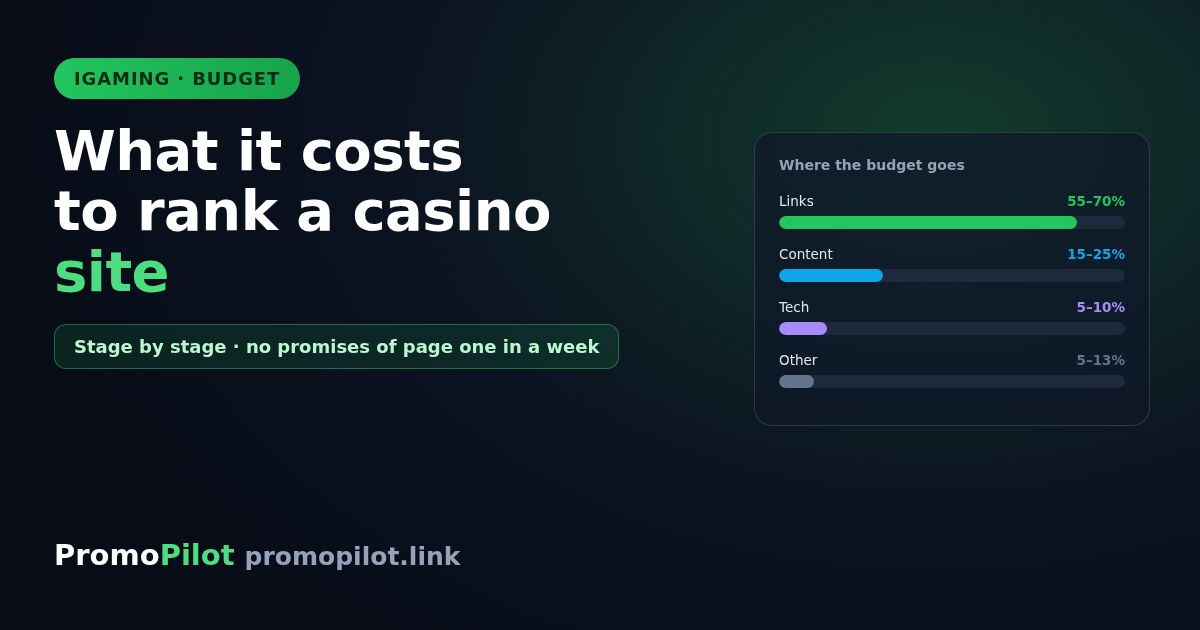
Before counting sums, it helps to see the proportions. In projects that actually reach a result, spending breaks down roughly like this.
Stage 1. Foundation — first 2–4 weeks
The most underrated stage. Rankings do not move here, so this is where people cut costs — and then the entire link budget pours into a leaking bucket.
What it covers
- Domain. New, or with history. An expired domain in gambling is a lottery: you may inherit an already-damaged profile, and untangling it is on you.
- Hosting and protection. The vertical lives under constant attacks from competitors; cheap shared hosting folds at the first surge.
- Technical base. Indexing, speed, URL structure, hreflang per geo, structured data. All the things that cannot be redone later without losses.
- Site structure. Which pages become commercial landings — this determines the entire downstream budget.
Stage 2. Content — 1–3 months, then ongoing
The key difference in gambling: content here is hygiene, not an advantage. In a normal vertical you can grow on articles. Here links hold the commercial SERP, and text exists so the page is eligible to rank at all.
The practical conclusion: do not try to win on volume. A thousand pages of weak text costs money, eats crawl budget and delivers nothing. Ten strong commercial pages, finished properly, beat it.
What you actually need
- Commercial landing pages for your core queries — these are what gets promoted.
- Localisation per geo, not machine translation of a single text. Both the search engine and the user can tell.
- A mandatory transparency minimum: licence, terms, responsible gaming. In a regulated vertical this affects trust.
Stage 3. Links — the main line item
More than half the budget goes here, and this is also where people overpay most. Let's compare the approaches honestly.
How to price it honestly
The only metric that means anything is cost per indexed link. Take the invoice, take the report, and check a sample of 10–15 URLs by searching for the exact page address. If half are indexed, your real price is double the one on the invoice.
For reference: promoting one page with a cascade on our platform costs $30 on Basic (5 first-tier links, 50 second-tier and a crowd layer) and $250 on Pro, which adds a third tier and a far larger crowd volume. Individual links to product pages start at $3 on the flexible plan. This is not the only option on the market, but it gives a clear unit of account: you pay to promote a page, not for rows in a report.
Stage 4. Retention — from month 4–6 onwards
The budget does not end when you reach the top. Rankings are not property; they are rent.
- Competitors keep growing. Stop, and you start falling behind.
- Some links fall off. Platforms close, pages get deleted, the profile naturally decays.
- Search updates. The vertical is under extra scrutiny, and algorithmic changes hit it first.
A practical rule: budget roughly a third of your active-growth spend for retention. That is cheaper than re-launching a project after it collapses.
Three budget scenarios
Not "prices", but allocation logic. What is achievable at different budget levels.
What not to spend on
- Mass blasts and "10,000 links for $50". The sum is small, but cleaning up costs more than never doing it.
- Thousands of weak pages. Eats crawl budget and does not rank.
- Expensive expired domains without a history check. You can buy someone else's problems with your own money.
- Spreading across geos. Five markets on a one-market budget means zero results in all five.
- Rankings as the only metric. A position without traffic and deposits is a number for a report, not for the business.
How to tell the budget is paying off
SEO in iGaming is measured not by "how fast we hit the top" but by whether the economics converge. You need three numbers:
- Cost of acquisition — total budget for the period divided by the number of new players from organic.
- Value of a player — average revenue per player over their lifecycle.
- Payback period — how many months it takes for the second to cover the first.
If organic acquisition is cheaper than acquisition through affiliate networks, the channel works — even if you are not in the top three yet. And the reverse: rank one with negative economics is not a win.
The bottom line
There is no exact figure for "ranking a casino costs X" — it depends on the geo, the competition and where you start from. But the cost structure is stable: more than half goes into links, and that is where it is decided whether the budget pays off.
The main thing to take away: count indexed links rather than placed ones, and cost per acquired player rather than rankings. A project that measures those two things gets to a result on any budget. A project that measures rows in a report gets there on none.
See pricing and plan your budget
Frequently asked questions
How much does it cost to rank a casino site?
There is no single figure: cost depends on the geo, the domain's age and the competition in that specific SERP. What is stable is the cost structure — 55–70% of the budget goes into links, 15–25% into content, the rest into the technical base, tools and the domain.
Why is promotion more expensive in gambling than in a normal niche?
Competitors in the top are 8–15 years older and have accumulated link mass, operators' domains are usually young, contractors add a markup for the vertical, and every new geo requires its own budget.
How long before an SEO budget pays off?
The first 2–4 weeks go to placement and indexing, visibility on mid- and long-tail queries grows over 1–3 months, and movement on commercial queries usually takes 3–6 months with an even schedule.
How many links are needed to rank a casino?
The count is secondary: what matters is the share of links that entered the index and the evenness of the schedule. A link outside the index does not exist for a search engine, so count indexed links, not placed ones.
Can it be done on a minimal budget?
Yes, if you narrow the task: one or two landing pages and a single geo instead of spreading out. The worst scenario is smearing a small budget across ten pages — none of them will work.
How do I know the budget is being wasted?
Check a sample of 10–15 links from the report for indexing, and calculate the cost per acquired player from organic. If fewer than half the links are indexed, or acquisition costs more than through affiliate networks, the budget is going the wrong way.