Tiered link building: how the method works, where it delivers and what it risks
The tiers in a cascade exist not to "pass weight down a chain" but to get tier one into the index at all. We look at the mechanism, the limits of the method, Google's position on automated link creation and how to verify the result.
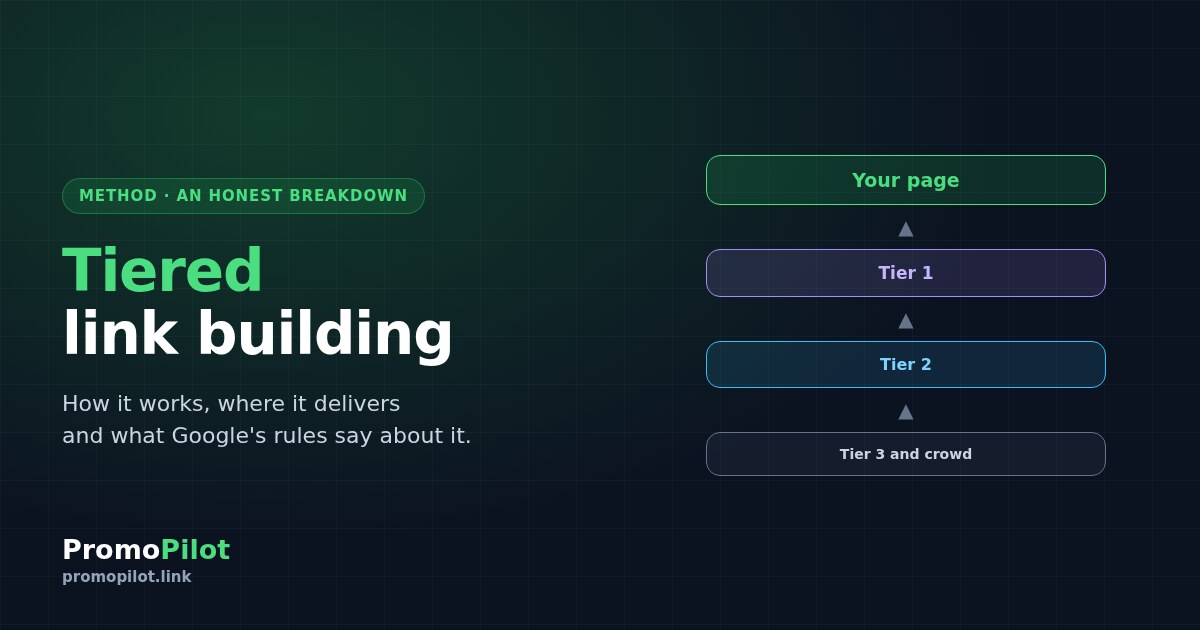
Tiered link building is a method where links are built not in one layer but in several: tier one points at the page you are promoting, tier two points at tier one, tier three at tier two. Below is how it actually works, why the tiers appeared in the first place, where the method delivers, and what Google's own rules say about it. That last part comes without softening: the wording is unpleasant, and you need to know it before you launch anything.
Where the tiers came from
The method is neither new nor anyone's proprietary invention: it has been discussed in English-language practice as tiered link building since roughly the early 2010s. The logic grew out of an observation that has lost none of its force.
You place a link to your page — say, an article on an industry platform. Two things can happen next. Either the search engine crawls that article, indexes it and counts the link. Or it does not crawl it — and then, as far as the engine is concerned, the link does not exist. Not "weak", not "less valuable": it simply is not there. A page outside the index participates in nothing.
The problem is that the second scenario is more common than people assume. A new page on a platform with no inbound links and no traffic can sit uncrawled for months. Hence the idea of a second tier: put a few external links on the donor page and the odds of it being crawled and indexed go up.
So the tiers appeared not for "passing weight down a chain", as is often written, but for a far more mundane task — to get tier one into the index at all. That is the real mechanism of a cascade, and everything else in it is secondary.
What Google says — read it in full
This is the section usually missing from vendors' articles. Google's wording in its spam policies:
"Link spam is the practice of creating links to or from a site primarily for the purpose of manipulating search rankings."
The list of prohibited practices names outright: "Using automated programs or services to create links to your site", along with "links with optimized anchor text in articles, guest posts, or press releases distributed on other sites".
Google Search Central, spam policiesThere should be no hedging here: tiered link building fits that description. Any service that automates link placement — ours included — operates in a zone Google calls a violation of its rules. Anyone claiming otherwise either has not read the document or is counting on you not reading it.
What follows from this in practice is a separate question, and the answer is not "so nothing is allowed".
First, the penalty for link spam today usually looks less like a fine and more like a write-off: Google's algorithms have learned to ignore links they do not trust, and such a link simply stops counting. Money spent, no effect — the most common outcome of a bad cascade.
Second, manual actions for unnatural links do exist and are applied, more often to sites with an aggressive profile: mass exact-match anchors, explosive pace, donors with no signs of life. That is fixable through disavowing links and a reconsideration request, but it costs months.
Third — and this needs to be clear before you start — the risk sits with the site owner, not the contractor. The links point at your domain, and the consequences stay with it. So the decision about method is yours, and it should be made with open eyes rather than on a promise that "everything is safe with us".
Where a cascade delivers and where it does not
| Situation | What to expect |
|---|---|
| A young site with no link profile at all | Noticeable effect. Starting from zero is hard; a cascade provides the first mass and speeds up crawling |
| A page at positions 11–25 on mid- and long-tail queries | The best case. Relevance is already there, weight is what is missing — this is where links decide |
| Verticals where ads are closed or expensive | Often the only scalable channel, hence the method's popularity in iGaming and adjacent niches |
| A page outside the top 50 on a head query | Almost nothing. Links do not substitute for missing relevance and structure |
| A site with technical indexing problems | Money down the drain. Fix the indexing of your own pages first |
| A young domain in a YMYL vertical | A poor idea. Quality assessment is stricter here and a link skew is more visible |
What actually determines the outcome
The difference between a cascade that survives updates and one that burns comes down to four parameters. Not one of them is about volume.
The only metric that means anything
A report saying "we placed 5,000 links" tells you nothing. There is one meaningful question: how many of those placements made it into Google's index.
Checking is simple. Take a random sample of 10–15 links from the report and, for each donor page, run a site:page-address query in search. If the page is in the index, it will show up. If it is not, the link on it does not exist as far as the engine is concerned.
It helps to understand why the figure almost always comes in below expectations. Indexing is not an automatic consequence of publishing: Google crawls and retains far from everything, and platforms with large volumes of uniform user-generated pages are the first to be affected. The lower tiers of a cascade were invented precisely to fight this — but they raise the probability, they do not guarantee the result.
The practical conclusion: a contractor who shows indexing per placement is more honest than one who shows only counts. And if the indexed share is low, that is not grounds for a scandal but grounds for asking what is being done about it.
What a cascade does not replace
It is worth being sober about the method's limits — they are wider than they look from inside the link industry.
Links do not create relevance. If a page does not answer the query, no number of links will make it the answer. A cascade amplifies what is already there; it does not create what is not.
Links do not solve technical problems. A page closed to indexing, a broken structure, missing snippets — all of that is fixed elsewhere, and spending on links before the fix is pointless.
And separately — on how the picture has changed. In December 2025 Ahrefs published an analysis of 75,000 brands, calculating which metrics are statistically associated with a brand appearing in AI results. Branded web mentions showed a correlation of around 0.66, while backlink count came in at around 0.19 — among the weakest factors. The authors note separately that correlation is not causation and that the relationships are moderate. But the direction reads clearly: the system pays attention to how often, and in what context, a brand appears in independent sources at all, and a bare link count does not play that role.
For a cascade this means the following: value sits in the part of it where a link is surrounded by meaningful text mentioning the brand on a live platform. The part that consists of links for links' sake works neither for classic ranking nor for the new kind of visibility.
How to evaluate a contractor
In summary
Tiered link building is a working tool with a comprehensible mechanism: the lower tiers exist so that the top one gets into the index and is counted. It delivers most on pages that lack weight, and almost nothing where relevance is what is lacking.
At the same time, the method is described directly in Google's rules as link spam, the risk sits with the site owner, and the outcome is determined by tier-one quality, anchor profile, pace and the indexed share — not by the number of placements.
If you decide to use this method, decide knowing all of the above. That is more honest than any promise of safety.
With an indexing check on every placement and a report on what actually made it into the index.
Frequently asked questions
What is tiered link building in simple terms?
It is building links in several tiers: tier one points at the page being promoted, tier two at tier-one pages, tier three at tier-two pages. The lower tiers exist so that the top one gets crawled by the search engine and lands in the index.
Why do I need a second tier if it does not point at my site?
A link on a page that is not in Google's index does not count at all. The second tier raises the probability that the tier-one page gets crawled and indexed — and only then does the link placed on it start working.
Does tiered link building violate Google's rules?
Yes. Google's spam policies name outright the use of automated programs or services to create links, as well as links with optimized anchor text in articles and guest posts. The risk, meanwhile, sits with the owner of the promoted site.
What can it actually cost you?
The most common outcome is not a penalty but a write-off: links the algorithm does not trust simply stop counting, and the budget goes with no result. Manual actions for unnatural links are also applied, more often with an aggressive profile: mass exact-match anchors, explosive pace, dead donors.
How many links are needed to grow in search?
The count is secondary. What matters is the quality of tier-one platforms, the shape of the anchor profile, an even pace and the share of placements that made it into the index. A link outside the index does not exist for a search engine, however many there are.
How do I check whether a cascade worked?
Take a random sample of 10–15 placements from the report and check each with a site:page-address query. That shows the real indexed share — the only figure by which the work can be judged.
Sources
Google Search Central, spam policies: the definition of link spam, the list of prohibited practices, requirements for the rel="nofollow" and rel="sponsored" attributes.
Ahrefs, "Top Brand Visibility Factors in ChatGPT, AI Mode, and AI Overviews", 12 December 2025 — 75,000 brands, Spearman correlation.