What DR do you need to rank in Google? An analysis of 2,754 SERPs
How much DR do you need to reach Google's top ten? We checked 2,754 results pages and 21,336 top-ten results. On average stronger domains rank higher: median DR is 72 at position one and 54 at position nine. But in 35.8% of results pages the top three includes a site with DR below 20, the strongest domain ranks first only 15.6% of the time, and the DR gap to the leaders is the same for pages at position 5 and position 25. We show where small sites break through most often and give a 15-minute protocol for checking any query.
"What DR do I need to rank in the top ten?" is one of the most common questions in SEO. The usual answer is a rule of thumb: check your competitors' DR and catch up. We tested how well that advice matches reality. We took 2,754 Google results pages and 21,336 top-ten results, and looked up the Ahrefs Domain Rating of every domain. The short answer: there is no threshold. Stronger domains rank higher on average, but in one results page out of three the top three includes a site with DR below 20, and within any given page DR barely decides who ranks where. Below are the numbers, where small sites break through most often, and how to tell in 15 minutes whether your DR is enough for a specific query.
How we measured
The queries are ones for which several hundred small and mid-sized business sites from different countries and niches, which we analyse in SEO Radar, appear in Google: services, online stores, B2B, healthcare, travel, technology and more. 72% of the queries are in Latin script (English, Polish, German and other languages); the rest are in Cyrillic.
For each query we captured Google's first 20 results (desktop) and kept unique domains: if a site has two pages in the results, the higher one counts. Position means the domain's place among unique domains. For every domain we fetched DR from Ahrefs' free API, with coverage of 99.9% of domains. The analysed sites themselves are excluded from the results-page statistics so they don't pull the numbers down.
On average, stronger domains do rank higher
Let's start with what confirms the familiar picture. The median DR of the domain at position one is 72, at position five 66, at position nine 54. The lower the position, the more domains with a weak link profile: the share of sites with DR below 20 rises from 15% at number one to 23% at number nine.
Looking only at this chart, the conclusion seems obvious: "you need DR 70 or you won't make the top". That's how most checklists reason. But an average across thousands of results pages hides the main thing: how each individual page is structured.
Within a single results page, DR decides almost nothing
We looked at each results page separately, and the picture changed.
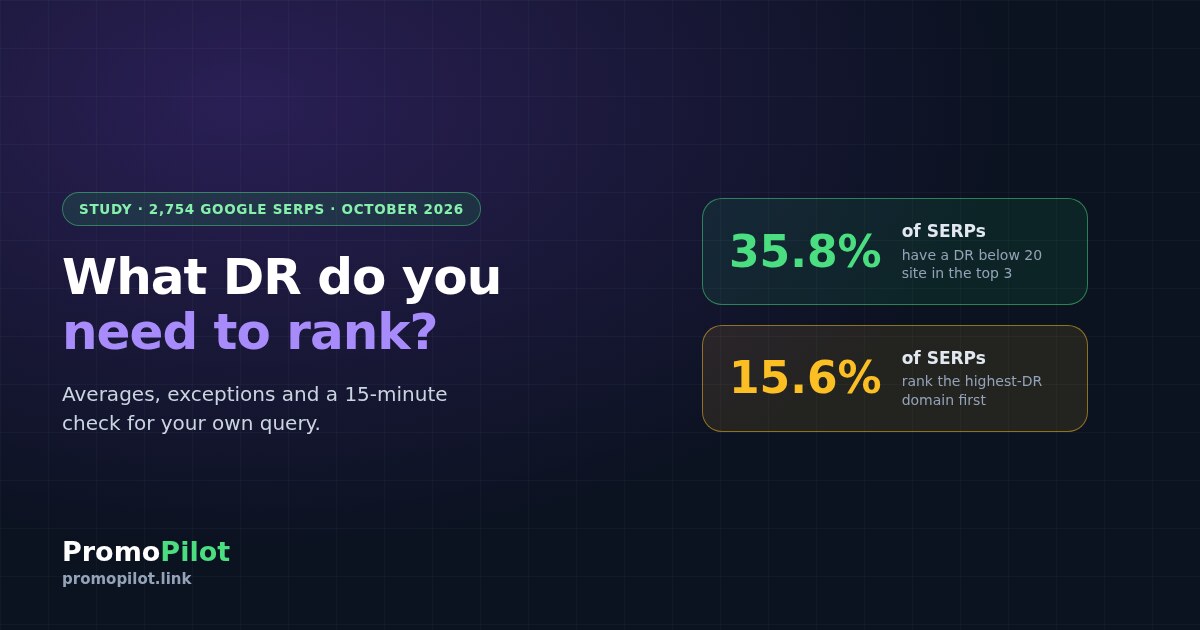
In 35.8% of results pages, the top three includes a site with DR below 20. In 25.1%, one with DR below 10, meaning almost no link profile at all. These aren't rare exceptions; it's one page in three. A site with DR below 20 ranks first in 14.9% of results pages.
The second finding is even more telling. The strongest domain by DR in the top ten ranks first in only 15.6% of results pages. The median position of the strongest domain is fourth. If you sort the top ten by DR and compare it with the actual order, in 55% of results pages the relationship is weak or absent.
The numbers hold across different cuts. For Latin-script queries, a site with DR below 20 appears in the top three in 32.1% of results pages; for Cyrillic queries, in 45.3%. Remove the queries of the single largest project from the sample and the share is 38.5%. Same order of magnitude every time.
The key test: the gap to the leaders doesn't shrink
The strongest version of the "DR decides" hypothesis goes like this: the closer your DR is to the leaders', the higher you rank. That can be tested. For every query we know the average position of the analysed site's page and the site's DR. If the hypothesis holds, pages that have climbed close to the top three should have a noticeably smaller DR gap to the leaders than pages on the second or third page of results.
The gap is the same at every height: 52–55 points. Sites whose pages rank 4–6 trail the leaders' DR by exactly as much as sites whose pages sit at position 25. The median DR of the analysed sites is 2.6; 74% have DR below 20. And the gap to the leaders is 10 points or less in only 15.8% of site–query pairs.
The takeaway: DR doesn't explain why one page of a small site ranks fifth and another ranks twentieth. Something else makes the difference. We see at least four candidates, and all of them are about the page, not the domain:
- Intent match. For a commercial query Google ranks service pages and catalogues; for an informational one, articles and guides. A page of the wrong type won't rise with any DR.
- Links to the page itself. DR describes the whole domain. Five good links to a specific page plus solid internal linking to it often matter more than a hundred links to the homepage.
- Completeness of the answer. Prices, timelines, terms, location, photos of work, comparison of options: everything the searcher is looking for, on one page.
- Locality and specialisation. A local service or a niche store often answers the query more precisely than a large aggregator where the right answer is one line out of a thousand.
Where small sites have it easier
Longer queries
The more specific the query, the more often the top three includes a domain with low DR: 32.5% for one- and two-word queries and 40.8% for four- and five-word ones. The median DR of the top three falls from 72 to 68. It's the standard "start with the long tail" advice, now with a number attached.
For very long queries of six words or more, the share drops back to 35%. These are usually questions, and they're answered by Wikipedia, forums and reference sites with high DR.
Spots no DR can win
Part of page one is taken by platforms from the start: social networks hold 9.0% of top-three spots, Wikipedia 4.6%, Reddit and Quora 3.1%, YouTube 1.7%, marketplaces and review sites another 0.7% or so. Together that's almost one top-three spot in five. You can't outrank them with links, but you can be inside them: a company page on social media, a useful Reddit answer or a YouTube video also bring people in.
Niches
Niches differ the most. In local services (repairs, cleaning, installation), automotive and online stores, a site with DR below 20 makes the top three in roughly half of the results pages, and the median DR of the top three is 46–63. In technology and marketing it happens in only one page in five, with a median top-three DR of 74–81: there, page one belongs to big media, SaaS platforms and reference resources.
Two more niches where the sample is smaller (8–9 different sites) but the picture is clear: media and finance. A weak domain reaches the top three there in 9–12% of results pages. If your project is in these topics, don't count on quick results without link building.
How to tell in 15 minutes whether your DR is enough
There's no universal threshold, but for each query you can get the answer by hand. Here's the protocol we use ourselves.
List the DR of the top-ten domains
Open the results for the query in an incognito window or through a rank-checking tool, and check every domain's DR. Ahrefs' Website Authority Checker does it for free. A simple table works best: position, domain, DR, page type.
Look for a weak domain in the top three
If the top three includes a site with DR below 20, the query is open: Google has already decided a small site can be the best answer. Your task is to make your page better than that site's page, not to catch up with everyone else's DR.
Cross out the platform spots
Count how many spots belong to Wikipedia, social networks, YouTube, Reddit, marketplaces and aggregators. If there are two or three in the top five, your realistic target is the spot right after them, and that target requires a very different DR than position one.
Compare page type and completeness
If the top three are all service pages and yours is an article, DR isn't the problem. If the leaders have prices, comparisons, reviews and an FAQ and you don't, DR isn't the problem either. First bring your page to the format Google has already chosen for this query.
Assess the gap if there's no weak site in the top three
If everyone in the top three has DR 60+ and you have 5, this query isn't yours yet. Find a longer, more specific query nearby: in our data, a weak domain reaches the top three in 41% of results pages for four- and five-word queries. Come back to the broad query once the site has gained visibility on the long tail.
Links: to the page first, then to the domain
You need links, but they're worth distributing differently from what the DR race suggests. First, to the specific pages you're promoting, with topical anchors, plus internal links to them from other pages of your site. Overall DR growth is useful as a backdrop: it helps every page at once and matters in niches where the top is held by DR 60+ domains.
Where links fit in
The data doesn't say links don't matter. It says DR is a poor guide for any specific query. A link profile sets the overall level at which a site can compete at all, while the ranking for a query is decided by the page and the links to that page. PromoPilot works on both levels: placements point to specific pages with anchors matched to queries, and a steady flow of new referring domains lifts the overall profile. SEO Radar shows which queries your site is already close to the top for, and where one or two links to a page may be enough for a jump.
If your traffic for these queries is falling rather than growing, start with our breakdown of why search traffic drops: often links aren't the issue at all.
Frequently asked questions
What DR do you need to rank in Google's top ten?
There is no universal threshold. The median DR of the domain at position one is 72 and at position nine 54, but in 35.8% of results pages the top three includes a site with DR below 20. Look at the specific results page rather than averages: if the top three already has a weak domain, the query is open and page quality decides.
Can you reach the top with a DR of 0 to 10?
Yes. In 25.1% of the results pages we analysed, the top three includes a site with DR below 10. Most often these are local services, automotive and online stores, as well as four- and five-word queries. For short queries in technology, marketing, finance and media the odds are much lower.
Why does a site with a lower DR rank above mine?
Because Google ranks pages, not domains. The strongest domain by DR ranks first in only 15.6% of results pages, and its median position is fourth. The page that ranks higher is usually the one that answers the query more precisely: the right type, more complete, with links to the page itself and good internal linking.
Is it worth building links just to raise DR?
Not as a goal in itself. DR is an Ahrefs metric and Google doesn't use it. Links help when they point to the pages you're promoting and when they grow your overall profile in a niche dominated by strong domains. The DR gap to the leaders is the same for pages at positions 4–6 as for pages at position 20, so the DR race alone doesn't explain rankings.
Which queries should a new site target?
Specific ones of three to five words where the top three already includes a site with DR below 20. For four- and five-word queries that happens in 40.8% of results pages, for one- and two-word queries in 32.5%. Check the top three by hand and start with queries where a small site is leading.
Are DR and DA the same thing?
No. DR (Domain Rating) is calculated by Ahrefs and DA (Domain Authority) by Moz. They use different formulas and link databases, so the values for one site can differ a lot. Both roughly estimate a domain's link profile, and Google uses neither of them for ranking.
Sources: PromoPilot's own analysis, October 2026 — 2,754 Google results pages (desktop, first 20 results, unique domains), 21,336 top-ten results. Domain Rating by Ahrefs, retrieved through Ahrefs' free API, covering 99.9% of domains. Positions of the analysed sites are average page positions from Search Console.