Google updates its AI content guidance: manual fact-checking and four qualities of main content
On 1 October Google updated both its AI content guidance and its helpful content document — the first changes since December 2025. They now say plainly that everything generated by AI, metadata included, must be manually checked before publishing, and they call bulk generation without oversight “little to no effort”. We go through exactly what changed and what it means for a site owner.
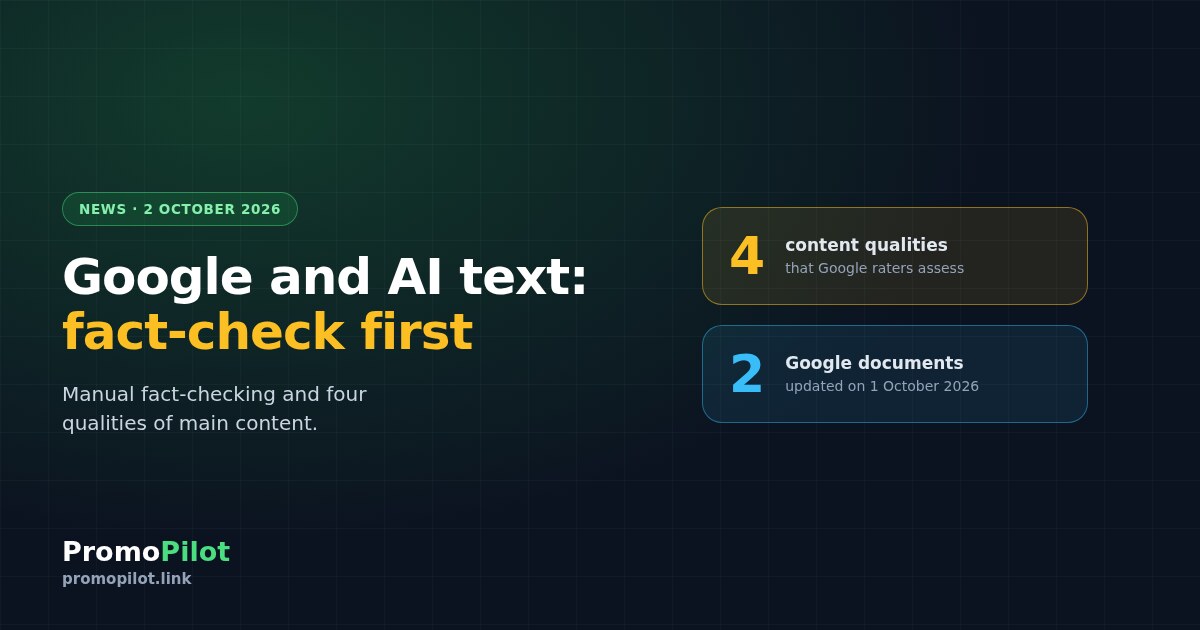
On 1 October Google updated two key documents on content quality at the same time — for the first time since December 2025. The guidance on AI-generated content now plainly requires manual fact-checking of everything produced by AI, metadata included. The helpful content document gained a new section on the four qualities raters use to assess a page's main content, plus a separate paragraph on invented authors. Neither change appeared in the documentation changelog, so they are easy to miss.
What was added to the AI content guidance
Until now this spot held a general call: when generating content automatically, “focus on accuracy, quality, and relevance”. Now it is followed by an explanation of why a call alone is not enough, and a direct requirement:
"Keep in mind that generative models don't retrieve facts, but predict a likely sequence of words based on their training data. Because of this, generative AI outputs may contain inaccuracies (also known as hallucinations). It is critical to manually factcheck and review all AI-generated content for accuracy and trustworthiness before publishing."
Google Search Central, guidance on using generative AI content, updated 1 October 2026Metadata — the page title, meta description, structured data and image alt text — was mentioned in this paragraph before too. The difference is that it is now covered not by a wish for accuracy but by the same manual review: "This review also applies to metadata". A generated, unreviewed title is as much of a problem as a generated article.
What appeared in the helpful content document
For the first time Google spelled out what counts as a page's “main content”: text and media, interactive features such as calculators and tools, user discussions and reviews where they are the reason the page exists, content inside tabs and expandable sections, and the visible headings. It also listed four qualities raters use to assess that content.
The most quoted line is the one about effort:
"Automatically generating pages from feeds or using generative AI to produce large amounts of text without manual oversight or curation represents little to no effort. Attribution or giving credit to other sources doesn't replace the need for original effort."
Google Search Central, “Creating helpful, reliable, people-first content”, updated 1 October 2026Next to it is a paragraph that did not exist before. Invented author profiles — AI-generated headshots, made-up names, false credentials meant to make content look as if experts wrote it — Google calls deception, and states plainly that any deception makes a page untrustworthy to both people and automated quality systems.
What this means in practice
The timing is worth noting too: the updates came out while the September spam update was still rolling out. Google did not link the two, and neither will we — though one of the spam policies, as a reminder, directly addresses generating pages at scale without value for readers.
One of these recommendations has already shown up in our own data. In our study of AI recommendations, among pages in Google's top ten, those the models used as sources named an author 79% of the time, against 56% for the rest. A real author and checked facts build trust well beyond Google's raters.
Sources: Google Search Central — “Google Search's guidance on using generative AI content” and “Creating helpful, reliable, people-first content”, both updated on 1 October 2026; the changes were identified by comparing them with the versions dated 10 December 2025 in the Wayback Machine archive.