google.com/goto: link wrappers in Google results and what they did to rank trackers
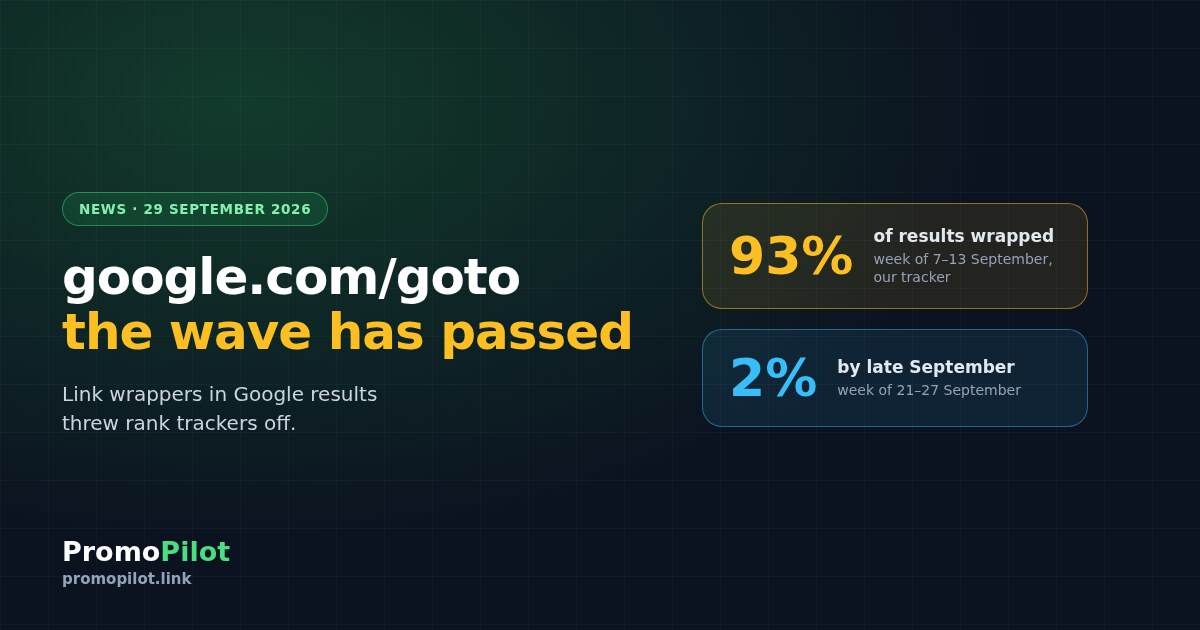
In September Google began swapping addresses in its results at scale: instead of a direct link, a result pointed to google.com/goto. Nothing changed for visitors, but rank trackers started seeing google.com instead of your site. In the results our tracker collected, wrappers appeared on 93% of pages in the week of 7–13 September and had almost vanished by the end of the month. What the measure is and what a site owner should check.
In September Google started swapping addresses in its results at scale: instead of a direct link to the site, a result pointed to google.com/goto, which then forwarded to the page. For an ordinary visitor nothing changed. For anyone tracking rankings, a lot did: a tool that reads the result's address from the page code sees google.com instead of your site. We looked at how this played out in the results pages our tracker collects, and what follows in practice.
What happened
The first google.com/goto wrappers in the results were spotted back in July, industry outlets covered them in August, and by early September there were so many that search data services started shipping fixes — SerpApi announced its fix on 5 September. There was no official announcement. Asked by journalists, Google replied with a general statement:
"We have a long history of deploying technical measures against evolving forms of abuse, and we regularly take steps to protect our services and users."
A Google spokesperson, comment to Search Engine Roundtable, 26 August 2026In other words, it is a measure against automated collection of results — scrapers, rank tracking services, companies that gather search results for their AI. It does not affect rankings, titles or snippets.
What we saw
Until 6 September there were no wrappers at all in the results pages our rank tracker collected. In the week of 7–13 September they appeared on 93% of results pages, and 89% of all top-10 results went through /goto — nearly every link. A week later the share fell to 37%, and by the end of September to 2%. The picture was the same on desktop and mobile.
An important caveat: this is what an automated collector sees. The wrapper is designed against scrapers, and Google may well switch it on selectively depending on how it assesses a particular client. So the drop at the end of September is either a rollback on Google's side or a change in how it classifies our collector. Our data cannot tell the two apart.
We checked two more things ourselves. First, the real address cannot be pulled out of the link parameter: none of the 105 wrappers we examined contained the address in readable form — there is an opaque encoded block instead. Second, the wrapper itself is an ordinary redirect: a request to it returns a 302 status with the real address in the Location header.
What this means for a site owner
This is one more reminder of what we wrote in our piece on why search traffic drops: before looking for the cause of a drop, make sure the drop exists and that Google itself shows it, not an intermediary.
Sources: Google's comment to Search Engine Roundtable (26 August 2026), SerpApi's announcement of its fix (5 September 2026). Own data: Google results pages collected by the PromoPilot rank tracker from 24 August to 27 September 2026, and a check of 105 google.com/goto links.