Does Domain Age Matter for Google Rankings? We Checked 755 Sites in 5 Countries
"Your domain is too young, give it a couple of years" is a common piece of advice for new businesses. We decided to measure it instead of repeating it. We pulled Google desktop results for 66 local commercial queries in Ukraine, Poland, the United Kingdom, Spain, and Brazil, looked up the…
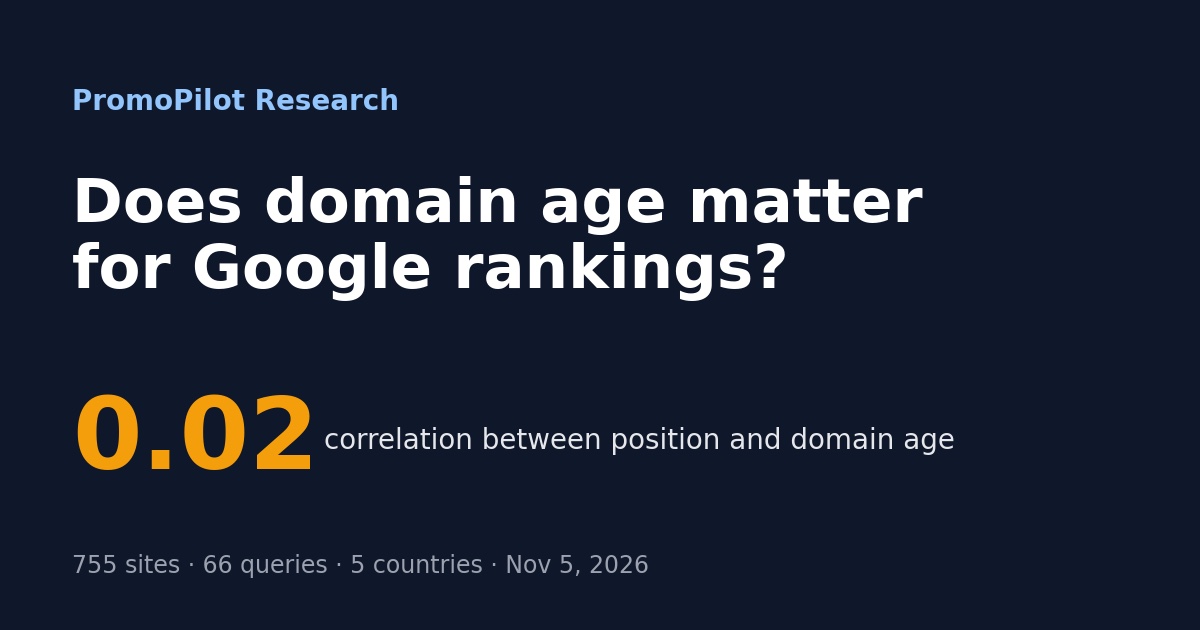
"Your domain is too young, give it a couple of years" is a common piece of advice for new businesses. We decided to measure it instead of repeating it. We pulled Google desktop results for 66 local commercial queries in Ukraine, Poland, the United Kingdom, Spain, and Brazil, looked up the registration date of every site in positions 1–20, and compared age with position.
Data: snapshot of November 5, 2026, updated November 5, 2026.
Key numbers
- Domain age is barely related to position: Spearman's coefficient is 0.02 across 755 sites in positions 1–20, and −0.05 within positions 1–10. Google desktop results, 66 local commercial queries in 5 countries, snapshot of November 5, 2026.
- The oldest site in the top 10 ranks above all the others in 11 of 66 queries (17%); with random ordering it would be 18%. Snapshot of November 5, 2026.
- Sites younger than one year in the top 3: 2 of 144. Younger than five years: 28 of 144 (19%). Snapshot of November 5, 2026.
- Median domain age: 10.6 years in positions 1–3, 9.2 years in positions 4–10, 10.0 years in positions 11–20 (755 sites, snapshot of November 5, 2026).
- Link authority (Open PageRank) on the same results is also barely related to position: −0.03 across 802 sites. Age and authority are related to each other (0.33). Snapshot of November 5, 2026.
The short answer
John Mueller of Google has said publicly that domain age by itself does nothing for rankings (Search Engine Roundtable covered his remarks). Our data points the same way: in local commercial results, domain age is barely related to position. Old sites are common at every depth, and a young domain can still reach the top 3.
How we collected the data
We ran 132 queries of the "niche + city" type through the BrightData SERP API: Google desktop, positions 1–20, organic results only, with each country's gl/hl settings. We took two snapshots on November 5, 2026 (17:27 and 18:00 UTC) and kept only the 66 queries whose top 10 overlapped by at least 50% between the two runs, because since September Google has served altered results to automated rank checks, as Nozzle and Ahrefs reported. Platforms were removed, and the remaining 868 sites were checked for a registration date via RDAP; a date was found for 755. Details are in the methodology section below.
Domain age by position group
The first check is the simplest: are sites at the top older than sites below them? The median age is 10.6 years in positions 1–3, 9.2 in positions 4–10, and 10.0 in positions 11–20. The middle group is the youngest, which is not the shape an "age factor" would produce.
| Positions | Sites (n) | Median age, years | Younger than 1 year | Younger than 2 years | Younger than 5 years | Older than 10 years |
|---|---|---|---|---|---|---|
| 1–3 | 144 | 10.6 | 1% (2) | 2% (3) | 19% (28) | 55% |
| 4–10 | 282 | 9.2 | 2% (7) | 5% (15) | 25% (70) | 44% |
| 11–20 | 329 | 10.0 | 4% (13) | 7% (23) | 20% (67) | 51% |

Young sites are rare at every depth, not only at the top: domains younger than two years are 2%, 5%, and 7% of the three groups, and domains older than ten years are roughly half of each (55%, 44%, 51%). If age pushed sites upward, the share of old domains would climb steadily toward position 1 and the share of young ones would fall. Instead, both lines are close to flat.

Age versus position: the correlation
Spearman's rank correlation between age and position across all 755 sites is 0.02. Within the top 10 it is −0.05. Both values sit so close to zero that the sign is noise: knowing a site's registration date tells you almost nothing about where it ranks.

We also tested the claim the way a business owner would phrase it: "the oldest site wins". For each query we took the top 10 sites with a known age (7 per query on average) and checked whether the oldest stood above all the others. It did in 11 of 66 queries (17%); with random ordering it would be about 18%. The oldest site wins no more often than chance.
By country
Country samples are small (7 to 20 queries each), so we show every country with n and do not draw conclusions for any single one. The Spearman sign flips from country to country at these sample sizes, which is what noise around zero looks like. Also, the .es registry has no public RDAP, so the Spanish sample rests on .com and other zones.
| Country | Queries | Sites (n) | Median 1–3 | Median 4–10 | Median 11–20 | Spearman |
|---|---|---|---|---|---|---|
| Ukraine | 19 | 224 | 8.2 | 8.6 | 8.8 | 0.07 |
| Poland | 20 | 221 | 12.4 | 9.7 | 10.0 | −0.05 |
| United Kingdom | 9 | 111 | 11.2 | 7.6 | 15.3 | 0.16 |
| Spain | 7 | 73 | 16.4 | 13.5 | 9.0 | −0.24 |
| Brazil | 11 | 126 | 12.4 | 9.6 | 11.3 | 0.06 |

By niche
Niches differ in how old the market is, not in how age relates to position. Shops, flowers, and food have the oldest domains (median 12.8 years); furniture and home have the youngest (8.3 years). In three of the seven niches the top 3 is younger than the niche as a whole. The top 3 counts are small (11 to 26 sites), so read the last column as a sketch.
| Niche | Queries | Sites | Median age, all | Median age, top 3 (n) |
|---|---|---|---|---|
| Dental | 11 | 148 | 8.9 | 10.3 (26) |
| Legal and accounting | 7 | 92 | 9.6 | 8.9 (16) |
| Beauty and health | 10 | 110 | 8.9 | 12.3 (23) |
| Repair and auto service | 13 | 120 | 10.3 | 10.7 (26) |
| Moving and transport | 6 | 69 | 9.0 | 8.6 (13) |
| Furniture and home | 6 | 53 | 8.3 | 6.3 (11) |
| Shops, flowers, food | 7 | 95 | 12.8 | 13.3 (18) |
Young sites in the top 3
Two examples from the sample show what a young domain can do. A domain registered 3 months ago holds position 3 for "dog grooming manchester". A 9-month-old domain holds position 3 for "encanador são paulo" (a plumber in São Paulo). Both are small local businesses, and in both cases the page title names the service and the city. We did not measure relevance, so treat this as an observation, not a rule.
Why old sites still fill the results
If age barely matters, why is about half of every position group older than ten years? Because the local market was taken long ago: dentists, lawyers, and car services in a large city have had websites since the 2000s, and most of those domains are still live. A ten-year-old site is not ranking because of its birthday; it has had ten years to accumulate pages, reviews, mentions, and links. Age travels together with those things, but it is the things, not the date, that a search engine can use. Our data cannot separate them perfectly. What it shows is that the "passport" number on its own does not sort the results.
What about link authority?
We checked a second passport-style metric on the same results: Open PageRank. It is also barely related to position, with a Spearman coefficient of −0.03 across 802 sites. Age and authority are related to each other (0.33): older domains do tend to have more links. But neither one, taken alone, predicts where a site stands in a local commercial SERP. Our working hypothesis, which this study does not measure, is that these results are decided by how well the page matches the query and by local signals such as the business profile and reviews, not by any single domain-level number.
Platforms take 17% of the slots
Before any of this analysis, 17% of the places in positions 1–20 were held by platforms: Google's own properties, Facebook, Instagram, directories, marketplaces, and government sites. By country: 14% in Ukraine, 14% in Poland, 24% in the United Kingdom, 11% in Spain, and 23% in Brazil. We removed them because their age says nothing about a small business, but they matter in practice: a young site competes for the remaining slots, not for all twenty.
What a young site should do
The young sites in our top 3 did not wait for their domain to age. Here is what we would do with a new site in a local niche.
- Build one page per exact query and city: a page written for "plumber in São Paulo" competes for that query, a general services page does not.
- Set up local signals: a complete business profile, a consistent address and phone number, and real reviews.
- Link the page from the home page and related pages so it is not buried three clicks deep.
- Add external links gradually, from pages that make sense for a local business, rather than in one burst.
Two free checks show where you stand: look up the age of your domain and your competitors' domains in our domain age checker, and open PromoPilot Radar to see which pages on your site are already close to the top 10. Neither tool promises a position; they tell you what to work on.
How to find out a domain's age
Three sources give slightly different answers. A domain age tool, including ours, reads the registration date from WHOIS or RDAP (RDAP is the structured successor to WHOIS). That date is the current registration, not the first one: if a domain expired and was registered again, the clock reset, even though the name may have a long history in the Wayback Machine. That is the mark of a dropped and re-registered domain. The registration date also differs from the date Google first indexed the site, which can be months or years later.
Methodology
Queries: 132 local commercial queries of the "niche + city" type (Ukraine 33, Poland 40, United Kingdom 19, Spain 20, Brazil 20). Results: Google desktop, organic only, depth 20, with each country's gl/hl settings, no geo-point inside the country, collected via BrightData SERP API in two snapshots on November 5, 2026, at 17:27 and 18:00 UTC. Because since September 2026 Google has served altered results to automated rank checks, as Nozzle and Ahrefs reported, we kept only queries whose top 10 registrable domains overlapped by at least 50% between the two snapshots: 66 of 131 (UA 19, PL 20, GB 9, ES 7, BR 11; one query returned no data). Figures use the second snapshot; the first gives the same picture (Spearman 0.04, oldest site first in 22% versus 20% at random). An October 27 snapshot was excluded: 338 of its results were google.com/goto redirects without a domain, and only 20 of 92 queries passed the stability threshold. Hosts were reduced to registrable domains, each counted once per SERP. Platforms (Google, social networks, Wikipedia, marketplaces, directories, aggregators, government sites) were excluded: 172 of 1,040 results (17%). Age is the current registration date from the registry's RDAP server (IANA bootstrap) as of November 5, 2026, found for 755 of 868 sites; .es has no public RDAP, and re-registration resets the age. Authority is Open PageRank (802 sites); cached DR covered only 70 sites, too few for a conclusion. Statistics: Spearman's rank correlation of position versus age; the "oldest first" metric takes the top 10 sites with a known age per query (k of at least 2) and checks whether the oldest ranks above the rest, with a random baseline equal to the sum of 1/k over queries (11.8 of 66, 18%). Not done: RDAP age was not compared with the first Wayback snapshot, because the Internet Archive was unavailable on November 5. Limitations: 66 queries, local commercial only, one day; small samples for the United Kingdom and Spain; correlation is not causation; the platform exclusion list is fixed, so some niche directories may remain in the sample; 5 PromoPilot client rows have the domain replaced with "(withheld)" in the CSV. Cost: SERP data about $0.99, RDAP and Open PageRank free.
FAQ
Does domain age affect SEO?
Barely, as far as we can measure. John Mueller of Google has said publicly that domain age by itself does nothing for rankings, and in our sample of 755 sites across 66 local commercial queries the Spearman correlation between age and position is 0.02. Old sites are common at the top because they have had years to build content, reviews, and links, not because of the date on the registration record.
How long does a young site have to wait before it can rank?
There is no fixed waiting period. In our sample, 2 of the 144 sites in the top 3 were younger than one year and 28 were younger than five years, so it happens, but rarely. The young sites that got there had a page written for one exact query and one city, in a narrow local niche. Working on that page is more useful than waiting.
Is it worth buying an old domain for SEO?
Our data gives no reason to expect a ranking boost from age alone: the oldest site in the top 10 ranks above the others in 17% of queries, and random ordering would give 18%. An old domain can bring existing links and history, but it can also bring a bad history, and a lapsed, re-registered domain shows a fresh registration date anyway. Before paying for one, check its archive history and backlinks rather than its age.
What is the difference between domain age and web archive history?
Domain age is the current registration date published by the registry through RDAP or WHOIS. Web archive history is when the Wayback Machine first captured content on that name. A domain that lapsed and was registered again looks young by RDAP but old in the archive. A domain that was registered and parked for years looks old by RDAP but has no history at all. The two measure different things, and neither one is the date Google first indexed the site.
How can I check the age of a domain?
Use a free domain age checker such as ours at /tools/domain-age.php, or query the registry directly through RDAP or WHOIS and look at the creation or registration field. Then compare it with the first capture in the Wayback Machine. If the two dates differ by years, the domain has most likely been dropped and re-registered.
Why do some .ua and .es domains have no registration date?
Not every registry publishes it. The .es registry has no public RDAP at all, and some .ua records come back without a creation date. A tool cannot invent a date in those cases, so it shows the age as unknown. In our study, sites without a date were left out of the age statistics: a date was found for 755 of 868 sites.
How to cite
PromoPilot (2026). Domain Age and Google Positions: 755 Sites in 5 Countries. Snapshot of November 5, 2026. Data CC BY 4.0: https://promopilot.link/uploads/blog/research/domain-age-0611/domain-age-positions-2026-11-05.csv?v=1. Page: https://promopilot.link/en/blog/domain-age-google-rankings-study.
Download the data
The full table (country, query, position, niche, domain, registration date, age in years, Open PageRank, referring domains) is available as a CSV under the CC BY 4.0 license: https://promopilot.link/uploads/blog/research/domain-age-0611/domain-age-positions-2026-11-05.csv?v=1. Domains of PromoPilot clients are withheld (5 rows).