Noindex and Broken Pages on 4,874 Sites: Checklist 2026
We checked how 4,874 websites handle their own pages on November 15–16, 2026: the homepage of every site and up to 10 internal pages linked from it on 4,545 of them (47,290 pages in total). 17.3% of those 4,545 sites have at least one internal page that tells search engines not to index it…
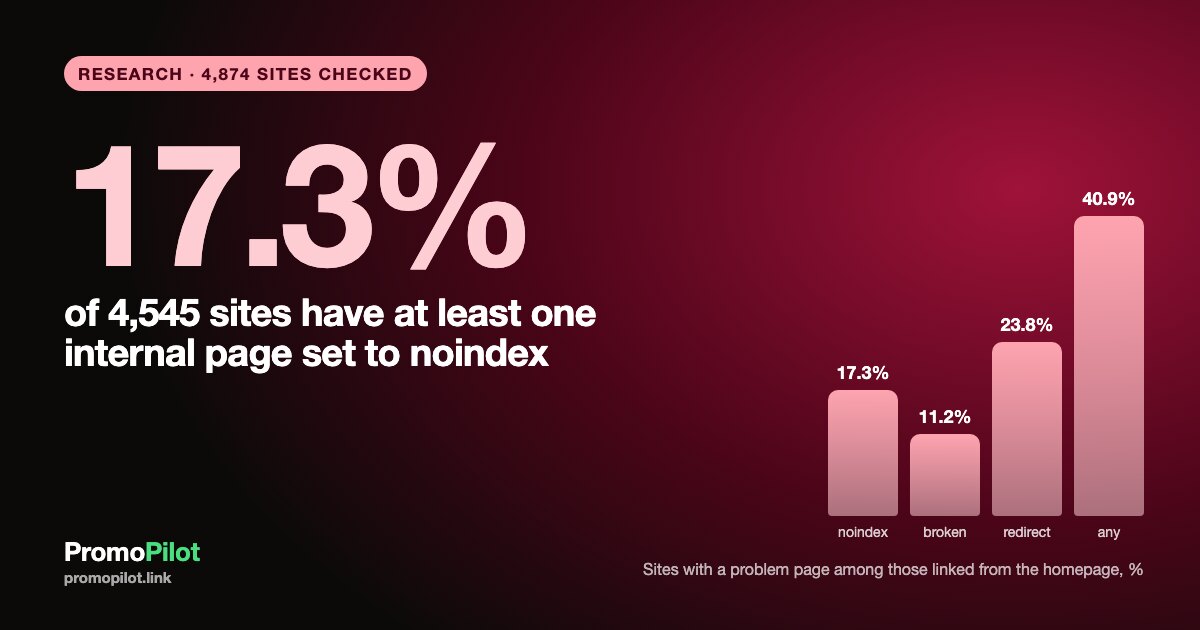
We checked how 4,874 websites handle their own pages on November 15–16, 2026: the homepage of every site and up to 10 internal pages linked from it on 4,545 of them (47,290 pages in total). 17.3% of those 4,545 sites have at least one internal page that tells search engines not to index it (noindex), and 11.2% link from the homepage to a page that returns an error. Counting redirects too, 40.9% of sites, about 4 in 10, have a noindex, broken or redirecting page among the first 10 pages linked from the homepage. Some of this is intentional (login and cart pages should not be indexed), some is a leftover from a migration or a plugin setting. Below are the numbers, the difference between noindex, robots.txt and X-Robots-Tag, and a checklist for finding these pages on your own site. Caveat: the sample is non-random (sites from our search-results cache) and covers about 10 pages per site, not the whole site, so the figures describe this sample, not the whole web.
Data: PromoPilot crawl of 6,000 sites, November 15–16, 2026; 4,874 sites whose homepage returned 200 with HTML are in the calculation, 4,545 of them with sampled internal pages
Key numbers
- Noindex: 17.3% of sites (785 of 4,545) have at least one sampled internal page closed with noindex. That is 2.75% of all sampled pages (1,301 of 47,290). On the homepage noindex is rare: 1.3% of 4,874 sites (61), and 10 of them also send it in the X-Robots-Tag header.
- Broken links: 11.2% of sites (510) link to at least one page that returns a 4xx or 5xx error. By page: 404 on 0.91%, other 4xx on 0.78%, 5xx on 0.10%, no response on 0.34%. For 2.3% of sites (105) every third checked page or more is broken.
- Redirects: 23.8% of sites (1,081) have internal links that go through a redirect. A redirect is an extra hop, not an error. 19.3% of homepages (939) have no canonical tag; on 3.7% (180) the homepage canonical points to a different address.
- Combined: 40.9% of sites (1,860 of 4,545) have at least one of the three problems (noindex, error, redirect). 72.6% (3,301) have neither noindex nor errors on the checked pages (redirects not counted).
- By CMS (generator tag, groups of 20+ sites): noindex on internal pages is 17.6% without a tag, 16.6% on WordPress and 5.1% on website builders; broken links are 18.9% on Joomla (37 sites, a small group), 12.8% on Drupal (47), 12.0% without a tag and 9.8% on WordPress.
- robots.txt: 5.5% of homepages (270) have no robots.txt; none of the 4,874 sites blocks everything with Disallow: /.
Noindex, robots.txt and X-Robots-Tag: three different switches
These are the controls that decide whether a page can appear in search, and they are often mixed up.
- Meta robots noindex is a tag in the page's head:
<meta name="robots" content="noindex">. The page can be crawled, but search engines are asked to keep it out of the index. - X-Robots-Tag is the same instruction sent in the HTTP response header:
X-Robots-Tag: noindex. It works for any file type (PDF, images) and is invisible in the page source, which is why it is easy to miss. In our sample 10 homepages send it. - robots.txt Disallow controls crawling, not indexing. A blocked URL can still be indexed from links without its content. If you also add noindex to a page that robots.txt blocks, the crawler never opens the page and never sees the noindex. To remove a page from search, allow crawling and use noindex.
- Canonical is a hint about which of several similar URLs is the main one. A canonical that points to another address tells search engines to prefer that address. It is not a block, but a wrong canonical on a key page has a similar effect for that URL.

Noindex: where it sits and when it is intentional
The homepage is almost never closed: 1.3% of sites (61 of 4,874). Internal pages are a different story: 17.3% of sites have at least one noindex page among the checked ones, and 1.0% of sites (45) have noindex on half of their checked pages or more. Counting the homepage as well, 17.5% of the 4,545 sites where we checked both the homepage and internal pages (796) have noindex somewhere in the sample.
Many of these pages should be closed. Login, registration, cart, checkout, account and internal search result pages are normally kept out of the index, and a link to them from the homepage menu is normal. Our data cannot tell intentional noindex from accidental, so treat the 17.3% as a list to review, not as a count of mistakes. The cases worth checking are different: a product category, a service page or a blog post that you want people to find, closed by a staging setting that was never switched off, by an SEO plugin option applied to a whole section, or by a template copied from a draft.
Broken pages: what the links from the homepage lead to
Most pages are fine: 97.75% of the 47,290 sampled pages answered 200. The rest is small in share but spread widely: 404 on 0.91% of pages, other 4xx (403, 401, 410, 429 and similar) on 0.78%, no response at all (timeout, connection error) on 0.34%, 5xx on 0.10%, and a redirect (3xx) on 0.12%.

Why does a link from the homepage to a 404 matter? The homepage is the page most visitors and crawlers see first. A link there that leads to an error page is a dead end for a visitor, wastes crawl on a page that will not be indexed, and passes the internal link signal into nothing. A 404 page itself is not a problem for a site (deleted pages should return 404 or 410); the problem is that you keep linking to it.
The distribution across sites is very uneven. 88.8% of sites (4,035) have no broken page among the checked ones, 5.8% (265) have a share up to 10% (roughly one page out of ten), and 1.3% (61) have more than half of the checked pages broken. That last group is usually not a few typos but a structural problem: a menu built for an old URL structure, a removed section, or a site that blocks our crawler on internal pages (a 403 for a robot is still a "broken page" in this count, so some of the 0.78% may be bot protection).

| Share of broken pages on the site | Sites | Share of sites |
|---|---|---|
| None | 4,035 | 88.8% |
| 1–10% | 265 | 5.8% |
| 11–30% | 140 | 3.1% |
| 30–50% | 44 | 1.0% |
| More than 50% | 61 | 1.3% |
Redirects: an extra hop, not an error
23.8% of sites (1,081) have at least one internal link that goes through a redirect, the most common of the three problems. A redirect is not an error: a permanent redirect (301 or 308) tells search engines that the page moved, and Google follows it. The cost is an extra request for every visitor and crawler, and, if redirects chain (A to B to C), more of them. The fix is cheap: change the link in your menu, footer or template to point directly to the final address. Typical causes are a switch from http to https, www to non-www, a missing trailing slash, and an old URL that was kept in the menu after the page was moved.
Redirect hygiene also covers the canonical tag. 19.3% of homepages (939) have no canonical, 0.5% (25) have more than one, and 3.7% (180) point it to a different address. A different address can be right (the homepage opens on a language path, or on www while the canonical is the bare domain), but then check that the target is the version you want indexed. Among internal pages, 17.5% of sites (793) have at least one page with a canonical to another address.
Platforms: where the problems are more common
We read the CMS from the generator meta tag, and many sites hide it, so "no tag" mixes every kind of platform. Noindex on internal pages is 17.6% without a tag, 18.8% for other tags and 16.6% on WordPress, in line with the overall 17.3%. Website builders are lower: 5.1% (59 sites). Broken links look different: Joomla 18.9% (37 sites) and Drupal 12.8% (47) are above WordPress (9.8%), but both are small groups, so treat them as a hint. Drupal also stands out in redirects (40.4% of its 47 sites) and in noindex on the homepage (12.8%), again on a small group.

Checklist: how to find noindex, broken and redirecting pages on your site
Work through the list in this order. The tools below check one URL or a list of links at a time; for a full crawl of a large site use a crawler or the site audit.
| Check | How | If you find it |
|---|---|---|
| Is the page closed with noindex (meta tag or header)? | Run the URL through the index checker: it shows the robots meta tag, the X-Robots-Tag header, the canonical and the status code. In Search Console, the URL Inspection tool shows "Indexing allowed: No" and the reason. | Decide if the page should be found. If yes, remove noindex from the template, plugin setting or server config. If no (login, cart), leave it. |
| Does the homepage or key section carry noindex by mistake? | Check the homepage, the main category pages and 3 to 5 important pages one by one. Look at the page source (search for "noindex") and at the response headers. | Look for a staging or "discourage search engines" setting that stayed on after launch, then re-check the pages. |
| Does a page return 404, 5xx or no response? | Run the homepage and menu links through the broken link checker. Check Search Console, Pages report, "Not found (404)" and "Server error (5xx)". | Fix the link or restore the page. If the page is gone for good, remove the link; if it has a close replacement, add a 301 redirect to it. |
| Does a link go through a redirect or a chain? | Check the menu, footer and template links in the redirect checker. It shows each hop and the final address. | Replace the link with the final address. Keep the redirect itself for old external links. Avoid chains of more than one hop. |
| Does robots.txt block pages you want indexed? | Open /robots.txt on your domain. Look for Disallow lines that match important sections. Test a URL in the robots.txt report in Search Console. | Remove the Disallow for pages that should be found. Do not combine Disallow with noindex on the same page. |
| Is the canonical correct? | On each key page, check that the canonical is the address you want indexed (usually the page itself). The index checker shows it. | Add a self-referencing canonical where it is missing; fix a canonical that points to an old, staging or other-language address. |
| Is anything accidental, after a release or migration? | Repeat the checks after a redesign, a CMS update, a domain or http to https move, and once a quarter. | Keep a short list of pages that are noindex on purpose, so that every other noindex is a bug. |
For a quick start, take the ten URLs that matter most (homepage, main categories, main products or services, the blog index) and run them through the three tools above. It takes a few minutes and covers the cases that our crawl found most often. Fixing these things does not by itself move a site up in results, but it removes obstacles to crawling and indexing the pages you want to be found.
Methodology and limitations
Data comes from the PromoPilot website crawl (TRI) of 6,000 sites from our search-results cache, collected November 15–16, 2026. We kept sites with a successful crawl whose homepage returned 200 with HTML: 4,874. For 4,545 of them we also checked up to 10 internal pages linked from the homepage (median 10), 47,290 pages in total. Noindex means a robots meta tag or an X-Robots-Tag header containing noindex. A broken page is one that answered 4xx or 5xx; pages with no response (timeout, connection error) are shown separately in the page-level figures. A redirect means the link answered with a 3xx code. CMS comes from the generator tag; groups below 20 sites are not shown.
Limitations: the sample is not random and cannot be transferred to the whole web; we checked about 10 pages per site that the homepage links to, not the full site; we cannot separate intentional noindex from accidental; a 403 or a block for our crawler counts as an error although a visitor may see the page; we did not measure any effect of these issues on rankings or traffic. The data contains no client projects and no domains. The aggregates are published as CSV under CC BY 4.0.
FAQ
What is the difference between noindex and a robots.txt Disallow?
Disallow in robots.txt stops crawlers from opening a page, but the address can still be indexed from links, without its content. Noindex (a meta tag or the X-Robots-Tag header) lets the page be crawled and asks search engines to keep it out of the index. Do not combine them on one page: if robots.txt blocks the page, the crawler never sees the noindex. To remove a page from search, allow crawling and use noindex.
Should I remove noindex from every page?
No. Login, registration, cart, checkout, account and internal search result pages are normally kept out of the index on purpose. Review the list of noindex pages and remove the tag only from pages you want people to find: service pages, categories, products, articles. In our sample 17.3% of 4,545 sites have at least one noindex internal page, and we cannot tell which of them are intentional.
Do 404 pages hurt a site?
A 404 page itself is normal: a deleted page should return 404 or 410. The problem is a link that still points to it, especially from the homepage or the menu. It is a dead end for visitors and a wasted crawl. In our sample 11.2% of sites link from the homepage to a page that returns a 4xx or 5xx error. Fix the link, restore the page, or redirect it to a close replacement.
Is a redirect on an internal link a problem?
Not an error, but an extra hop for every visitor and crawler, and chains make it worse. A permanent redirect (301 or 308) is the right way to move a page; the internal links should then point to the final address. In our sample 23.8% of sites have at least one internal link that goes through a redirect, which makes it the most common of the three issues.
How do I check a page for noindex?
Open the page source and search for noindex in the robots meta tag, and check the response headers for X-Robots-Tag, which is not visible in the source. Faster: run the URL through our index checker, which shows the robots meta tag, the X-Robots-Tag header, the canonical and the status code. In Search Console, the URL Inspection tool shows whether indexing is allowed and why not.
I removed noindex. How soon will the page appear in search?
There is no fixed time. After you remove noindex, the crawler has to visit the page again and decide whether to index it. You can ask Google to re-crawl the URL with the URL Inspection tool in Search Console and make sure the page is linked from other pages of the site. Make sure that robots.txt does not block it and that the canonical points to the page itself.
Sources
- Google Search Central, Block search indexing with noindex: developers.google.com
- Google Search Central, Robots meta tag and X-Robots-Tag specifications: developers.google.com
- Google Search Central, Introduction to robots.txt: developers.google.com
- Google Search Central, Redirects and Google Search: developers.google.com
- Google Search Central, How HTTP status codes affect Google Search: developers.google.com
- Google Search Central, Canonicalization: developers.google.com
How to cite
PromoPilot (2026). Noindex, broken and redirecting internal pages on 4,874 sites. Data November 15–16, 2026. CC BY 4.0: https://promopilot.link/uploads/blog/research/noindex-broken-2811/noindex-broken-pages-4874-sites-2026-11.csv . Article: https://promopilot.link/en/blog/noindex-broken-redirect-pages-4874-sites-checklist-2026
Download the data
The aggregate tables (CSV, license CC BY 4.0). They contain aggregates only, no projects, domains or client data.
- Key metrics (noindex, status codes, redirects, canonical, robots.txt; homepage and internal pages): https://promopilot.link/uploads/blog/research/noindex-broken-2811/noindex-broken-pages-4874-sites-2026-11.csv
- Noindex and broken pages by CMS (generator tag): https://promopilot.link/uploads/blog/research/noindex-broken-2811/noindex-broken-by-cms-2026-11.csv
- Distribution of sites by share of broken pages: https://promopilot.link/uploads/blog/research/noindex-broken-2811/broken-internal-share-distribution-2026-11.csv