How to Tell if a Text Was Written by AI
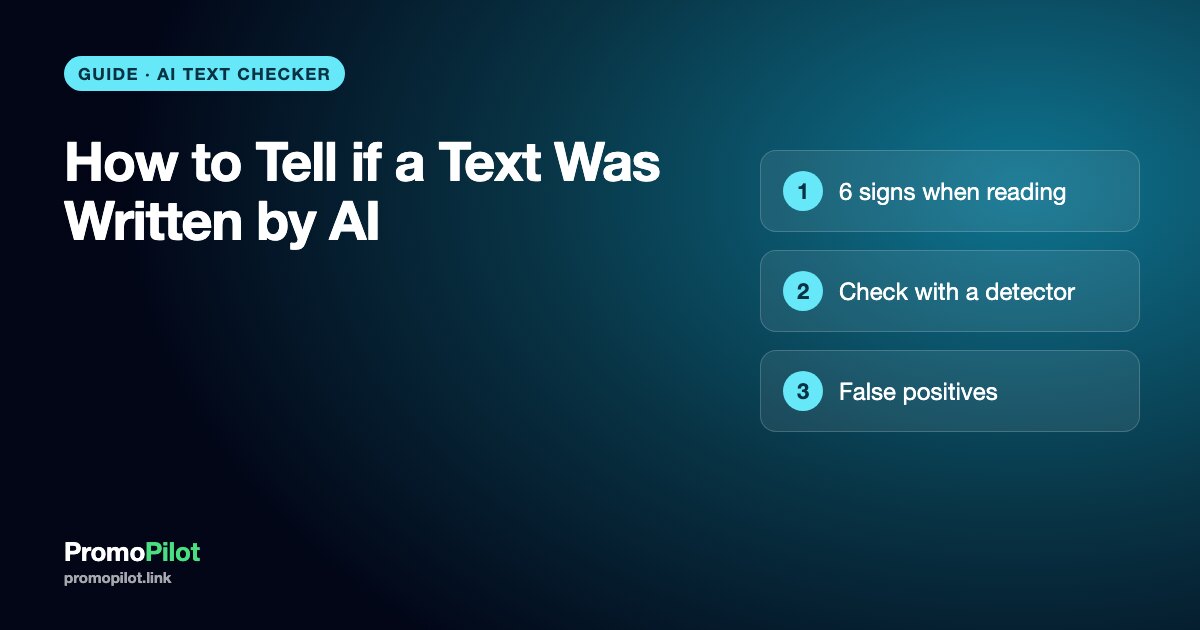
How to tell if text is AI written: 6 signs you can spot by reading, a step-by-step check with a free detector, how to read the 12 metrics, why false positives happen and what to do next. An estimate, not proof.
A freelancer sends you an article, a student hands in an essay, or a review reads a little too smoothly, and the question comes up: did a person write this, or a language model? No single button answers that with certainty, and any tool that claims otherwise deserves suspicion. What you can do is follow a short routine that gives you an honest picture in a few minutes. This guide covers how to tell if text is AI written, how a statistical detector works, how to read its output and where it goes wrong.
Short answer: what you can and cannot find out
- A detector gives you an estimate of probability, not proof of authorship. Detectors err in both directions: human writing can look machine-made, and edited AI writing can pass as human.
- The most reliable approach combines three things: your own reading of the text, a detector result, and context (who the author is, whether drafts exist, whether they can explain what they wrote).
- Statistics need material to work with: at least 50 characters and 3 sentences, and more reliable from about 150 words.
How to tell if text is AI written: 6 signs you can spot by reading
Before opening any tool, read the text slowly. No sign proves anything alone, but several together are worth noticing.
1. Stock openers and closers
Phrases such as “In today’s fast-paced world…”, “It is worth noting that…”, “In conclusion…”, “plays a crucial role”. They are correct and empty: they fit any text on any subject.
2. Even sentence length and a steady rhythm
People write unevenly: a short sentence, then a long one, then a fragment. Models often produce paragraphs where every sentence has about the same length and the same shape.
3. Symmetrical structure
Three bullets in every list, three sentences in every paragraph, subheadings built the same way. A composition that is too tidy, with not a single exception, is also a clue.
4. No concrete detail
No names, dates, sourced figures, personal experience or examples that went wrong. The text says “many companies” and “various factors” but never names one.
5. Too many connectors and hedges
“Moreover”, “furthermore”, “on the one hand… on the other hand” in nearly every sentence, plus cautious phrasing that asserts nothing: “can be”, “in certain cases”.
6. Polished but empty
Each sentence is grammatical and the paragraph still says very little. If you cannot summarize what the text actually claims in one sentence, that is worth a second look.
How a statistical detector works, and why it is not proof
Our free AI text detector does not use a neural network and does not compare your text with the output of a particular model. It computes 12 statistical signals and combines them into a probability: entropy, burstiness (variation in sentence length), vocabulary richness, fit to Zipf’s law, stylometry, stock AI phrases, punctuation, coherence, grammar, sentence openings, readability consistency and rhythm. The result is a percentage, a verdict (human, mixed or AI) and an explanation for each metric.
That design has a consequence worth saying plainly. The detector measures what a text resembles, and resemblance is not authorship. Phrase dictionaries exist for English, Ukrainian, Russian and Polish. For the other five supported languages (German, French, Spanish, Italian, Portuguese) it relies on statistics alone.
When you read the output, look at the explanations, not only the headline number. If one signal points to AI, for example evenly sized sentences, that is a weak hint. If stock phrases, a steady rhythm and a thin vocabulary all line up, there is more reason to look closer.
Is this text AI generated? A step-by-step check
- Paste the text into the detector, or switch to the URL option to check a web page. The tool accepts 50 to 50,000 characters and needs at least 3 sentences.
- Give it enough text. Statistics on three sentences are shaky. Use 150 words or more, ideally the whole piece.
- Pick a language or leave auto-detect on. Nine languages are supported.
- Click Check and review the probability, the verdict and the explanations.
- Want the detail? Open AI Detector PRO. It colors each sentence from green to red and draws a 12-metric radar. A reliable breakdown needs 8 to 10 sentences or more.
The current limit is 20 checks per minute per IP, with no daily cap and no sign-up.
Checking a web page by URL
If the text lives on a site, you do not need to copy it. Switch to the URL option, enter the address, and the page text is extracted automatically. The output is the same as for pasted text.
False positives and misses
This section matters most, because it decides whether you wrongly accuse an innocent person.
- Formal and technical writing. Manuals, legal and scientific texts are written evenly and with fixed phrasing. A detector can give them a high AI probability even though a person wrote them.
- Edited AI text. If an AI draft was rewritten by hand, filled with facts and given a broken rhythm, the score may come out low.
- Short excerpts. Three sentences do not provide enough statistics.
Three common situations
It is my own text
A high AI probability is a hint, not a verdict. Add concrete detail: your own examples, sourced figures, a short sentence after a long one. The style gets livelier and the result usually changes.
It is a contractor’s text, such as a freelance writer’s
Use the detector as a quick filter before accepting the work. A high result is not a reason to end the relationship, it is a reason to ask questions: request sources, a draft, or an explanation of one paragraph. A conversation tells you more than one percentage.
It is someone else’s text and I must decide whether to trust it
Context helps here: are there verifiable facts, are there sources, does the style match the author’s earlier work. The detector supports that review and does not replace it. Text from some models can also carry invisible characters, which a separate tool can reveal.
Next steps after you have a result
- Do not judge a person from one detector and do not call the result proof.
- If you are fixing your own draft, rewrite the formulaic spots by hand or try the text humanizer. It does not promise to pass detectors, and you should reread the output afterwards because numbers and names can shift.
We explain how to read the percentage and the marks in the report in the help article how to read the result.
Frequently asked questions
How can I tell if text is AI written for free?
Paste the text (at least 50 characters and 3 sentences, ideally 150 words or more) into the free detector, choose a language or keep auto-detect, and click Check. No sign-up is needed. You get an AI probability, a verdict and explanations per metric.
Is this text AI generated if the detector says so?
Not necessarily. The score is an estimate based on 12 statistical signals. Formal and technical human writing can score high. Treat the result as one clue next to your own reading and the context.
Can I check a web page instead of pasting text?
Yes. Switch to the URL option and enter the address. The page text is extracted automatically and the output is the same as for pasted text.
Which languages does the detector support?
Nine: Russian, Ukrainian, English, German, Polish, French, Spanish, Italian and Portuguese. Language can be detected automatically or chosen by hand.
Can I fully trust an AI detector?
No. No detector gives a final answer, and all of them are wrong in both directions at times. Use the result together with careful reading and context.