Google’s spam update is done: how to tell a penalty from a rank tracker glitch
Google’s September 2026 spam update rolled out from September 24 to October 8 — almost two weeks, versus one to three days for previous ones. On the same dates Google served rank trackers truncated results, and they recorded drops that never happened. Manual actions are also on the rise. Here’s how to tell a real drop from a data glitch.
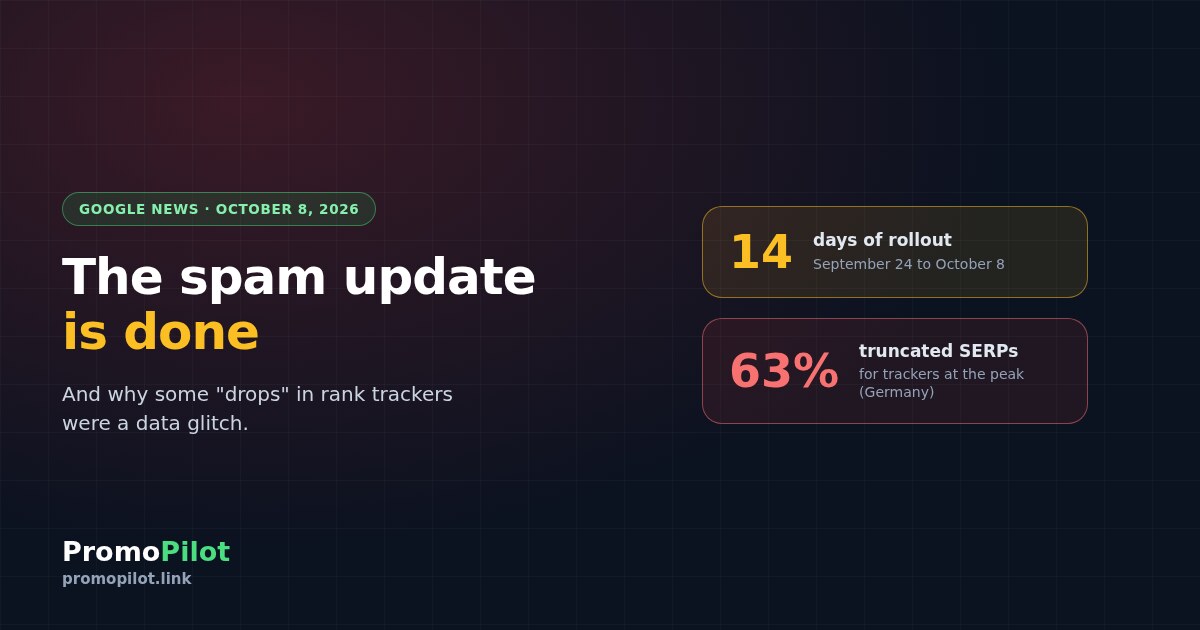
Google's September 2026 spam update is done: it rolled out from September 24 to October 8, almost 14 days. But over those same days many rank trackers received truncated results from Google and recorded drops that never happened. Meanwhile, penalty specialists report a rise in manual actions. Here's what actually affects your site and how to tell a real drop from a data glitch.
What we know about the update
Google launched the update on September 24 around noon US Eastern time and announced it complete on October 8. It's global and covers all languages. Google called it a normal spam update, didn't say what share of queries it affected and didn't announce any policy changes. Nor did it call it a link spam update.
"Normal" is a stretch. The three previous spam updates of 2026 rolled out in one, two and three days (March, June, August). This one took two weeks, and according to Search Engine Roundtable the waves of volatility came on September 25–27, September 30 and October 4–6. Some SEOs compare the effect to a core update. We covered the launch in our earlier news.
If your site was hit, Google advises reviewing it against its spam policies and warns that recovery can take many months: its systems need to confirm the violations are gone.
Same dates: trackers saw truncated results
Danish tool Morningscore published a breakdown: from the evening of September 24, Google started returning incomplete results to automated searches. Instead of the usual 50 results across six pages, fewer than 40 — and in those results almost eight of the previous top-ten sites were missing on average. The tracker recorded this as ranking drops.
Google hasn't commented. What matters is that the glitch started the same evening as the spam update. So some of the "drops" site owners saw in their trackers during those two weeks weren't a penalty but an artefact of data collection.
We checked our own rank tracker. It captures the first page of results, and the average number of results on it stayed at about 9 from September 12 to October 8, with no dip on the incident dates. Top-ten positions in our tracker were unaffected. Trackers that page deeper, to position 50 and beyond, were hit hardest.
More manual actions
Separately, Search Engine Roundtable gathered signals of a rise in manual actions. Consultant Marie Haynes says requests for help with manual actions went from essentially none to several a week. Most involve thin content, pure spam and scaled content abuse, often on long-standing legitimate businesses. Google hasn't confirmed or commented on the rise.
What to check if your rankings dropped
Check Search Console, not your tracker
Open the Performance report and compare clicks and impressions for September 24 to October 8 with the previous weeks. If your tracker showed a drop but clicks and impressions are flat, it was a data glitch. If Search Console dropped too, the change is real.
Look at Manual actions
Go to "Security & Manual Actions" in Search Console. If it's empty and the drop is real, it's most likely algorithmic. A manual action always comes with a notification stating the reason.
Go through the spam policies
Scaled content without value, thin pages, third-party content on subdomains, hidden text, sneaky redirects. Google didn't call this a link spam update, but a natural link profile — with varied sites and diverse anchors — remains the best insurance.
Don't make drastic moves
Recovery after a spam update takes months, and deleting pages or links in bulk by guesswork can do more harm than the update itself. Find the cause first, then fix it. A detailed diagnostic protocol is in our piece "Why search traffic drops".
Sources: Google Search Central (completion announcement, October 8, 2026); Search Engine Roundtable on the rollout and on the rise in manual actions (October 8, 2026); Morningscore on truncated results for rank trackers (October 2026); PromoPilot rank tracker data.