How to track your brand in AI answers: 8 trackers and 3 free reports reviewed (2026)
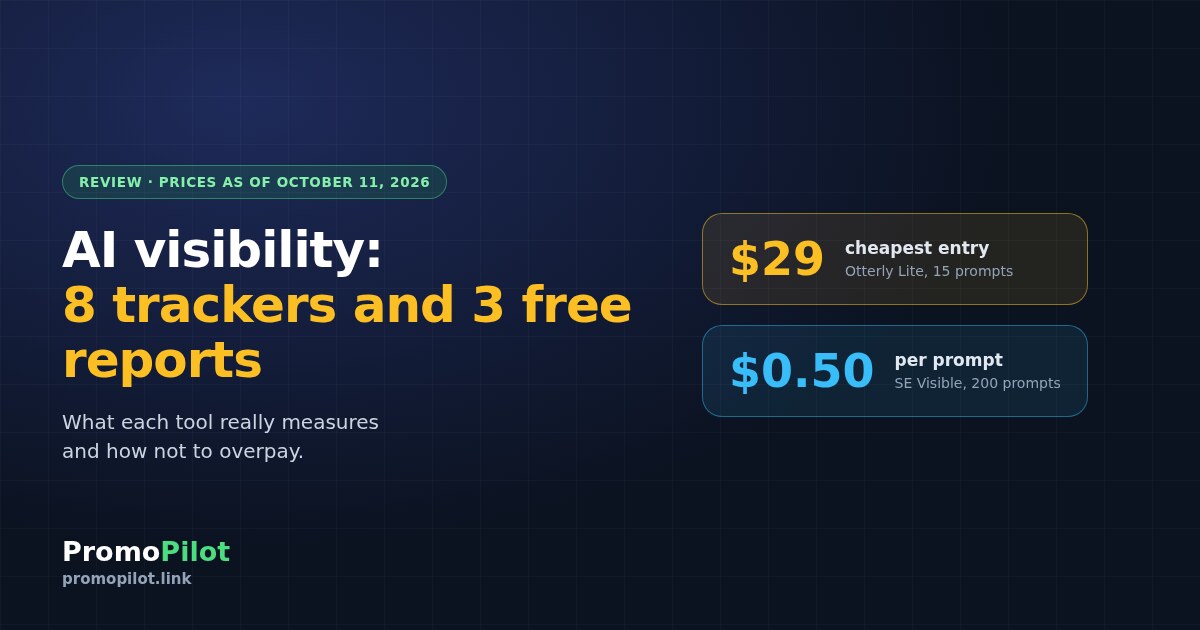
How do you know whether ChatGPT recommends your site or Gemini cites it? We reviewed three free sources — the generative AI report in Search Console, AI Performance in Bing and the AI Assistant channel in GA4 — and eight paid trackers. What each one measures, how it collects answers, what entry costs (from $29 a month) and what a prompt costs (from $0.50), and how to choose without overpaying. Prices checked against official pages on October 11, 2026.
Search Console shows your Google rankings. But how do you know whether ChatGPT recommends your site, whether Gemini mentions you, or where Perplexity gets its answer? In 2026 dozens of services appeared promising to show exactly that, and Google, Bing and Google Analytics added reports of their own. We reviewed three free sources and eight paid trackers: what each one actually measures, what entry costs, and how not to overpay for data that tells you nothing. Prices and features were checked against each vendor's official pages on October 11, 2026.
What can actually be measured
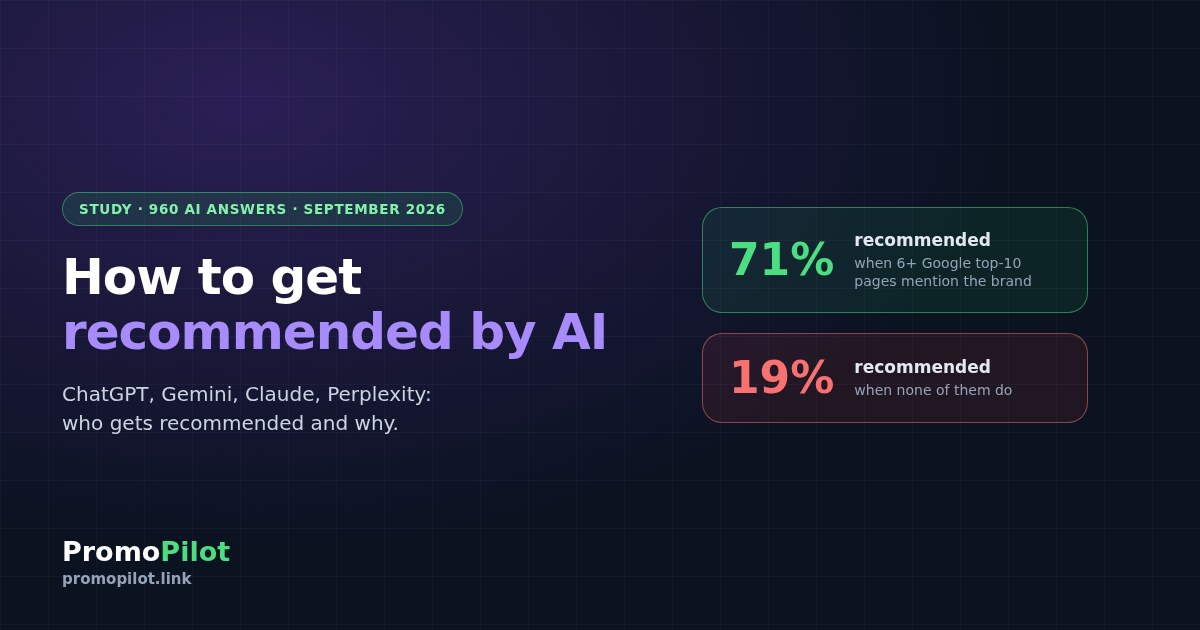
First, the defining trait of AI answers. In our study of 960 answers from ChatGPT, Gemini, Claude and Perplexity, asking one model the same question twice returned the same set of brands only 14–26% of the time. Only the core is stable: 4–6 brands that appear in most repeats. So "AI ranking" means almost nothing. The meaningful metrics are different:
- Mentions: the share of answers that name your brand, across a set of prompts.
- Citations: whether the AI links to your pages as a source, and which ones.
- Share of voice: your mentions versus competitors' for the same prompts.
- Sentiment: the context of the mention — recommended, compared or warned against.
- Traffic: how many people actually reached your site from AI assistants.
No tool covers everything. Free reports give impressions, citations and traffic, but don't tell you whether you're recommended. Trackers answer that, but only for the sample of prompts you define.
Start with the free sources
Google Search Console: the generative AI report
Google announced the Generative AI performance report on June 3, 2026, and it has been available to all sites since August 31. It shows your pages' impressions in AI Overviews and AI Mode, broken down by page, country, device and date, down to the hour. There are no clicks, CTR, positions or queries, Gemini answers aren't included, and the report may not appear if impressions are low. We covered it in detail in a separate piece.
Bing Webmaster Tools: AI Performance
Bing's report has been live since February 10, 2026. It's the only free source that shows citations specifically: how often your pages are cited as a source in Microsoft Copilot and Bing's AI answers, which pages, and the "grounding queries" the AI used to find them. Topics, intents and citation share were added in June. There's no traffic data. It's especially useful for English-language markets, since ChatGPT's search relies heavily on Bing's index.
Google Analytics 4: the AI Assistant channel
Since May 2026, GA4 has a default AI Assistant channel: visits from ChatGPT, Gemini, Copilot, DeepSeek and other assistants land there with the medium ai-assistant. Three caveats. The channel isn't applied retroactively. Clicks from AI Overviews and AI Mode come from google.com and count as organic search. And some app traffic without a referrer ends up in Direct. For Claude and Perplexity it's safer to create your own channel group with a regular expression; there's an example in Google's help.
Paid trackers: eight services
All the services below work the same way at heart: you define a list of prompts, the service regularly asks them to AI platforms and analyses the answers. They differ in which AI platforms they cover, how many prompts you get, how often they check, and how answers are collected — through the interface a regular user sees, or through an API, where the answer may differ.
Otterly.AI
The Lite plan at $29 a month ($25 billed annually) gives you 15 prompts checked daily in ChatGPT, AI Overviews, Perplexity and Copilot, with unlimited seats. AI Mode and Gemini are $9 a month each, Claude $29. Answers are collected through the public interfaces; only Claude goes through the API. You get citation analysis, a brand visibility index, prompt research and GEO page audits. From Standard ($189, 100 prompts) you get an API and a Looker Studio connector.
Peec AI
Starter at $95 a month gives 50 prompts in three models of your choice (ChatGPT, AI Mode, AI Overviews, Copilot, Gemini), one project and unlimited users. Pro ($245) has 150 prompts and 2 projects; Advanced ($495) has 350 prompts, 5 projects, multiple countries and Looker Studio. Perplexity, Claude, Grok and other models are Enterprise only. Data comes from the user interface. Its strength is metrics: visibility, position in the answer, sentiment, share of voice, source and gap analysis, and prompt suggestions with demand estimates.
Semrush AI Visibility Toolkit
$99 a month per domain gives 25 prompts checked daily in AI Mode, AI Overviews, Gemini and ChatGPT search, plus a weekly Brand Performance report with share of voice and sentiment. 50 more prompts cost $60 a month. The prompt database of 317M+ prompts with volume and intent is valuable for choosing what to track. Semrush One bundles include more prompts, from 50 for $199. Claude, Copilot and Grok are only in Enterprise AIO. The toolkit itself has no trial.
Ahrefs Brand Radar
Two modes. Custom prompts start at $50 a month for 2,500 checks: about 80 prompts checked daily on one platform (one check is one prompt on one AI platform in one location). Claude costs 8 checks per update. Paid Ahrefs plans include a small allowance too: 5 prompts on Lite. The second mode is an index of 470M+ prompts built from Ahrefs' keyword data: $199 a month per platform, $699 for all of them (AI Overviews, AI Mode, ChatGPT, Perplexity, Gemini, Copilot). The index shows mentions and citations for prompts you'd never have thought of yourself.
SE Ranking and SE Visible
In SE Ranking, AI tracking is built into the plans: Core at $129 includes 100 daily prompts, and the AI Search add-on gives 200 more for $89. The standalone SE Visible starts at $99 ($79 billed annually) for 200 prompts in ChatGPT, Gemini, AI Mode, Perplexity and AI Overviews, 3 projects and unlimited users. Answers are collected through a browser, like a regular user. There's sentiment, share of voice, classification of cited domains (media, blogs, forums) and local visibility. Countries are limited for now: US, UK, Canada, France, Germany, the Netherlands, Spain.
Scrunch
Core at $250 a month gives 125 prompts, 5,000 responses, 5 licences, 5 competitors and one country across ChatGPT, Perplexity, AI Overviews and Copilot. New prompts are checked daily for the first two weeks, then every 72 hours. Data comes from a mix of browser automation and official APIs. Beyond monitoring there's AI bot traffic to your site and page audits; Enterprise adds a platform that serves an optimised version of your site to AI agents.
Profound
The official pricing page currently shows no self-serve plans: only a trial (50 prompts daily for 7 days in ChatGPT, Gemini and AI Overviews) and Enterprise on request — up to nine AI platforms, citation and sentiment analysis, AI bot traffic, prompt volumes, API and SSO. Answers are captured from the consumer interface, not model APIs. Agencies get separate client workspaces from $399 a month.
Similarweb AI Brand Visibility
The AEO Intelligence plan starts at $99: 150 prompts in ChatGPT, AI Mode, Gemini and Perplexity, one user and 3 months of history. It shows share of mentions, the top 30 brands per topic, sentiment, URL-level citations and an AI traffic module that includes Grok, Claude and Copilot. Plans at $333 and $542 add Similarweb's regular SEO and ads data.
Comparison at a glance
| Service | Entry, $/mo | Prompts | AI platforms on entry plan | How answers are collected | Trial |
|---|---|---|---|---|---|
| Otterly.AI | 29 | 15 | 4 (+3 paid add-ons) | Interface | 7 days |
| Peec AI | 95 | 50 | 3 of your choice | Interface | Yes |
| Semrush | 99 | 25 | 4 | Via Position Tracking | No |
| Ahrefs Brand Radar | 50 | ≈80 | 1 | Not disclosed | No |
| SE Visible | 99 | 200 | 5 | Browser | 10 days |
| Scrunch | 250 | 125 | 4 | Browser and API | 7 days |
| Profound | On request | — | Up to 9 | Interface | 7 days |
| Similarweb | 99 | 150 | 4 | Not disclosed | Yes |
How to choose without overpaying
Your audience's AI platforms
Five platforms with ten prompts each are more useful than ten platforms with two. For English-language B2C, ChatGPT, AI Overviews and AI Mode usually matter most; for a technical audience add Perplexity and Claude. Don't pay for logos your customers don't use.
Do the volume maths up front
The real load is prompts × AI platforms × checks per month. For an agency, multiply by the number of clients too: a $29 plan per client becomes hundreds of dollars for ten. Ask whether failed checks count against your limit and what one platform "costs": at Ahrefs, Claude takes 8 checks.
Interface or API
An answer from a model's API often differs from what a person sees in the app, where search, memory and personal settings are on. Services that capture answers through the interface or a browser are closer to reality but cost more. In a demo, ask where the answer comes from and request the raw answer with date, country and citations.
Frequency, country and citations
Daily checks on 15 prompts give more noise than signal; weekly trends across 50–100 prompts are usually enough to make decisions. Check whether you can set the country, since answers for the US and Poland differ. And make sure the service shows the specific cited URLs, not just mentions: citations reveal which third-party pages you need to get onto.
Can you do without a tool?
For a first snapshot, yes. Take 20 prompts you should be recommended for, ask each one to four AI platforms five times, and record how many answers include you and your competitors. That's 400 answers and a couple of hours of work a month. Such a table quickly shows whether there's a problem and on which platforms. A paid tracker becomes necessary once you have more than a hundred prompts, need weekly trends or a client report.
PromoPilot already collects some of this data automatically. SEO Radar shows visits from AI assistants for each page from your GA4 and checks whether AI search cites your site for queries where you already appear in Google. The SEO audit checks whether AI knows your brand and whom it recommends instead. It doesn't replace a full tracker, but it lets you start without a separate subscription.
Frequently asked questions
How do I find out whether ChatGPT recommends my site?
Ask ChatGPT 10–20 prompts you should be recommended for, each at least five times, and count the share of answers that include your brand. A single run means nothing: answers change from one run to the next. For regular monitoring, trackers such as Otterly, Peec AI or SE Visible will do.
Is there a free way to track AI visibility?
Yes, three sources. Search Console shows impressions in AI Overviews and AI Mode, Bing Webmaster Tools shows citations in Copilot and Bing answers, and GA4 shows visits from AI assistants through the AI Assistant channel. None of them shows whether you are recommended or whom AI recommends instead.
Which AI visibility tracker is the cheapest?
Otterly.AI has the lowest entry price: $29 a month for 15 prompts across four AI platforms. SE Visible has the cheapest prompt: $99 for 200 prompts, about $0.50 per prompt. Prices were checked on the official pages on October 11, 2026.
Why does my tracker show one thing while I see another in ChatGPT?
Because AI answers are random and depend on country, language, memory and user settings, and some services collect answers through an API where search may behave differently. Compare the share of answers with your brand over a week or a month, not a single answer.
Can I see AI Overviews traffic in Google Analytics?
No. Clicks from AI Overviews and AI Mode come from google.com and count as organic search. The GA4 AI Assistant channel collects visits from ChatGPT, Gemini, Copilot and other assistants. Impressions in AI Overviews and AI Mode are only visible in the generative AI report in Search Console.
How often should I check AI visibility?
For most sites, weekly or monthly on a fixed set of prompts is enough. Daily checks on a small sample produce mostly noise. What matters is the trend in the share of answers that include your brand, not the result of a single day.
Sources: official pricing pages and documentation of Otterly.AI, Peec AI, Profound, Semrush, Ahrefs, SE Ranking, Scrunch and Similarweb (checked October 11, 2026; some sites show currency by visitor location, prices here are in US dollars excluding tax). Google Search Central on the Generative AI performance report (June 2026), the Bing Webmaster blog on AI Performance (February and June 2026), Google Analytics help on default channel groups. PromoPilot's own study of 960 AI answers (September 2026). This review is not sponsored.