Which Free SEO Tools Do AI Assistants Recommend? We Asked ChatGPT, Perplexity, Gemini and Claude 30 Questions (October 2026)
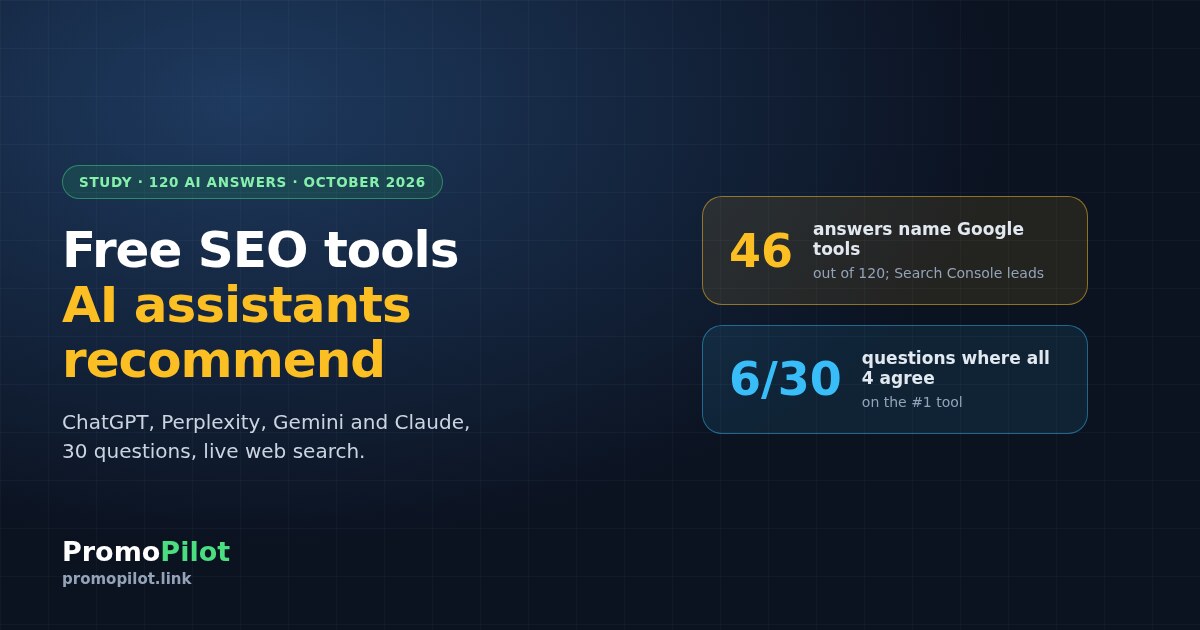
Which free SEO tools do ChatGPT, Perplexity, Gemini and Claude recommend, and where do they get the list? We asked 30 questions with web search on and got 120 answers. Google tools lead (46 of 120), the assistants rarely agree (all four pick the same #1 in only 6 of 30 questions), 90% of sourced answers cite the tool's own site and 58% cite a "best X" roundup. Plus categories nobody owns yet, how AI citations differ from Google's top 10, and our own result: 0 of 120.
More and more people skip the search results and simply ask an assistant: "What's the best free tool to check my sitemap?" So which tools do the assistants actually name, and where does that list come from? On October 13, 2026 we asked ChatGPT, Perplexity, Gemini and Claude 30 such questions, from broken links and DMARC records to AI image detectors, with live web search switched on. That gave us 120 answers. We extracted every recommended tool, sorted every cited source and compared it all with Google's top 10. Google's own tools come out on top, the assistants rarely agree with each other, and for 11 of the 30 questions they barely overlap at all.
- Google's tools appear in 46 of 120 answers and are the first pick in 18. Search Console alone is named in at least 21 answers. Next come Ahrefs (21 answers), Semrush (18) and MxToolbox (12).
- The answers name 283 distinct tools, and 181 of them (64%) appear only once.
- Two assistants answering the same question share only about a quarter of their tools (average Jaccard index 0.24). All four agree on the #1 pick for just 6 of 30 questions.
- 90% of answers with sources cite the website of a tool they recommend, and 58% cite at least one "best X tools" roundup. Not a single Reddit thread was cited.
- Only 13% of the URLs the assistants cite are in Google's top 10 for the same query. Roundups make up 23% of AI citations but only 7.5% of Google's top-10 results.
- Our own site, PromoPilot, was mentioned in 0 of 120 answers, even though we have a free tool for every one of the 30 questions.
This is our second study of AI recommendations. The first, 960 answers about which brands AI recommends and why, covered eight consumer and business markets. This time we took one niche we know well: free SEO and webmaster tools.
How we ran the test
We wrote 30 questions the way a site owner would type them, such as "Is there a good free sitemap validator to check my XML sitemap?". They cover eight areas: site audit and crawling, on-page markup, authority and links, email and DNS, security and uptime, AI content tools, AI visibility, and marketing utilities.
Each question went once to each of four models through the API, with the model's own web search and no system prompt: OpenAI GPT-5.4 (we call it ChatGPT for short), Perplexity Sonar Pro, Google Gemini 3.8 Flash and Anthropic Claude Sonnet 5. A separate model then extracted the tools each answer recommends and matched each one to its domain. The full method and its limits are at the end of the article.
Google, Ahrefs and Semrush lead the list
The most recommended "brand" is Google itself. Its tools appear in 46 of 120 answers, across 19 of the 30 questions, and are the first recommendation in 18 answers. Most of that is Search Console, named in at least 21 answers, but assistants also send people to Postmaster Tools for email, the Rich Results Test for markup and the Campaign URL Builder for UTM tags.
The free tiers of the big SEO suites come next. Ahrefs (21 answers) and Semrush (18) are recommended for backlinks, domain authority and site audits; in the "authority and links" category each appears in 12 of 16 answers. Screaming Frog (8 answers) is the default answer for crawling a site, thanks to its free 500-URL limit.
Utility categories follow a different pattern. There, one long-established specialist site wins almost every time: MxToolbox for SPF, DMARC and blacklists (12 answers, first pick in 8), Qualys SSL Labs for certificates, Sucuri SiteCheck for malware, WhatsMyDNS and DNSChecker for DNS propagation, and DownForEveryoneOrJustMe for "is it down" questions. The models know these sites even without searching.
A third, smaller group deserves attention: compact multi-tool sites. Patrick Stox's free tools (robots.txt tester, sitemap validator, schema generator), Swetrix, SmallSEOTools and UptimeRobot each get recommended across several different questions. Each has a separate, clearly described page for every tool.
Below the top of the list, there is a very long tail. The 120 answers name 283 distinct tools, and 181 of them (64%) appear in just one answer.
Four assistants, four different lists
To measure how far the assistants agree, we compared each pair of models question by question using the Jaccard index: the share of tools that both answers name out of all tools either one names. 1 means identical lists, 0 means nothing in common. On average the index is 0.24, so two assistants answering the same question share roughly one tool in four.
The closest pair is Gemini and Claude (0.30), followed by GPT-5.4 and Gemini (0.27) and Perplexity and Claude (0.24). The least similar are GPT-5.4 and Claude (0.21), Perplexity and Gemini (0.21), and Perplexity and GPT-5.4 (0.20). All four models picked the same #1 tool for only 6 of the 30 questions, and at least three of the four agreed on 13.
Those six questions with full agreement are worth listing, because they show what a "settled" category looks like:
- Schema markup generator: TechnicalSEO.com.
- SSL certificate check: Qualys SSL Labs.
- Malware scan of a website: Sucuri SiteCheck.
- IP or domain blacklist check: MxToolbox.
- Is a site down for everyone or just me: DownForEveryoneOrJustMe.
- Where my site ranks on Google: Google Search Console.
Five of the six winners are long-established specialist sites, and the sixth is Google's own product. A newcomer is unlikely to replace them in AI answers any time soon. These categories are not a good place to start.
Keep in mind that this is a single run. In our September study the same model repeated its #1 pick in 79–95% of cases but the full list in only 14–26%, so single answers are snapshots, while totals across 120 answers are more reliable.
Categories where no tool owns the answer
At the other end are questions where each model names its own tools and there is no shared favourite. For anyone building a tool, this is the most interesting part of the study: there is no incumbent to displace. Besides the seven below, EXIF removal, robots.txt testing, redirect checks and Open Graph previews also scored 0.13 or lower.
| Question | Overlap (Jaccard) | What the assistants named first | Our free tool |
|---|---|---|---|
| Remove invisible characters from text | 0.02 | four different picks, from online removers to "use VS Code or Notepad++" | Invisible character remover |
| Check the meta tags on my pages | 0.03 | Meta Tags Viewer, SEOmator, OverlayQA; Gemini named no specific tool | Meta tag checker |
| Reverse IP lookup | 0.07 | HackerTarget (twice), ViewDNS.info, YouGetSignal | Reverse IP lookup |
| Domain age checker | 0.08 | 1Lookup, ICANN Lookup, SmallSEOTools, WhoisXML API | Domain age checker |
| Remove the Gemini watermark from an image | 0.08 | Gemini or Google AI Studio itself (twice), Photopea, Cleanup.pictures | Gemini watermark remover |
| Validate an XML sitemap | 0.09 | Patrick Stox's validator, Search Console, XML-Sitemaps.com (twice) | Sitemap checker |
| Analyze Search Console data for quick wins | 0.14 | Search Console itself, then GSC Explorer, The SERP Master, ian.is | Search Console export analyzer |
The Search Console question is a good illustration. All four assistants mention Search Console itself, and then each suggests a different niche tool. There is clear demand for "find quick wins in my Search Console data", and no single answer has emerged yet. For invisible characters, four models gave four unrelated answers, and one simply recommended a code editor.
Low overlap does not mean the topic is unpopular. It means the models have not found a strong, widely cited reference, which is when a clear tool page and a few mentions in roundups can make a difference.
What the assistants cite: tool sites and "best X" roundups
90 of the 120 answers included web sources, with 844 cited URLs in total. We sorted each source into a type: the website of a tool recommended in the same answer, other tool or vendor pages, "best X tools" roundups (titles with "best", "top N", "N free tools", "alternatives", "vs", "compared" or "review"), other articles, documentation and community sites.
Two patterns stand out. First, assistants like to cite the tool's own page: 90% of answers with sources (81 of 90) link to the website of at least one tool they recommend. For individual recommendations, the tool's own domain is among the sources in 63% of cases (244 of 388), and in 64% of cases for the #1 pick. GPT-5.4 relies on this most of all: 75 of its 100 citations lead to the site of a tool it recommends, and it cites the tool's own domain for 83% of its recommendations. For Perplexity the figure is 75%, for Claude 49% and for Gemini 26%.
Second, roundups matter. 58% of answers with sources (52 of 90) cite at least one "best X tools" page. Perplexity returns its whole search result list as citations (a median of 18 URLs per answer), so it dominates raw counts. Without Perplexity, citations split into 53% tool sites and 29% roundups. Claude and Gemini lean on roundups the most: 33% and 44% of their citations respectively, although Gemini only had sources in 8 answers.
Several publishers were cited across different questions. wpbeginner.com appeared in 5 answers on 5 different questions (SEO checkers, backlinks, rank tracking, schema, Search Console), and techradar.com in 4. cmswire.com, shopify.com, geekflare.com, supermonitoring.com and aioseo.com appeared in 3 answers each. The most cited single pages were roundups of backlink checkers, AI image and text detectors and schema generators, 3 answers each.
Community sites were almost absent. We did not find a single Reddit thread among the 844 citations, and the only "community" source was one Medium post. In our September study, Reddit made up about 9% of Gemini's citations on consumer questions. For tool questions in this niche, at least in this run, assistants went to tool pages and roundups instead.
AI answers and Google's top 10 are different lists
For each question we also took the Google US top 10 for a short keyword version, such as "free sitemap validator". The overlap with what the assistants cite turned out to be small. Only 13% of cited URLs (109 of 844) are exactly the same as a Google top-10 result, and 22% (183 of 844) share a domain with one. Of the tools the assistants recommend, 34% (193 of 560) have their domain in Google's top 10 for that keyword. The figure barely differs by model: from 33% for Claude to 37% for Perplexity.
The reason is the type of page. In this niche, Google's top 10 is mostly the tool pages themselves, and roundups account for only 7.5% of results. Among AI citations, roundups make up 23% overall and 29% without Perplexity. So ranking a tool page in Google and getting into AI answers are partly different jobs. The first is about your own page; the second also depends on being listed on the pages that the assistants read.
Gemini barely searched
| Model | Answers with web sources | Median URLs per searched answer | Average tools named | Cost per answer |
|---|---|---|---|---|
| Perplexity Sonar Pro | 30 of 30 | 18 | 4.6 | $0.010 |
| GPT-5.4 (web) | 25 of 30 | 4 | 3.6 | $0.029 |
| Claude Sonnet 5 (web) | 27 of 30 | 5 | 5.4 | $0.059 |
| Gemini 3.8 Flash (web) | 8 of 30 | 5.5 | 5.1 | $0.012 |
Even with web search enabled, Gemini 3.8 Flash used it in only 8 of 30 answers and answered the other 22 from memory. To appear in such answers, a tool has to be well known before the model's training data was collected; a new tool can only get there through search, which Gemini rarely used. GPT-5.4 and Claude searched in most cases (25 and 27 of 30), and Perplexity searched in all 30.
Our result: zero out of 120
We have a free tool for every one of the 30 questions: from the sitemap checker and meta tag checker to the AI visibility checker. In this test PromoPilot was not mentioned in any of the 120 answers and was not cited as a source once. We searched the answer text and every cited URL for our name. Our site is also not in Google's top 10 for any of the 30 keywords.
This is not a measurement error, and we did not expect otherwise. Most of our tools are new, few third-party pages mention them, and none is listed in the roundups the assistants cited. The study shows what that costs: assistants recommend tools they can find on the tool's own page and in other people's "best X" articles. A tool with neither is invisible to them, however good it is.
What this means if you build tools or run a site
- Give every tool its own page. In 90% of answers with sources, the assistant cited the site of a tool it recommended, and GPT-5.4 did so for 83% of its picks. The page should state plainly what the tool does, so the model can quote it.
- Get into the roundups that assistants read. 58% of answers with sources cited a "best X tools" page, while such pages make up only 7.5% of Google's top 10. Ask the assistants your own target question, look at which pages they cite, and work on being listed there with an honest description of what your tool does better.
- Start with categories that have no owner. Where all four models already agree on a winner, such as SSL Labs or MxToolbox, there is little room. Where the overlap is near zero, a clear page and a couple of mentions can be enough to be named.
- Treat Google and AI as two separate jobs. Only 13% of cited URLs are in Google's top 10. A good ranking helps, but it does not guarantee a recommendation, and the reverse is also true.
- Don't count on a single model. Two assistants share only about a quarter of their tools for the same question. Check visibility across several assistants and several phrasings.
- Measure the share of answers, not one screenshot. Answers change from run to run. A single answer that names you, or doesn't, proves nothing on its own.
You can check whether AI search cites your own site with our free AI visibility checker: it shows which sources the assistants use for your questions and whether your robots.txt lets AI crawlers in. For ongoing work, SEO Radar shows visits from AI assistants for each page from your GA4 data and checks whether AI search cites your site for queries where you already appear in Google. If you want to go beyond tools, our review of AI visibility trackers compares the paid options.
Methodology and limitations
- Scope. A single run on October 13, 2026, all requests within about ten minutes: 30 questions in US English, one answer per model per question, 120 answers, no errors.
- Models. As served by OpenRouter that day:
perplexity/sonar-pro(built-in search),openai/gpt-5.4,google/gemini-3.8-flashandanthropic/claude-sonnet-5, the last three with native web search. No system prompt, default temperature, up to 1,500 output tokens. The consumer apps have their own system prompts, memory and sometimes different search, so their answers may differ. - Sources. The citations each API returns; Gemini's redirect links were resolved to real addresses and tracking parameters removed.
- Tool extraction.
google/gemini-2.5-flashat temperature 0 listed the tools each answer recommends, not merely cites; each tool was matched to its registrable domain. Generic advice such as browser DevTools or curl was excluded. Some noise remains: several products are grouped under a parent domain such as Google, and a few odd domains were counted as tools. Source types come from a title and URL heuristic, not manual review. - Google. One snapshot of the google.com top 10 (US, English, desktop) for a short keyword version of each question, via the Bright Data SERP API.
- Gemini searched in only 8 of 30 answers, so its picks mostly reflect training data.
- Cost. About $3.41: $3.29 for the answers, $0.07 for extraction and about $0.05 for 30 Google requests.
A single run is noisy: read per-question picks as a snapshot and the totals across 120 answers as the main result.
Frequently asked questions
Which free SEO tool do AI assistants recommend most often?
Google's own tools, above all Search Console: they appeared in 46 of 120 answers and were the first pick in 18. Ahrefs (21 answers), Semrush (18) and MxToolbox (12) came next.
Do ChatGPT, Perplexity, Gemini and Claude recommend the same tools?
Mostly not. Two assistants answering the same question shared about a quarter of their tools on average (Jaccard index 0.24), and all four agreed on the first pick for only 6 of 30 questions.
Where do AI assistants get their tool recommendations?
Mostly from two kinds of pages: 90% of answers with sources cited the website of a recommended tool, and 58% cited at least one best tools roundup. No Reddit thread was cited.
Does ranking in Google mean AI will recommend my tool?
Not necessarily. Only 13% of the URLs cited by the assistants were in Google's top 10 for the same query, and roundups made up 23% of AI citations but only 7.5% of Google's top 10.
How can a new tool get recommended by AI assistants?
Give the tool its own clear page, get it listed in the best X roundups that assistants cite for your query, and start with categories where the models do not agree on a winner yet.
How reliable are these results?
They come from one run of 120 answers on October 13, 2026, in US English, through the API. Individual answers vary between runs, so per-question picks are a snapshot; totals across all answers are more robust.
Data: PromoPilot study of 120 answers from Perplexity Sonar Pro, GPT-5.4, Gemini 3.8 Flash and Claude Sonnet 5 via OpenRouter, October 13, 2026; Google US top 10 via Bright Data SERP API on the same day. Brand names belong to their owners; no tool vendor sponsored or reviewed this study. Previous study: 960 AI answers, September 2026.