Google updates its user-generated spam guide: noindex for link-shared pages
Google updated its guide on user-generated spam: it now covers page builders and AI tools and recommends noindex by default for pages shared by link. We checked 57 posts on 19 publishing platforms.
On 26 October 2026 Google updated its guide "Prevent user-generated spam on your site and platform". It now also covers tools that let users publish shared pages, generated content or web apps. The main new advice: pages made only to be shared by link should get noindex by default. We checked what this means for links on such platforms using fresh posts from our own publishing pool.
What changed in the guide
- Wider scope. Before, the guide was mostly about comments, forums and free hosting. Now it names tools where users create shared pages, generated content and web apps: page builders, note and document services, AI app makers.
- New section "Only index content meant for Search". A platform should decide which user content is meant to be found in search and which is only for people with the link. For content made for sharing, collaboration or utility, Google suggests
noindexby default (a robots meta tag or the X-Robots-Tag header) or a crawl block in robots.txt. - Search Console monitoring. Verify the site or subdomain to get manual action and security alerts, and watch the Page Indexing and Performance reports for sudden spikes in indexed pages or for queries that do not fit the platform.
- Platform metrics. Track how many public pages are created and indexed, set alerts for sudden jumps, and look for a few accounts producing a large share of indexable URLs.
This is guidance, not a new algorithm or a spam update. The Search Status Dashboard has no new entry. But platforms that follow it will change how their users' pages are indexed.
What we checked
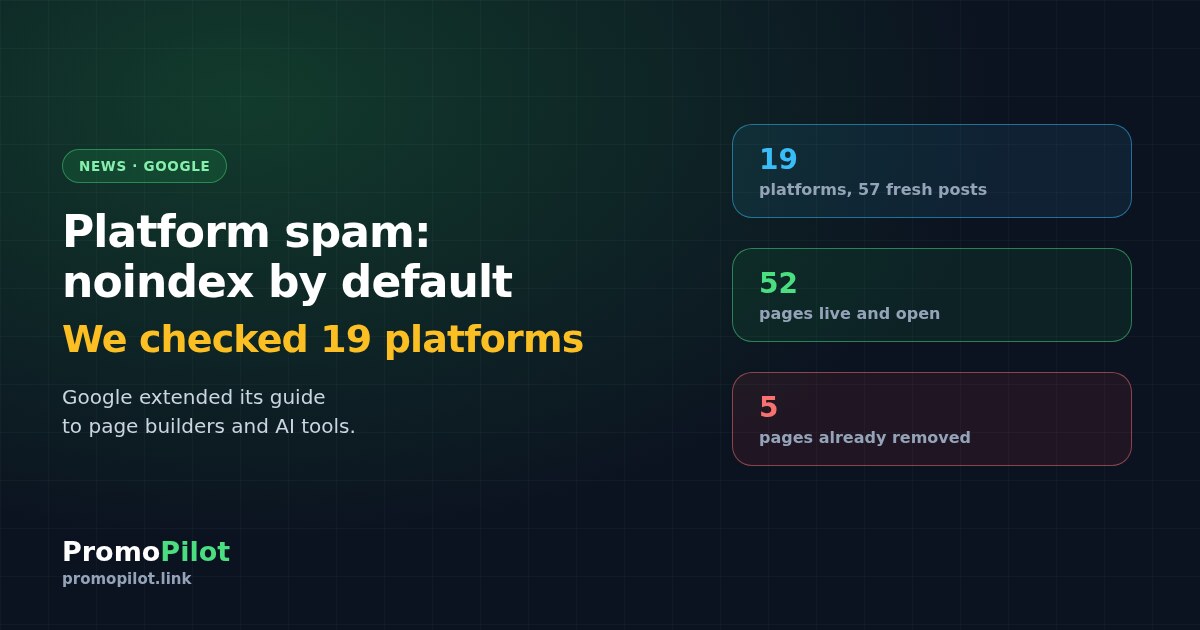
Our pool has 19 active publishing platforms: blogs, page builders, note services and static hosting. On 27 October we opened the 3 latest posts on each platform from the last 45 days, 57 pages in total, with a normal browser and checked the response code, the robots meta tag and the X-Robots-Tag header.
- 52 of 57 pages are live and open to indexing. None of the live pages has
noindexin the meta tag or the header. - 5 pages on 2 platforms are already removed: on one blog host 2 of 3 posts return 410, on the other all 3 return 404 with
noindex. - 17 of 19 platforms have all 3 checked posts live.
A wider check on 27 October showed the difference between the two: one platform removes whole new blogs within hours, the other removes sites only occasionally (48 of 48 posts in a larger sample are live). Our system detects removed placements and republishes them on other platforms automatically.
So far the new advice has not reached the platforms in our sample: no one has turned on noindex for public posts. But removal of posts is already happening, which is the same anti-spam work, only done by deleting pages. That is why each placement has to be checked after publication, not only on the day it went live.
What it means for a website
- If you build links on platforms, check that the page with your link is not closed from indexing. A link from a
noindexpage will not help the target page get found. Our robots.txt checker shows crawl blocks, and the meta tag analyzer shows the robots tag. - Recheck placements over time. Removed posts and new
noindexdefaults appear after publication. Recheck links a few weeks later and replace removed ones. - If you run a platform or a tool with shared pages, decide now which pages should be in search. Result pages, shared reports and previews are usually better with
noindex. - Watch Search Console. A sudden jump in indexed pages is a reason to check for spam accounts. If rankings fell, first rule out other causes, as in our article on the September spam update.
Sources: Google Search Central, "Prevent user-generated spam on your site and platform" and the Search Central documentation updates log, entry of 26.10.2026; Search Engine Roundtable, 26.10.2026; PromoPilot check of 57 posts on 19 platforms, 27.10.2026. Prepared by the PromoPilot team.