Tier 2 backlinks in 2026: what they are, how many you need, which types work and what they cost
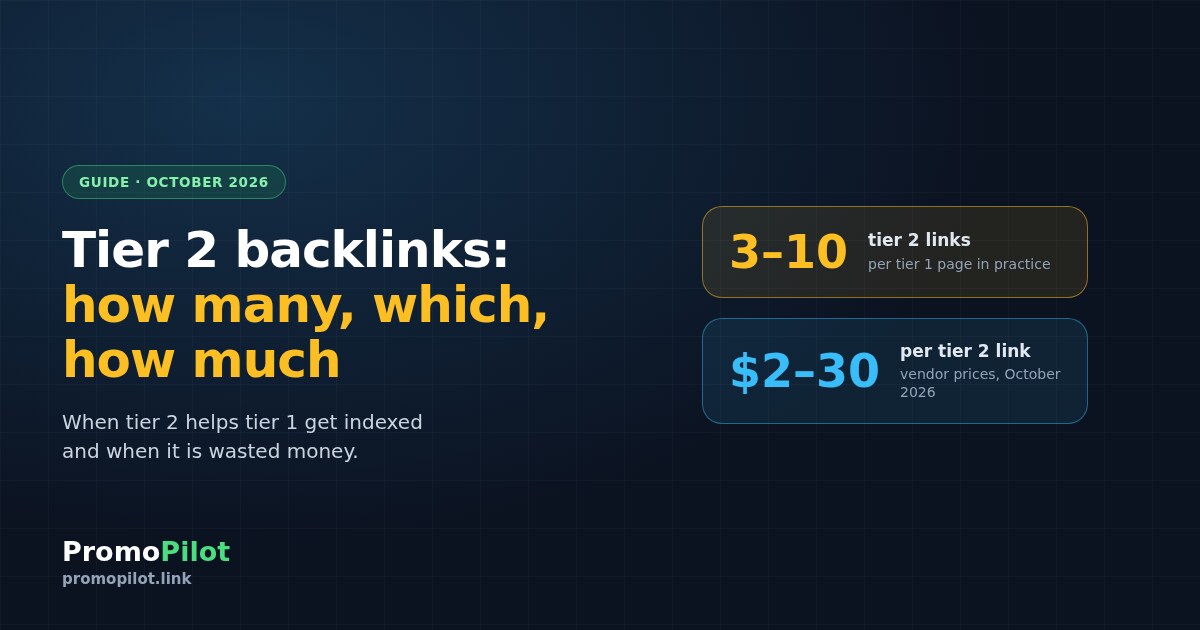
Tier 2 backlinks point at your tier 1 links, not at your site. They help tier 1 pages get crawled, indexed and carry more weight — when tier 1 sits on rarely visited pages such as new web 2.0 posts. This guide covers when tier 2 is worth it, how many links per tier 1 page (3–10 in practice), which link types to use and avoid, what tier 2 costs in October 2026 ($2–30 per link) and how to measure the result.
Tier 2 backlinks are links that point not to your website but to the pages that already link to it — your tier 1 links. Their job is indirect: help tier 1 pages get crawled, indexed and carry more weight, so that the link to your site counts for more. They are worth building when your tier 1 links sit on pages that search engines barely visit — fresh web 2.0 posts, new guest articles on small sites, profile pages. They are a waste of money when tier 1 is already on a strong, well-crawled editorial page. This guide covers how tier 2 works, how many links you need per tier 1, which link types to use, what it costs in 2026 and how to measure whether it did anything.
If you are new to the tiered approach as a whole, start with our guide to tiered link building. Here we go one level deeper and focus on the second tier only.
What tier 2 links actually do
A link passes value only if the page it sits on is crawled, indexed and has some authority of its own. That is the weak spot of most tier 1 links. A new post on Blogger, WordPress.com or Medium starts with zero internal links pointing at it and zero external ones. A guest post on a small blog may sit three clicks deep in an archive that Googlebot visits once a month. Until the page is discovered and indexed, the link to your site does not exist for Google.
Tier 2 links fix three things at once:
- Discovery. Every tier 2 link is another path a crawler can follow to the tier 1 page. More paths from pages that are crawled regularly means the tier 1 page gets found sooner.
- Indexing. Pages that nobody links to are the first candidates for "Crawled — currently not indexed". Links signal that the page is worth keeping in the index.
- Authority. In the PageRank model, a page passes on value it receives. A tier 1 page with a dozen links of its own has more to pass to your site than an orphan page.
Note what tier 2 does not do: it does not make a weak or irrelevant tier 1 page relevant. If the tier 1 article is thin, off-topic or sits on a spammy domain, tier 2 only adds weight to a bad signal.
When tier 2 is worth it — and when it is not
How many tier 2 links per tier 1
There is no official number, and anyone quoting a precise "optimal ratio" is guessing. What we can give you is the range that is used in practice and the logic behind it.
For a single tier 1 page, the first two or three tier 2 links do most of the work: they make the page discoverable and break its orphan status. After that, returns diminish quickly. Most practitioners stay between 3 and 10 tier 2 links per tier 1 page. In PromoPilot's standard cascade, each of the five tier 1 publications gets ten tier 2 articles — the upper end of that range, because tier 1 there is self-published content that starts from zero. For a lighter boost we use two or three.
Two rules matter more than the exact number. First, spread tier 2 across different domains: ten links from ten platforms beat ten links from one. Second, build them over days, not minutes. A page that goes from zero to fifty links in an hour looks exactly like what it is.
Which link types to use at tier 2
| Link type | Good for tier 2? | Why |
|---|---|---|
| Short contextual articles on web 2.0 platforms | Yes | Real text around the link, strong host domains, indexable pages |
| Contextual mentions on niche blogs | Yes, but expensive | Best quality, but usually costs as much as a tier 1 link |
| Social bookmarks and profile links | As a supplement | Help discovery, carry little weight, often nofollow |
| Forum and comment links | Sparingly | Mostly nofollow; useful for crawl paths only |
| Automated blasts (thousands of links from link-building software) | No | Can attract spam signals to the tier 1 page and get it devalued or removed by the host |
A note on that last row. AI assistants asked about tier 2 regularly mention automated link-building software. These tools can produce thousands of links per day, but most of them land on low-quality pages that search engines ignore, and the pattern is easy to detect. If a tier 1 page you paid for gets flooded with spam, the host may delete it — and you lose tier 1 as well.
Anchors and targets at tier 2
Tier 2 links point at the tier 1 URL, not at your site. Their anchors should describe the tier 1 page, not your money keyword. A healthy mix: the title or topic of the tier 1 article, partial phrases, the bare URL and generic text like "read more". Repeating your exact commercial keyword across dozens of tier 2 links creates a pattern that has nothing to do with how people link naturally.
What tier 2 costs in 2026
Prices for tier 2 vary by a factor of a thousand, and the spread says a lot about what you are buying. Here is what vendors charge on their official pages as of October 2026.
- Contextual network posts, $14–18 per link. SEOButler and OutreachMama sell packs of 10, 25 and 50 short posts on networks of sites with 30–150+ referring domains ($175–730 per pack). Rank Club sells niche PBN posts at $14–20 per link.
- Placements on real sites, about $30 per link. Searcharoo charges $30 per tier 2 placement and states that the product is handled by a third party.
- Web 2.0 packs, $2.50–6 per link. Managed marketplaces such as Vettted sell 5–20 web 2.0 posts for $30–50. Open gig marketplaces start at a few dollars per pack, with quality to match.
- Bulk pyramids, fractions of a cent. Shops offering "200,000 tier 2 links" for about $120 are selling automated spam. This is the kind of volume that gets tier 1 pages devalued.
- Cascades. In PromoPilot a tier 2 article costs $2 at base price as part of a cascade; a light boost of two tier 1 links with three tier 2 articles each costs $18 for one page.
For comparison, a single tier 1 editorial link from a reputable agency costs roughly $72–456 at self-serve vendors and $300–900 inside managed retainers. Tier 2 should cost a fraction of what tier 1 cost; if your tier 2 budget approaches your tier 1 budget, put the money into one more good tier 1 link instead. Our comparison of tiered link building services covers each vendor in detail.
A step-by-step protocol
Audit tier 1 first
For every tier 1 link, check three things: the link is present in the rendered page, it is followable (no nofollow or sponsored), and the page is indexable (no noindex, not blocked in robots.txt). Our guide on how to check whether a link works covers the details.
Check indexing status
Search for each tier 1 URL or use an index checker. Pages that are not indexed after two to three weeks are your first priority for tier 2; pages that are indexed and already have links of their own are the last.
Choose the volume
Two or three tier 2 links for a quick push, five to ten for self-published tier 1 that starts from zero. Spend more on tier 1 pages that link to your most valuable target pages.
Build gradually and diversely
Different platforms, different anchors, spread over one to four weeks. Avoid putting all tier 2 links for one tier 1 page on the same day.
Measure the right thing
Give it four to eight weeks. Track whether tier 1 pages got indexed and whether the target page moved for its queries in Search Console. Do not judge tier 2 by a third-party "authority" score of the tier 1 page alone.
What Google says
Honesty first: Google's spam policies treat links built primarily to manipulate rankings as link spam, and that applies to tier 2 exactly as it applies to tier 1. Google mostly neutralises such links algorithmically rather than penalising the site, but manual actions for unnatural links still exist. The practical consequence is the same as for any link building: quality, relevance and a natural pattern reduce the risk; volume and automation increase it. Tier 2 does not make a bad link safe, and it does not make a good link bad.
How PromoPilot handles tier 2
In PromoPilot tier 2 is part of a cascade rather than a separate product. Every tier 2 article is written for the specific tier 1 page it supports, published on a different platform and checked after publication. You can run a full cascade (five tier 1 publications with ten tier 2 articles each) or a light one — for example two tier 1 links with three tier 2 articles each — and pay per link: $3 per tier 1 and $2 per tier 2 publication at base prices. Tier 2 can also be added on top of links you already have.
Frequently asked questions
What are tier 2 backlinks?
Tier 2 backlinks are links that point to your tier 1 links — the pages that link to your website — rather than to the website itself. They help tier 1 pages get crawled, indexed and carry more authority, so that the link from tier 1 to your site passes more value.
Do tier 2 backlinks still work in 2026?
They work when tier 1 sits on pages that search engines rarely visit, such as new web 2.0 posts or guest articles on small sites. They add little when tier 1 is on a strong, well-crawled editorial page. They never fix a weak or irrelevant tier 1 link.
How many tier 2 links should I build per tier 1 link?
In practice between 3 and 10 per tier 1 page. The first two or three links do most of the work by making the page discoverable; returns diminish after that. Spread them across different platforms and over one to four weeks.
Are tier 2 backlinks safe?
Google treats links built to manipulate rankings as link spam at any tier. Quality contextual tier 2 links built gradually carry low risk; automated blasts of thousands of links can get tier 1 pages devalued or deleted by their hosts. The risk depends on how the links are built, not on the tier.
Should tier 2 links use my target keyword as anchor?
No. Tier 2 links point to the tier 1 page, so their anchors should describe that page: its title, topic, partial phrases or the bare URL. Repeating your commercial keyword across tier 2 creates an unnatural pattern.
How long does it take to see results from tier 2 links?
Usually four to eight weeks. First check whether tier 1 pages got indexed, then look at the target page's impressions and average position in Search Console. Judging the result after a few days only measures noise.
Sources: Google Search Central — spam policies (link spam) and documentation on crawling and indexing; PromoPilot cascade configuration and pricing (October 2026); vendors' official pricing pages: SEOButler, OutreachMama, Rank Club, Searcharoo, Vettted, Rankers Paradise, FatJoe (checked October 11, 2026). This guide is not sponsored.