Google launches the November core update and moves Search to Gemini 4 Hydrogen: what site owners should do
In one week Google rolled out the November core update and the new Gemini 4 Hydrogen model for Search. What is known, how to tell the two apart and what to do now.
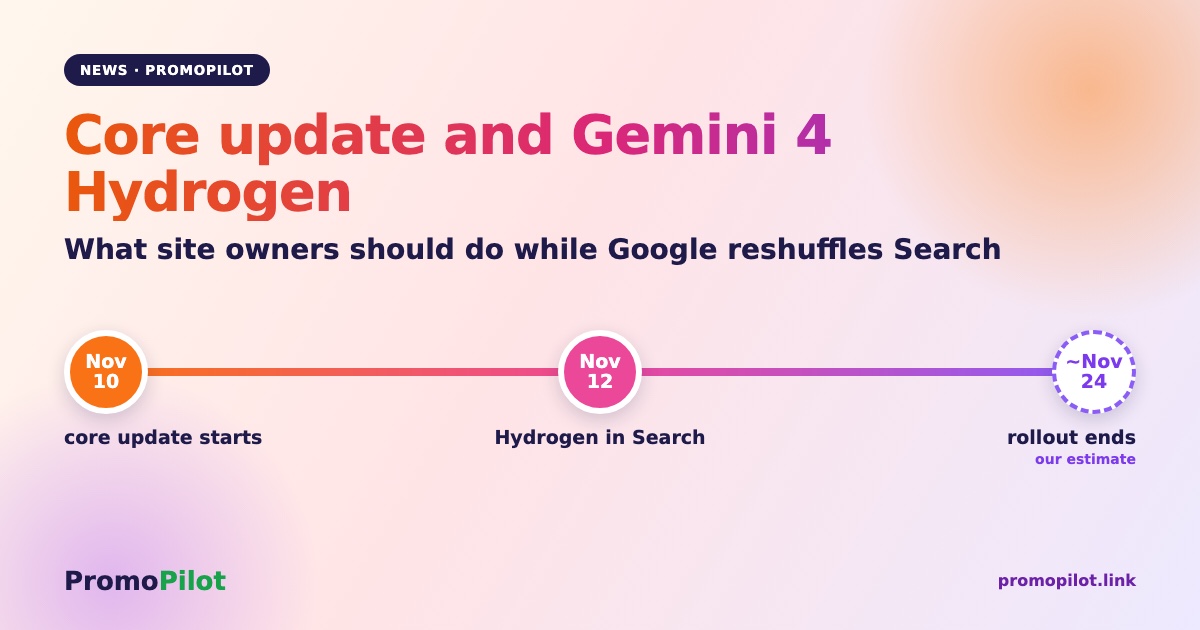
On 10 November Google started the November 2026 core update, and on 12 November it announced that Search is moving to the Gemini 4 Hydrogen model.
The core update: a rollout of up to two weeks
The update went live on 10 November at 10:06 US Pacific time and applies globally, in all languages. The rollout can take up to two weeks, so it should wrap up around 24 November, right before US Thanksgiving and Black Friday. As of 13 November there is no completion notice; follow the Search Status Dashboard. The documentation on core updates says these updates are broad and do not target specific sites or pages. First confirm the rollout has finished, then wait at least a full week before analyzing in Search Console, comparing the week after completion with the week before the rollout began.
Gemini 4 Hydrogen in Search
On 12 November Robby Stein, VP of Product for Google Search, called the new model the biggest model upgrade to Search yet. It is available to all users worldwide in Google Search. What Google states: better understanding of intent (multi-part questions, typos, very specific requests), improved query fan-out, meaning parallel searches across subtopics that, in Google's words, helps people find sites they might not have discovered before, more visual answers (images, comparison tables, custom tools) and more nuanced answers in every supported AI Mode language. The post says nothing about traffic, how sources are cited or controls for publishers. Details are in the Google blog.
Why you should not mix the two events
Both changes landed in the same week, so a traffic swing in these days may come from re-ranking, from the new way AI Mode presents answers, or from both. A single total will not tell you which. Split the data: in the Search Console Performance report, compare the periods before and after 10 and 12 November by page and query.
What to do now
- Do not rebuild the site or panic-buy links in the middle of the rollout: the picture will only be clear once it ends.
- Record positions and impressions of your key pages today, then compare once the rollout has ended and a full week has passed (by our estimate it ends around 24 November if it uses the full two weeks): the week after against the week before the rollout began.
- Check that important pages are indexed and answer specific sub-questions directly: fan-out pulls in pages that cover subtopics of a query.
- Build your link profile gradually and naturally: steady growth matters more than sudden spikes. The free PromoPilot SEO Radar can check your site and help you pick pages worth strengthening.
Sources: Google Search Status Dashboard, 10 November 2026; Google blog, Robby Stein, 12 November 2026; documentation on core updates. Retold by the PromoPilot team.