EU proposes the Digital Fairness Act: what to check on your site before Black Friday
The European Commission proposed the Digital Fairness Act against dark patterns. It is not law yet, but fake timers are already banned. A practical checklist before 27 November.
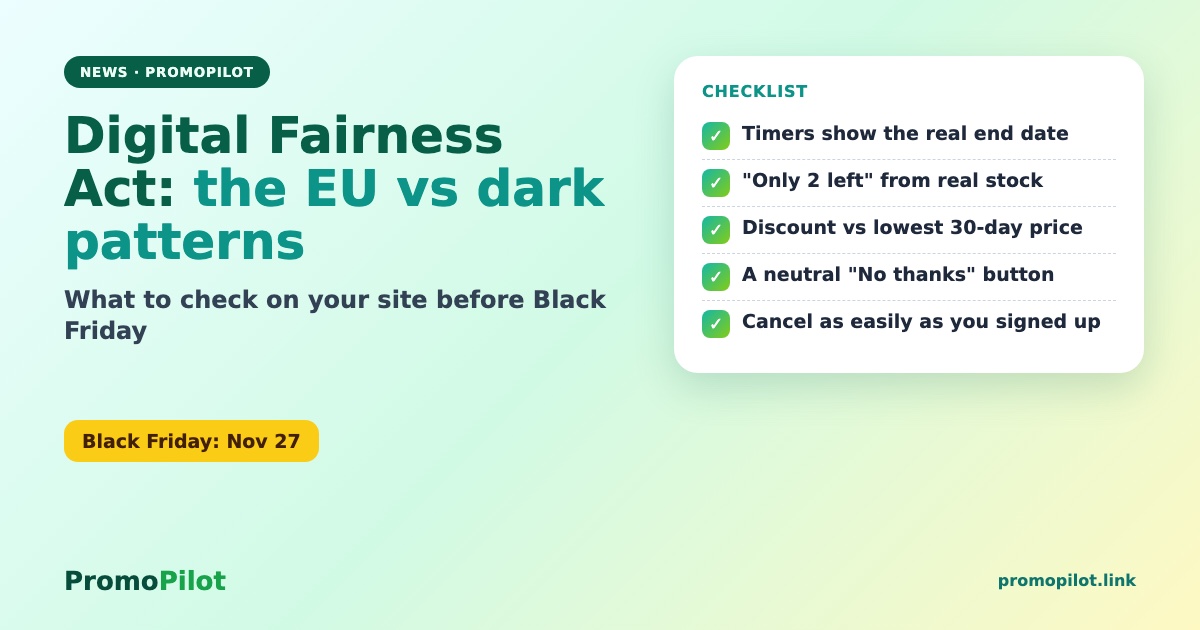
On 11 November the European Commission presented a proposal for the Digital Fairness Act, a major update of EU consumer rules against manipulative design. It is not law yet, but some of the practices it targets are already banned, and Black Friday is 27 November.
What the Commission proposed
According to the Commission's press release, the goal is to give consumers the same protection online as offline. The main novelties:
- a ban on manipulative marketing tactics (dark patterns), for example fake claims that a product is almost sold out;
- easier cancellation of contracts and subscriptions, an end to unwanted automatic renewals and to free trials that turn into subscription traps;
- an option to switch off addictive design features such as persistent prompts;
- clear disclosure of influencer marketing;
- limits on unfair personalised ads and prices aimed at minors or based on sensitive data;
- a right to talk to a human in customer service, and clear rights when an AI agent buys on the consumer's behalf.
The package also covers clear pricing of in-app virtual currencies and ticket queues, and bans gambling-like features for minors.
Status: a proposal, and where the big fines sit
The European Parliament and the Council will now discuss the proposal. It will take time and the text may change. Separately, the Commission proposed revising the Consumer Protection Cooperation Regulation: it would give the Commission direct powers to investigate large cross-border cases, with fines up to 6% of a company's worldwide annual turnover. That is part of the CPC revision, not of the DFA itself. Non-EU companies would need a legal representative in the EU.
What is already banned today
Annex I (point 7) of the Unfair Commercial Practices Directive prohibits falsely stating that a product is available only for a very limited time to push an immediate decision. So countdown timers that reset and fake "only today" offers are already banned in all EU countries. Under Article 6a of the Price Indication Directive, an announced price reduction must show the prior price: the lowest price over a period of at least 30 days before the reduction (some EU countries have exceptions). This has applied since 28 May 2022.
Checklist for your site before 27 November
- The timer shows the real end of the offer and does not restart on page reload.
- "Only N left" counters use real stock data.
- Discounts use the lowest price over a period of at least 30 days before the reduction as the reference (some EU countries have exceptions).
- The decline button in pop-ups is neutral, without shaming like "No, I don't like saving".
- A free trial turning into a paid plan and auto-renewal are clearly disclosed, and cancelling is as easy as signing up.
- No pre-ticked add-ons in the cart.
- Paid reviews and influencer posts are marked as advertising.
- Support offers a way to reach a human.
Before the sales rush, run the free site check on your key landing page: meta tags, speed, HTTPS and security headers. Fix pop-ups and checkout texts by hand. Our tool does not check legal compliance.
This is not legal advice. For your own case, consult a lawyer.
Sources: European Commission press release IP/26/2407, 11 November 2026; Directive 2005/29/EC; Directive 98/6/EC. Retold by the PromoPilot team.