AI Music Detector: How to Tell if a Song Is AI (Suno, Udio Test 2026)
Our own test: 23 human recordings, a Suno label before and after conversion, Deezer data on AI uploads, SynthID and a five-step check that does not overpromise.
No AI music detector can prove that a song was made by Suno or Udio. A file can only give itself away through a label in its metadata, and that label disappears with a single re-encode. We checked this on our own audio watermark detector: on 23 real recordings by human musicians, and on the same files after we added a "Suno" label. Below are the numbers, what streaming platforms do in 2026, and a five-step check that does not overpromise.
Key takeaways
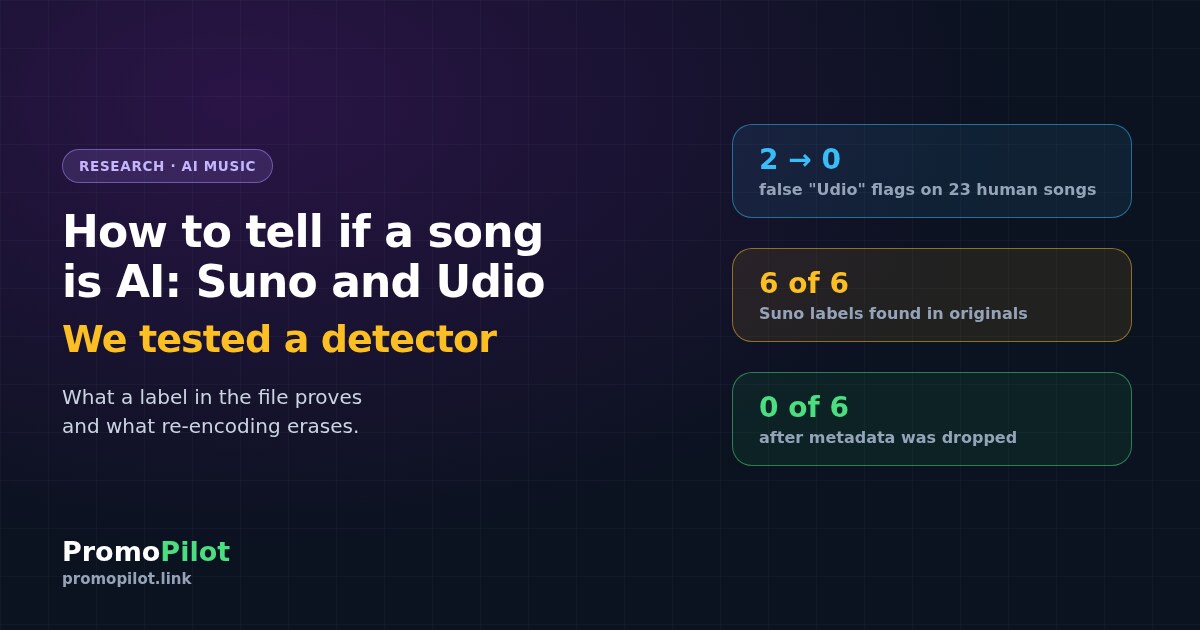
- Labels in metadata work, until someone removes them. We wrote "Suno" into the tags of 6 recordings: the detector found it in 6 of 6. After a normal conversion to MP3 the tag survived in 6 of 6. After a conversion that drops metadata, 0 of 6.
- A careless detector accuses humans. Our first version marked 2 of 23 human recordings as "Udio, high", because the letters "udio" sit inside the words "Studio" and "audioSampleRate". After the fix on 27.10.2026: 0 of 23.
- We found no official Suno or Udio documentation of an inaudible watermark, C2PA Content Credentials or standard ID3 provenance tags in every song.
- The scale of the problem is real. According to Deezer, more than 50% of the tracks uploaded to it every day in July 2026 were AI-generated, up from 10% in January 2025.
- Only Google documents a watermark for music. SynthID is embedded in any audio generated through its Lyria model and can be checked with Google's SynthID Detector.
Why "AI music detector" usually means something else
People search for an AI music detector about 3,600 times a month in the US alone, and another 590 times for "how to tell if a song is AI". Behind these queries are three very different tools, and it helps to know which one you are using:
- A metadata reader. It opens the file's tags (ID3 in MP3, RIFF chunks in WAV, Vorbis comments in OGG, XMP, C2PA manifests) and looks for a generator name. It is fast and gives no false hope: if the label is there, it shows it; if not, it says nothing about the sound itself. Our audio watermark detector works this way.
- A watermark decoder. It looks for a signal hidden in the waveform itself. This works only if the generator embedded such a signal and the detector knows its key. Today that means Google SynthID for Lyria, and SynthID for ElevenLabs audio.
- A classifier. A neural network trained on examples of AI music, as at Deezer. It recognises the "handwriting" of models and does not need any label, but it gives a probability, not proof, and it can be wrong in both directions.
Most free online "AI song checkers" are the third kind, with no published false-positive rate. When a service says a track is "97% AI", ask: tested on which generators, which file formats, and how often does it accuse a human?
Our test 1: 23 human recordings, before and after the fix
We took 23 recordings by human performers from Wikimedia Commons: orchestras, choirs, the U.S. Marine Band, folk and electronic music from the Free Music Archive. Formats: 10 WAV, 6 MP3, 5 OGG and 2 FLAC, the same mix that people upload to an online checker. None of these files has anything to do with AI.
The first run showed an unpleasant problem: 2 of the 23 recordings were labelled "Udio, high". The reason was not the sound but the text inside the file. The detector looked for the substring "udio", and it is found in "Studio" (the name of the recording software) and in "xmpDM:audioSampleRate" (a standard XMP field). For a musician, this is exactly the false accusation that ends in a dispute with a distributor.
We changed the rule: a generator name now counts only as a whole word, or as a value equal to the name. After the fix, on 27.10.2026, the same 23 recordings gave 0 generator flags. Two files got a medium-level note "XMP packet": this is metadata from an audio editor, not a sign of AI. In the report it is listed as provenance information, not as a watermark.
Our test 2: does a Suno label survive conversion?
We could not download real Suno tracks for the test: public song pages are available, but the file CDN returned "403 Forbidden" to our requests, and we did not try to get around it. So we checked the mechanism itself. We took 6 human recordings and wrote encoded_by=Suno into their tags, as a generator or an export tool could do. Then we ran three versions of each file through the detector:
- Original with the label: found in 6 of 6.
- Converted to MP3 with default settings: found in 6 of 6. A normal ffmpeg conversion copies tags.
- Converted with metadata dropped: found in 0 of 6. The sound is identical; the label is gone.
The same with the software=Udio label in MP3: found in 4 of 4. After converting these files to OGG, the label sits in a Vorbis comment, and the detector finds it there too: 4 of 4. Our first version missed it, because a Vorbis comment is written as software=Udio; we fixed this on 27.10.2026.
The conclusion is simple. A label in metadata is honest evidence when it is present, and says nothing when it is absent. Many upload pipelines, messengers and audio editors drop tags on their own, so "no label" is the usual state of a file, both for a human song and for an AI one.
What platforms do in 2026
Deezer has been publishing its numbers since January 2025, when about 10,000 AI tracks a day (10% of uploads) came to the service. By April 2026 it was 75,000 a day, or 44%, and in July 2026 Deezer said that AI tracks were more than half of daily uploads, with a June peak of about 90,000 tracks a day. Deezer labels such tracks, says its technology recognises songs from Suno and Udio models, and is now removing AI tracks that have not been streamed for six months or are involved in fraudulent streams.
Spotify announced on 25.09.2025 support for the DDEX industry standard for AI disclosures in music credits, a new music spam filter and stricter impersonation rules. According to the company, it removed more than 75 million spam tracks over the previous 12 months. Note that a disclosure in credits is information from the label or distributor, not a technical detection: if no one declared AI, the credits will be silent.
Google states that SynthID embeds a watermark into any audio generated or published through the Lyria music model and the podcast feature of NotebookLM. Its SynthID Detector can check audio made with Google AI and with some partners' models.
Suno and Udio have both been in disputes with major labels. In November 2025 Warner Music Group settled with Suno and announced a partnership on licensed models. Neither the settlement reports nor the services' own pages that we found describe a watermark or C2PA labels in every song. We will not invent what is not documented.
How to check a song: five steps that do not overpromise
Get the original file, not a recording of a recording
Ask for the export from the service or the DAW. A file from a messenger, a ripped stream or a re-upload has almost certainly lost its tags.
Read the metadata
Upload the file to the audio watermark detector: it shows ID3, RIFF, Vorbis, XMP and C2PA data and points to generator names. A found label is a strong signal. No label proves nothing.
Check for SynthID if Google tools are possible
If the track could have come from Lyria (YouTube experiments, Google products), check it with Google's SynthID Detector. It is the only public check of a documented watermark for music.
Treat classifiers as an opinion
A probability from an AI music classifier is useful for sorting a large catalog, not for accusing a specific artist. Before acting on it, ask the author for project files, stems or a recording session.
Record what you checked
Save the detector report and the date. If the track goes to a distributor, declare AI use honestly: on Spotify this now goes into DDEX credits, and on Deezer an undeclared AI track can still be labelled by its own detection.
What our detector cannot do
Over the last two weeks visitors ran the detector 816 times from 144 different addresses, mostly in English. That is why we did both tests above: a tool people use for disputes about authorship must not accuse humans.
If you need to check images or video as well, read our overview "AI watermark detectors: SynthID, C2PA and metadata". And if you run a music blog or label site and want its pages to grow in Google, the SEO Radar shows which pages are close to the top and what will move them.
FAQ
Do Suno songs have a watermark?
We found no official Suno documentation of an inaudible watermark or C2PA labels in every song. A file can carry the service name in its tags, but tags are easy to lose: in our test a label disappeared in 6 of 6 files after a conversion that drops metadata.
Is there a free AI music detector?
Yes, but check what it does. Our audio watermark detector reads metadata and generator labels for free. Google SynthID Detector checks its own watermark. Classifiers give a probability without a published false-positive rate.
Can a detector prove that a human made a song?
No. The absence of a label or watermark does not prove human authorship. The best evidence is project files, stems and a record of the work.
Why did a detector mark my own song as AI?
Often because of text inside the file: the name of a studio program, an XMP field or a tag. In our test a careless rule turned "Studio" into "Udio" in 2 of 23 human recordings. Ask the service which finding triggered the verdict.
Do Spotify and Deezer remove AI songs?
Not all of them. Deezer labels AI tracks, keeps fully AI tracks out of algorithmic and editorial recommendations, and removes those with no streams for six months or with fraudulent streams. Spotify fights spam and impersonation and shows AI disclosures in credits.
Sources: PromoPilot tests, 27.10.2026 (23 recordings from Wikimedia Commons; 6 recordings with a Suno label, three versions each); TechCrunch, "Music streamer Deezer says more than 50% of daily uploads are AI-generated", 21.07.2026; Spotify Newsroom, "Spotify strengthens AI protections for artists, songwriters, and producers", 25.09.2025; Google DeepMind, SynthID; reports on the Warner Music Group and Suno settlement, November 2025. Prepared by the PromoPilot team.