Best backlink indexers in 2026: 11 compared, refund rules and what the tests really show
A backlink indexer cannot force Google to index a page; it can only get Googlebot to visit sooner. We compared 11 indexers on their official pages in October 2026: price per URL from under half a cent to $0.98, only three automatically return credits for URLs that were not indexed, and public tests contradict each other (one service scores 32%, 96% and 99%). We explain the refund models, red flags and how to test an indexer on your own links in two weeks.
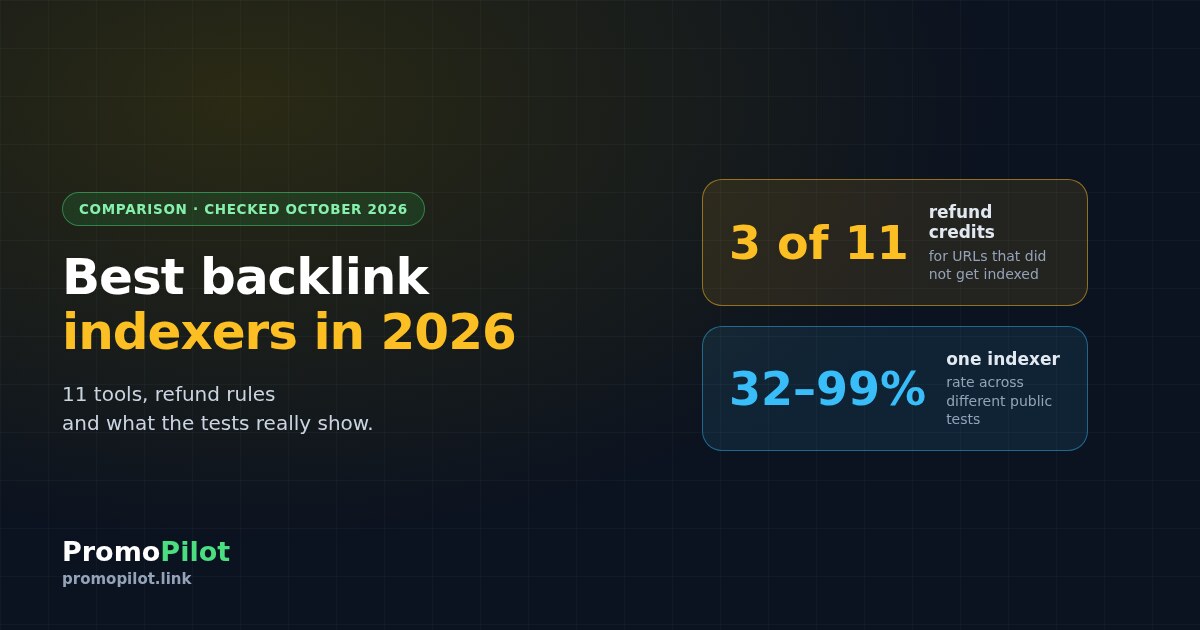
A backlink indexer cannot make Google index a page. What it can do is get Googlebot to visit the page sooner, and the good ones refund your credit when the page still does not make it into the index. We compared eleven indexers on their official pages in October 2026 — pricing, refund rules, claimed rates and APIs — and reviewed every public test we could find. The short version: the price per URL ranges from less than half a cent to almost a dollar, only three services automatically return credits for URLs that were not indexed, and the published "tests" contradict each other so badly that the same service scores 32%, 96% and 99% depending on who ran it. Below is what each tool actually offers and how to test one yourself before buying in bulk.
What an indexer can and cannot do
Google is clear that crawling and indexing are separate steps and that indexing is a quality decision. Its Search Console help says a page that was crawled but not indexed "may or may not be indexed in the future", and that there is no need to resubmit it. John Mueller has repeated for years that you can't force pages to be indexed. No indexer has a back door into that decision. For the usual causes of backlinks not indexed by Google, see our guide.
What indexers sell is discovery: signals that make Googlebot fetch a URL quickly — pings, links from pages that are crawled often, social and bookmark mentions, sometimes submissions through channels Google did not design for this purpose. Discovery matters for backlinks, because a new guest post or platform article can sit unvisited for weeks. But if Google visits the page and decides it is not worth indexing, no amount of resubmission changes that.
Free options come first
For backlinks on other people's sites none of these help directly. That is the gap paid indexers fill.
Eleven indexers compared
| Indexer | Entry price | Per URL (entry pack) | If a URL is not indexed | API |
|---|---|---|---|---|
| Rapid URL Indexer | $25 for 500 credits | $0.05 | Credit returned automatically after 14 days (Google only) | Yes |
| IndexMeNow | $59 for 60 credits | $0.98 | Credit returned automatically after 10 days | Yes, free |
| SpeedyIndex | $5 for 5,000 tokens | $0.10 per indexed link | Tokens returned after 7 days in pay-per-indexed mode | Yes |
| Omega Indexer | $19/month for 190 credits | $0.10 | Refund advertised; terms on the site conflict | Yes |
| IndexChex | $21.99 for 5,000 credits | $0.0044 standard, ~$0.26 instant | No refund | Yes |
| Indexceptional | $29 for 60 credits | $0.48 drip, $2.42 instant | No refund: you pay per URL sent | Announced |
| Rocket Indexer | $3 for 40 credits | $0.075 | No refund for non-indexed URLs | Yes |
| Ultra Indexer | $9 for 100 credits | $0.09 | No refund, "all sales final" | Yes, from Starter |
| IndexFlow | Free 50 credits/month, packs from $5 | $0.008 | 7-day money-back on the plan, not per URL | Yes |
| Links Indexer | Free plan, $9.99/month | Quota-based | Generally no refunds | Yes |
| Free Indexer | Free points, from $5/month | Quota-based | Not stated | Not stated |
Prices are from the official pages on October 11, 2026. Omega Indexer blocks automated access, so its terms come from its own pages as shown in search results; check them on the site before buying.
The refund model matters more than the price
Because no indexer can guarantee the result, the honest ones price the risk in. There are three models.
Credit back for non-indexed URLs
Rapid URL Indexer returns the credit if a URL is not indexed in Google within 14 days, IndexMeNow after 10 days, SpeedyIndex after 7 days in its pay-per-indexed mode. You effectively pay only for URLs that made it in. Note that these are credits, not cash, and add-ons such as Bing submission or priority modes are usually not refundable.
Pay per submission, no refunds
IndexChex, Indexceptional, Ultra Indexer, Rocket Indexer and Links Indexer charge for every URL you send, indexed or not. IndexChex says it plainly: crawling is guaranteed, indexing is not. The low per-URL price of some of them only makes sense if their real indexing rate on your links is high.
Subscription with a trial or money-back window
IndexFlow offers a monthly free allowance and a 7-day money-back guarantee on plans; Links Indexer and Free Indexer run on daily quotas. The guarantee covers the subscription, not individual URLs.
What the published tests really show
Search for "best backlink indexer" and you will find dozens of tests with precise percentages. We looked at how they were run.
| Test | Sample | What it found | How much to trust it |
|---|---|---|---|
| Search Logistics (updated March 2025) | 200 synthetic pages per method, control group | Indexing Expert 99.5%, Omega 88.5%, SpeedLinks VIP 72.5%, 11 methods and the control 0% | Best design found, but synthetic pages rather than real backlinks, and it does not cover several popular tools |
| IndexCheckr data via Search Engine Journal (February 2025) | 16M+ pages on customer sites | 29.37% of URLs submitted to indexing tools were indexed; 21.29% of indexed pages were later dropped | Large sample, but limited to one tool's customers |
| Charles Floate (July 2026) | 45 URLs in total | Indexceptional 99.4%, Rapid 99%, SpeedyIndex 89.9% | Low: a 99.4% rate is impossible with 45 URLs; no control group |
| "indexbench" (April 2026) | "1,000 URLs" across 8 tools in 5 cohorts | Rapid 96.4%, Indexceptional 91.2%, SpeedyIndex 52.3% | Low: the design does not add up and links to one vendor are promotional |
| Two Indie Hackers posts (2026) | 40–500 URLs per tool, inconsistent | Each crowns a different winner; one puts Rapid at 32% | Advertorials |
The conclusion is uncomfortable but useful: there is no independent, controlled, large-sample test of today's popular indexers. Results depend heavily on what you submit — a fresh guest post on a strong site and a 300-word profile page will behave very differently with the same tool. That is why the only number that matters is the one you measure on your own links.
Red flags
- "Indexed in 5 minutes" next to a crawl-only guarantee. A crawler visit is not indexing. Read the guarantee, not the animation.
- Use of the Google Indexing API for ordinary pages. At least one tool lists it among its methods. Google limits the API to job postings and livestream videos and warns that abuse can lead to revoked access.
- Submission to "statistical sites". Pushing URLs to thousands of whois and site-stat pages is an old discovery trick with little effect today.
- Identical package grids under different brands. Indexceptional and IndexMeNow use the same credit tiers and list prices. It may be a white-label product; check who you are paying.
- Self-ranking reviews. Most "best indexer" lists rank the author's own tool or partner first.
How to test an indexer in two weeks
Pick 100 real URLs
Use backlinks of the type you actually build — guest posts, platform articles, profiles — that are live, followable and not yet indexed. Our guide on how to check whether a link works shows how to confirm the first two.
Keep a control group
Submit 70 URLs and hold back 30. Without a control group you cannot tell what the tool did from what Google would have done anyway — and Google indexes a share of pages on its own.
Check on days 3, 7 and 14
Use the same method every time: a site: search for each URL or an index checker. Record indexed or not, with the date.
Compare to the control and recheck at day 30
The tool's real effect is its rate minus the control's rate. Recheck at 30 days: some pages drop out again, and a tool that only gets pages indexed briefly is worth less.
Why backlinks don't get indexed in the first place
An indexer treats the symptom. The usual causes are the page itself: thin or duplicated text, a host site Google crawls rarely, a page buried deep in an archive with no internal links, or a noindex tag. Supporting a tier 1 page with a few contextual links is often more durable than repeated pinging — that is the idea behind tier 2 backlinks. For your own site, our study of pages outside Google's index covers the main reasons.
In PromoPilot, tier 1 and tier 2 publications are submitted to an indexing service automatically, and every link in the report shows whether it is indexed. We do not guarantee indexing — nobody honestly can — but you see the status of each link instead of a single percentage.
Frequently asked questions
What is the best backlink indexer in 2026?
There is no independently proven winner. Among the services we checked, Rapid URL Indexer, IndexMeNow and SpeedyIndex automatically return credits for URLs that are not indexed, which makes them the safest to start with. Cheaper pay-per-submission tools such as IndexChex can make sense at volume, but only after you test them on your own links.
Do backlink indexers actually work?
They speed up discovery: Googlebot visits the page sooner. They cannot force indexing, which is Google's quality decision. Data from IndexCheckr customers showed 29.37% of URLs submitted to indexing tools were indexed, and published tests range from 0% to 99% depending on the tool and the pages submitted.
Can I use Google Search Console to index my backlinks?
No. The Request indexing button works only for sites you own or manage. Backlinks on third-party sites can only be discovered through links, sitemaps of those sites or third-party indexing services.
Is it safe to use a backlink indexer?
Indexers that send discovery signals do not harm your site directly, because they act on the backlink page, not on yours. Be careful with tools that use the Google Indexing API for ordinary pages, which is outside Google's terms, and with tools that blast URLs to thousands of low-quality pages.
How much does backlink indexing cost?
In October 2026 entry packs range from about $0.004 per URL (IndexChex standard mode) to $0.98 per URL (IndexMeNow). Services with automatic credit refunds for non-indexed URLs cost about $0.05–0.98 per URL; the cheapest options do not refund anything.
Does IndexNow work for Google?
No. IndexNow notifies Bing, Yandex, Naver, Seznam, Yep and Amazon. Google does not participate. It is still worth using for your own site, because Bing's index feeds ChatGPT's search and Microsoft Copilot.
Sources: official pricing, refund and FAQ pages of Rapid URL Indexer, IndexMeNow, SpeedyIndex, IndexChex, Indexceptional, Rocket Indexer, Ultra Indexer, IndexFlow, Links Indexer and Free Indexer; Omega Indexer terms from its own pages as shown in search results (all checked October 11, 2026). Google Search Central: Page indexing report help, Ask Google to recrawl, Indexing API quickstart (updated July 2026), sitemaps ping deprecation (June 2023); indexnow.org FAQ. Tests: Search Logistics backlink indexers test (updated March 2025), Search Engine Journal on IndexCheckr data (February 2025), Charles Floate (July 2026), indexbench (April 2026). This comparison is not sponsored.