Where to buy web 2.0 backlinks in 2026: five options compared and five checks every link must pass
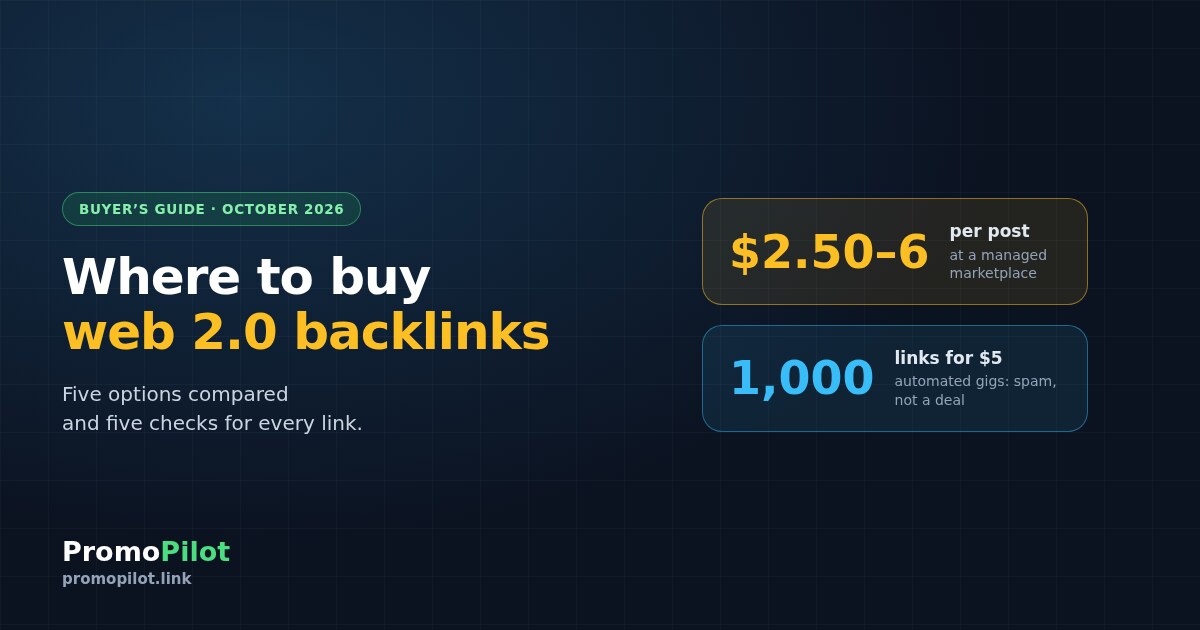
Web 2.0 backlinks still sell for a few dollars, and most never help rankings: Google has said links from free posting sites carry little value, many platforms add nofollow or noindex, and blogs created for links get deleted. They still work as support for tier 1 links if each one is live, followable and indexed. We compare five ways to get them in October 2026 — from free DIY to $2.50–6 managed posts and $5 gigs with 1,000 automated links — and the five checks every link must pass.
Web 2.0 backlinks are links from posts you publish on free blogging and content platforms — Blogger, WordPress.com, Tumblr, Medium-style sites, notes and mini-site builders. In 2026 they can still be bought for a few dollars, and that is exactly the problem: most of what is sold never helps rankings. Google's John Mueller has described links from free posting sites as having no SEO value, many platforms add nofollow or noindex, and platforms routinely delete blogs created for links. Web 2.0 still has a place — as support for tier 1 links, for crawl paths and for a brand footprint — but only if each link is live, followable and on a page that gets indexed. This guide compares the five ways to get web 2.0 links in October 2026, what they cost and the five checks every link must pass.
For a platform-by-platform view of Blogger, WordPress.com, Medium and others, see our article on whether web 2.0 still works for SEO. Here we focus on buying.
What web 2.0 links can and cannot do
Five ways to get web 2.0 links
| Option | Typical price | What you get | Main risk |
|---|---|---|---|
| Do it yourself | Free, plus 30–60 minutes per post | Full control over platform, text and links | Time; accounts created only for links get deleted |
| Gig marketplaces (Fiverr, Legiit) | $5–50 per package | Anything from 5 hand-made posts to 1,000 automated ones | Quality varies wildly; refunds often only as site credit |
| Managed marketplace (Vettted) | $30–50 for 5–20 posts | Posts by vetted sellers, Excel report with URLs and logins | Fees non-refundable; dofollow and permanence not stated |
| Bulk SEO shops (Rankers Paradise and similar) | $40–170 per package | Link pyramids, hundreds of foundation links plus mass tier 2 | Automated volume that search engines treat as spam |
| Cascade services (PromoPilot) | $2–3 per post as part of a cascade | Articles written for a target page, each checked and reported | Platform links remain weaker than editorial links |
The options in detail
Do it yourself
Create a blog on one or two reputable platforms, write a few genuinely useful posts on your topic, and link to your tier 1 pages or your own site where it makes sense. Keep the blog alive: platforms remove blogs that consist only of links, and a deleted blog takes every link with it.
Gig marketplaces: Fiverr and Legiit
Legiit lists over 700 backlink services starting at $6; web 2.0 gigs run from about $5 to $50, including offers of 1,000 automated web 2.0 links for $5 on obscure engines. Fiverr web 2.0 gigs mostly sit under $50 and promise hundreds of links. On Legiit, refunds for cancelled orders go to wallet credit, not your card; on Fiverr, cancelled orders go to your Fiverr balance by default and completed orders cannot be disputed in the Resolution Center.
Managed marketplace: Vettted
A US marketplace where strategists assign vetted sellers instead of letting you pick. Web 2.0 packages: $30 for 5 posts plus 50 blog comments, $40 for 10 plus 100, $50 for 20 plus 150 — about $2.50–6 per web 2.0 post. You get an Excel file with live URLs and account logins. Fees are non-refundable; dofollow status and permanence of the web 2.0 posts are not stated.
Bulk SEO shops
Shops such as Rankers Paradise sell web 2.0 "link pyramids" from about $40 and tiered packages with hundreds of foundation links supported by up to 200,000 tier 2 links for $120, in any niche and language. The volume itself is the warning: nobody writes 200,000 posts by hand, and Google's spam policies name links from automated programs as link spam.
Cascades: PromoPilot
Our own service, described by the same criteria. PromoPilot publishes articles on blogging and content platforms as part of a cascade around one target page: $3 per tier 1 and $2 per tier 2 publication at base prices, or $30 per page for the standard cascade. Every article is written for the page it supports, published on a different platform, checked in the rendered page after publication and listed in the report with its indexing status. Platform posts are still platform posts: they work best as support for stronger links and for pages that editorial budgets do not reach.
Five checks for every web 2.0 link
Is the link in the rendered page?
Some platforms render posts with JavaScript or turn pasted URLs into plain text. Open the page as a visitor would and confirm the link is there. Our guide on how to check whether a link works explains the method.
Is it followable?
Look at the rel attribute of the link itself, not of the navigation. Several popular notes and paste platforms add nofollow to every outbound link. A nofollow link can still bring visitors, but it does not pass ranking value.
Is the page indexable?
Check the meta robots tag and the X-Robots-Tag header. Some platforms mark user posts noindex, which makes the page invisible in search no matter how many links point to it.
Is it indexed after two to three weeks?
If not, the page either needs support links or is on a platform Google rarely indexes. Our comparison of backlink indexers covers the paid options and how to test them.
Is it still there after 30 days?
Platforms delete spammy posts and whole blogs, sometimes weeks later. Recheck every link a month after publication and keep a list for replacements.
Frequently asked questions
Are web 2.0 backlinks still worth it in 2026?
As direct links to your site they are weak; Google has said links from free posting sites carry little or no value. They still help as tier 2 support for guest posts and other tier 1 links, and as a brand presence, if each link is live, followable and on a page that gets indexed.
Where can I buy web 2.0 backlinks?
Options in October 2026 include gig marketplaces such as Fiverr and Legiit ($5 to $50 per package), the managed marketplace Vettted ($30 to $50 for 5 to 20 posts), bulk SEO shops with link pyramids, and cascade services such as PromoPilot ($2 to $3 per post). You can also create them yourself for free.
How much do web 2.0 backlinks cost?
From fractions of a cent for automated bulk gigs (1,000 links for $5) to about $2.50 to $6 per post at managed marketplaces. In PromoPilot a platform article costs $3 as tier 1 and $2 as tier 2 at base prices. Cheap bulk offers are automated spam.
Are web 2.0 links dofollow?
It depends on the platform and changes over time. Several popular notes and paste platforms add nofollow to all outbound links or mark posts noindex. Check the rel attribute of the link itself and the page's robots settings before you count a link.
Can web 2.0 backlinks hurt my site?
Mass automated web 2.0 links are link spam under Google's policies. Google mostly ignores them, but large volumes pointed straight at your site or at your tier 1 pages can attract spam signals. A few handwritten, relevant posts carry little risk.
Should web 2.0 links point to my money site or to tier 1?
Usually to tier 1: guest posts, niche edits and other links that point to your site. There they add crawl paths and help those pages get indexed. Point them straight at your site only from genuinely useful posts on a brand blog you maintain.
Sources: official pages and terms of Vettted, Legiit, Rankers Paradise and PromoPilot; Fiverr help center on refunds and cancellations (Fiverr gig prices from search listings); all checked October 11, 2026. Google Search Central spam policies (link spam, updated August 28, 2026). John Mueller on links from free posting sites, reported by Search Engine Journal (April 2020). This guide is not sponsored.