Google moves source links higher in AI Mode and AI Overviews: what changed on 15 October
On 15 October 2026 Google said inline source links in AI Mode and AI Overviews will appear higher and more often, and announced a test section for official websites, thumbnails on related-article links and wider news carousels. A day later it updated the Indexing API quota page. We checked every claim against Google's own pages: what is launching, what is a test, why your Search Console position will not change, and four free checks for your site.
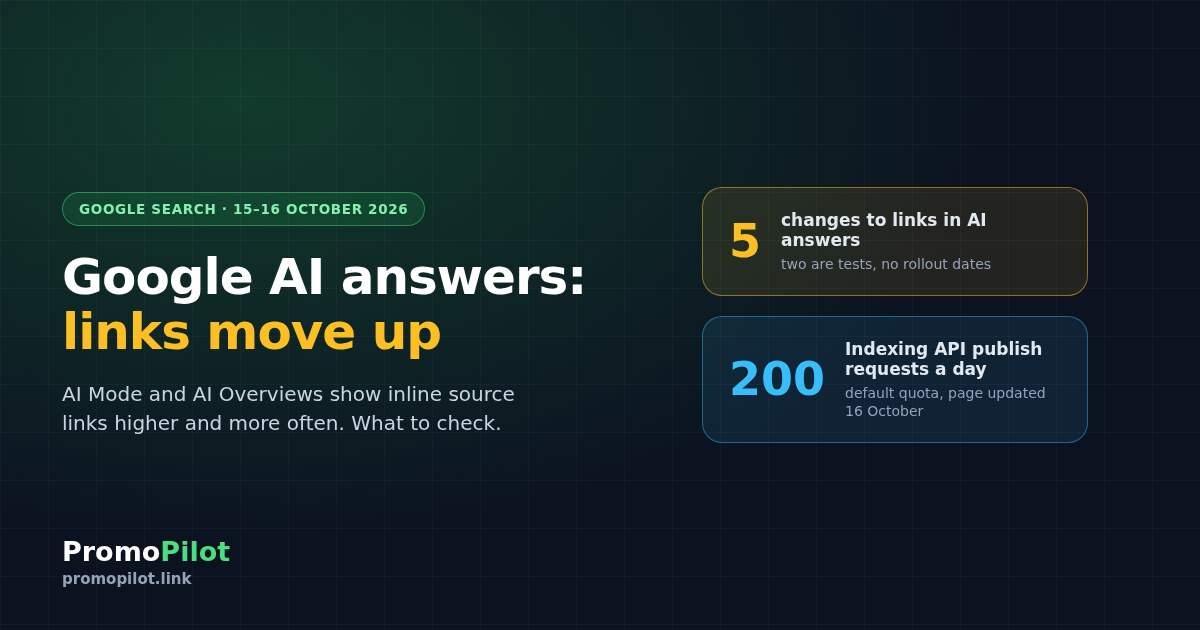
On 15 October 2026 Google announced that inline links to sources will appear higher up in AI Mode and AI Overviews answers, and more often. The same post adds a test section for official websites, image thumbnails on related-article links and wider news carousels. A day later, on 16 October, Google also refreshed the quota page of its Indexing API. Below: what exactly was announced, what is only a test, and what a site owner can check today without paying for anything.
What Google announced on 15 October
The announcement is a post on the Google Search blog, "More ways to connect with the web from Search", by Hema Budaraju, VP of Product Management. It lists five changes:
- Inline links. These are links embedded in words or phrases of the AI answer. Google reports "continued and substantial increases" in them and is launching updates to show them higher, more often.
- Official websites section (test). For queries where one or two official pages are the right answer, Google is testing a dedicated section at the top of the response, with a short note on why each link is useful.
- News carousels. Carousels of timely articles that highlight a user's Preferred Sources are starting to roll out to more locations and languages. Google says the number of people choosing Preferred Sources has grown more than 7x since the start of the year.
- Related-article links. Links at the end of some answers get image thumbnails and a more clickable design.
- Creator profiles (test). In AI Mode, Google has started testing clickable creator and publisher names on video results. They lead to the creator's Search profile.
What is confirmed and what is not
We checked the coverage against the original post:
- No rollout dates. The post does not promise "the coming weeks" or "October". Two of the five changes are explicitly tests, and the carousels are "starting to roll out".
- No numbers on the increase. Google did not say how many answers contain inline links or by how much their share grew. Search Engine Journal points this out as well.
- Thumbnails are not on every link. Only the related-article links at the end of some answers get images. Inline links inside the text stay text links.
- Your reported position will not change. According to the Search Console help page, an AI Overview occupies a single position and all its links get that same position. A link that moves higher inside the answer still reports the same position. Clicks on such a link do count as clicks.
Indexing API: the quota page was updated on 16 October
The Search Central changelog says the update documents the current quota limits and removes an outdated form. The quota page now lists the defaults per project:
The important part has not changed. Google's quickstart says the Indexing API can only be used for pages with JobPosting or BroadcastEvent embedded in a VideoObject, that is, job listings and livestreams. Google also warns that going over the quota, including through multiple accounts, may get your access revoked. For normal pages the tools are a sitemap, internal links and URL Inspection in Search Console. If pages stay out of the index, our article on pages Google does not index walks through the causes.
What this means for your site
Higher inline links only matter if your page is among the sources at all. Google's documentation on AI features and your website is short on this: the page must be indexed and eligible to show a snippet, and "there are no additional technical requirements". No special files and no special schema.org markup are needed. Nobody can promise a citation, but you can remove what rules it out.
Make sure nothing blocks the snippet
A noindex or nosnippet robots tag, a max-snippet:0 value or a Googlebot block in robots.txt take a page out of AI answers. Our free AI Visibility Checker reads your robots.txt for AI crawlers, checks the homepage robots tags for noindex and nosnippet, and looks for /llms.txt. Note that Google-Extended does not control Search: blocking it does not remove you from AI Overviews.
Check the generative AI setting in Search Console
Since this summer Search Console lets a site choose whether it appears in generative AI features. If the site is opted out, it gets no impressions or traffic from AI Overviews and AI Mode, and it cannot appear as a Preferred Source there. If readers already know you, Google offers a button and a deep link that ask them to add your site as a preferred source.
Give the answer a phrase worth linking
Inline links attach to specific words. A page that states a fact, a price, a requirement or a step plainly in one or two sentences is easier to cite than one that hides it in a long introduction. Structured data is not required for AI features, but if you use it, keep it valid: the Schema Markup Validator shows errors in JSON-LD, Microdata and RDFa.
Measure without fooling yourself
AI Overviews and AI Mode traffic is counted inside the regular "Web" search type in Search Console. The separate AI report shows impressions only, without queries; we covered it in our breakdown of the Generative AI report. A practical test: export your Performance data for two weeks before and after the change reaches your market and compare clicks and CTR on the same queries in the Search Console Export Analyzer. For AI search outside Google, the AI Visibility Checker asks up to three questions to an AI search engine with live web search and shows whether your site is cited. It is a proxy, not Google itself.
About llms.txt: Google says it needs no special files for AI features, so the file will not help with AI Overviews. Who does read it is covered in our llms.txt article; the llms.txt generator builds a draft from your sitemap if you decide you want one. For a fuller action plan, see how to get into AI answers and what the data says about AI Overviews and traffic.
FAQ
When will the new inline links appear in my country?
Google gave no dates or list of countries. The post says the inline link updates are launching, the official websites section and creator profiles are tests, and news carousels are starting to roll out to more locations and languages.
Do I need llms.txt or special markup to be cited in AI Overviews?
No. Google's documentation says there are no additional technical requirements and no special files or schema.org markup are needed.
Will a higher inline link improve my position in Search Console?
No. An AI Overview takes one position and all its links share it. A click on the link does count as a click.
Can I use the Indexing API to index blog posts faster?
No. Google documents it only for job postings and livestreams, that is, pages with JobPosting or BroadcastEvent in a VideoObject. For ordinary pages use a sitemap, internal links and URL Inspection.
Sources: Google Search blog, "More ways to connect with the web from Search" (15 October 2026); Google Search Central changelog and Indexing API quota and quickstart pages (checked 17 October 2026); Google documentation on AI features and on preferred sources; Search Console help on Performance report data; Search Engine Journal (15 October 2026).