Link Campaigns vs Control: 145 Pages Measured in 2026
Do links to a page change what Google shows for it? We compared 145 pages after a link campaign (a multi-tier set of links to one page, what we call a cascade) with 902 before/after pairs of pages that never had one. The short answer: impressions and clicks more often grow, while average…
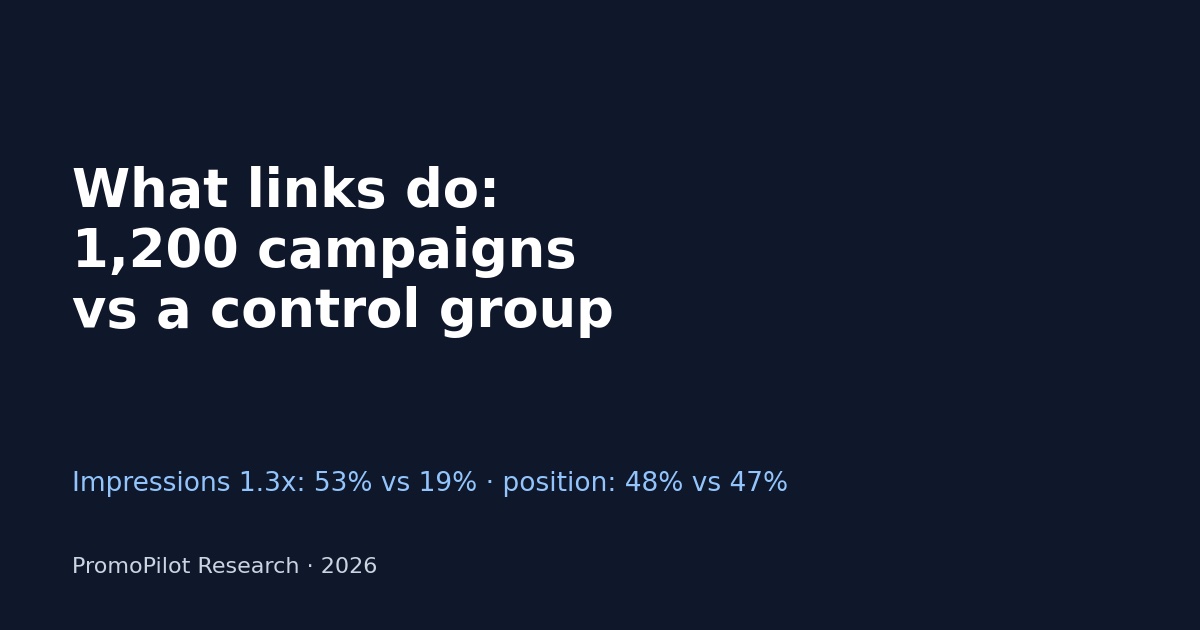
Do links to a page change what Google shows for it? We compared 145 pages after a link campaign (a multi-tier set of links to one page, what we call a cascade) with 902 before/after pairs of pages that never had one. The short answer: impressions and clicks more often grow, while average position over the background barely moves.
Data: link campaigns up to 5 November 2026, Google Search Console, updated 8 November 2026
Key numbers
- Impressions grew 1.3 times or more on 53% of pages with a campaign (of 145) against 19% in the control (902 pairs): +33 percentage points, 95% interval +16 to +49.
- Clicks grew 30% or more (at least +3) on 34% against 7%: +27 points, interval +12 to +38. A caveat: among pages with 3 or more clicks before the start the interval crosses zero (50% against 22%, interval -4 to +53).
- Position went up by at least 1 place on 48% of pages against 47% in the control: +3.8 points, interval -12.7 to +19.8. Over the background this is not significant.
- The effect starts from week 3. By day 60 a first position shift is seen on 73% against 59%, and a first click shift on 25% against 13% (56 campaign pages against 476 placebo pages).
- Pages with 0 impressions at the start show growth on only 6% (120 pages).
About the data
A link campaign is a set of links in several tiers that leads to one target page. We have 1,200 completed campaigns (1,169 pages on 487 domains) up to 5 November 2026. Google Search Console is connected for only some of our clients, so a clean before/after measurement is possible for 145 pages on 60 domains. The control is 902 before/after pairs for 333 pages of 34 projects that never ran a campaign, with the same windows: 28 days before the start against days 3 to 30 after it.
Impressions and clicks grow, position does not

| Outcome | With campaign | Control | Difference, pp | 95% interval, pp |
|---|---|---|---|---|
| Impressions x1.3 or more | 53% | 19% | +33.4 | +16.2 to +48.8 |
| Clicks +30% and at least +3 | 34% | 7% | +27.0 | +12.2 to +37.7 |
| Position up 1 or more | 48% | 47% | +3.8 | -12.7 to +19.8 |
| Position up 3 or more | 33% | 37% | +0.4 | -12.7 to +12.3 |
| Position down 1 or more | 31% | 33% | -3.1 | -15.7 to +9.7 |
The difference is standardized by starting position band, so it does not equal simple subtraction.
Why is position the weak metric? A page's average position is weighted by impressions and shifts whenever the set of queries changes. When a page starts to appear for new, more distant queries, the average goes down even as the page gains visibility. Impressions do not have this problem, which makes them the more honest measure here. The intervals for the position rows run from about -13 to +20 points, so we cannot tell a real effect from noise, and we do not claim one.
The click result needs care too. Among 66 campaign pages that already had 3 or more clicks before the start, 50% grew by 30% or more against 22% in the control (163 pairs), but the interval (-4 to +53 points) includes zero.
Regression to the mean
A page far from the first page often rises on its own, simply because a low position is partly bad luck of the measurement window. Table 2 shows it: on positions 21 to 50, 65% of pages with a campaign rose, and 66% of control pages. A move from 40th to 25th place happens without links too.
| Starting position | Outcome | With campaign | Control |
|---|---|---|---|
| 4-10 | Position up 1 or more | 39% (69 pages) | 32% (356 pairs) |
| 11-20 | Position up 1 or more | 55% (27 pages) | 49% (128 pairs) |
| 21-50 | Position up 1 or more | 65% (29 pages) | 66% (232 pairs) |
| 4-10 | Clicks +30% | 42% (69 pages) | 10% (356 pairs) |
The clearest gap is in clicks on positions 4 to 10: 42% against 10%. Slices with fewer than 30 pages are small, so read them as direction, not as a measurement.
When to expect a result

A first shift is any rise of the 7-day position by at least 1 place. It does not mean steady growth: over 30 days, position over the background does not differ from the control (Table 1). In the first two weeks a campaign does not differ from the placebo (pages without a campaign with arbitrary start dates): on day 14 a position shift is seen on 39% against 40%. The gap opens from week 3 (54% against 48% on day 21) and grows: 61% against 53% on day 30, and 73% against 59% on day 60. For clicks: 25% against 13% on day 60. Google's crawler first visited the target page a median of 22 days after the start (183 pages), which matches this timing.
Which pages respond

Starting visibility decides most. Pages with zero impressions at the start (120 pages) show any growth signal in only 6% of cases. For pages at positions 1 to 3 it is 38% (34 pages), at 4 to 10 it is 54% (101), at 11 to 20 it is 73% (34), and at 21 to 50 it is 64% (45). The lesson: first the page must be indexed and getting impressions.
What to do
- Pick pages that already get impressions and sit at positions 4 to 50.
- Measure impressions and clicks, not average position.
- Wait 30 to 60 days, and do not judge in the first two weeks.
- Compare with the site's own trend: pages without new links are your control.
- For pages with no impressions, start with indexing and content that matches demand.
- Do not read a rise from 40th to 25th place as proof: it happens without links as well.
In PromoPilot, link campaigns go to pages that already get impressions, and the report shows the result in impressions and clicks, not in ranking promises. Pick a page and see how a campaign works: PromoPilot services.
Methodology and limits
Source: completed PromoPilot link campaigns up to 5 November 2026 and daily Google Search Console metrics of connected projects (read-only, aggregates, no domains or URLs). Windows: 28 days before against days 3 to 30 after the start. The clean sample is pages with a position and at least 10 impressions both before and after, each page counted once (its first campaign): 145 pages on 60 domains. The control is matched, not randomized, and the differences are standardized by starting position band. Intervals are a cluster bootstrap by project, 1,000 repeats, 95%. Time to first shift: the first day when the 7-day position is at least 1 place above the base, or 7-day clicks exceed the base x1.3 + 2; 56 pages that started before 5 September against 476 placebo pages from 29 projects.
Limits. This is a correlation, not proof of cause. Client pages with campaigns are "livelier" than control pages (median impressions before: 79 against 32), so part of the difference in impressions and clicks may be self-selection. A page's average position is noisy when the query set changes. Small slices (under 30 pages) are not published separately. We will recalculate on 2 December 2026 and run a randomized pilot with a held-out control (8 weeks).
FAQ
What do links change for a page in Google?
Most often impressions and clicks grow: impressions rose 1.3 times or more on 53% of pages with a campaign against 19% in the control, clicks on 34% against 7%. Average position over the background barely moves: 48% against 47%, not significant. This is a correlation, so treat it as a signal, not a promise.
How long until I see a result from links?
Do not judge in the first two weeks: in that period pages with a campaign look the same as pages without one. The difference appears from week 3. By day 60, a first position shift is seen on 73% of 56 campaign pages against 59% of 476 placebo pages, and a first click shift on 25% against 13%.
Why do impressions grow while average position does not?
Average position is noisy. When a page starts appearing for new, more distant queries, its average position is pulled down even though it is gaining visibility. Impressions and clicks capture that gain more honestly, which is why we measure the effect with them.
Which pages do links not help?
Pages that have no visibility yet. Among 120 pages with zero impressions at the start, only 6% showed any growth signal afterwards. On pages already at positions 4 to 50 the share was 54% to 73%. First get the page indexed and matched to real demand, then add links.
How can I measure the effect of links honestly?
Compare against a control: similar pages on the same site or in the same period without new links. Look at impressions and clicks for the same time windows, wait 30 to 60 days, and remember regression to the mean: pages far from the first page often rise on their own (65% with a campaign against 66% without, at positions 21 to 50).
How to cite
PromoPilot (2026). Link Campaigns vs Control: 145 Pages Measured. Data up to 5 November 2026. CC BY 4.0: https://promopilot.link/uploads/blog/research/cascade-effect-1011/link-campaign-effect-2026-11-05.csv . Article: https://promopilot.link/en/blog/link-campaigns-vs-control-145-pages-measured
Download the data
The aggregate table (CSV, license CC BY 4.0): https://promopilot.link/uploads/blog/research/cascade-effect-1011/link-campaign-effect-2026-11-05.csv. It contains aggregates only, with no domains.