Online Stores Before Cyber Monday: 4,874 Sites Checked
Cyber Monday is on November 30. A day before it, we compared the technical state of 610 online stores with 4,264 other sites from the same crawl (November 15–16, 2026). The difference is in weight and speed. The median store homepage carries 332 KB of HTML, almost twice as much as other sites (172…
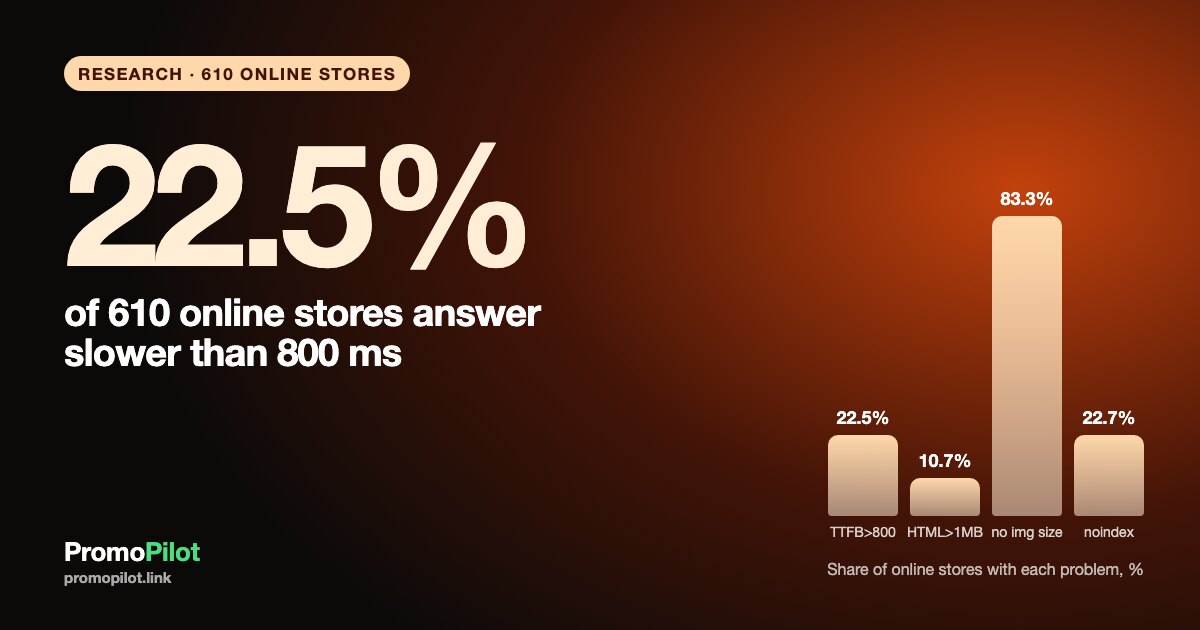
Cyber Monday is on November 30. A day before it, we compared the technical state of 610 online stores with 4,264 other sites from the same crawl (November 15–16, 2026). The difference is in weight and speed. The median store homepage carries 332 KB of HTML, almost twice as much as other sites (172 KB), and 22.5% of stores take longer than 800 ms to start answering, against 17.9% of other sites. 83.3% of store homepages have images without set dimensions, which makes the page jump while it loads. At the same time stores are ahead on basics: fewer of them send HTML without compression, work over HTTP/1.x only, or lack HSTS and Open Graph. Below are the numbers and a short list of what can still be checked today.
Data: PromoPilot crawl of 6,000 sites, November 15–16, 2026; 4,874 sites whose homepage returned 200 with HTML are in the calculation: 610 online stores and 4,264 other sites
Key numbers
- Weight: the median store homepage HTML is 332 KB, other sites 172 KB (1.9 times less). 10.7% of stores (65 of 610) have more than 1 MB of HTML on the homepage, other sites 5.1% (219 of 4,264). This is the HTML document alone, before images and scripts.
- Server response: the median TTFB of a store homepage is 483 ms, other sites 384 ms. Slower than 800 ms (the threshold Google recommends): 22.5% of stores (137) and 17.9% of other sites (763). On internal pages the median is 437 ms against 377 ms.
- Images: the median store homepage has 56 images, other sites 24. 83.3% of stores with images (502 of 603) have at least one without width and height, and in the median store that is 63% of the images on the page (other sites 52%). 73.6% have images without alt text.
- Noindex: 22.7% of stores (138 of 608 with checked internal pages) have an internal page set to noindex, other sites 16.4%. Part of it is intentional (cart, account, filters). Broken links are at the same level: 10.9% against 11.3%.
- Where stores are ahead: HTML without compression 1.0% against 4.8%, HTTP/1.x only 7.4% against 11.5%, no HSTS 37.4% against 48.5%, no Open Graph tags 12.1% against 21.9%, a CDN is detected on 46.4% against 40.1%.
- Certificates: on the crawl date, 4 stores (0.7%) had a TLS certificate expiring within 14 days, that is before Cyber Monday, and 26 (4.3%) within 30 days. 82.5% of store certificates are short, 90-day ones, so they depend on automatic renewal.
Who counts as an online store here
We counted a site as an online store if its homepage or checked internal pages carry schema.org markup of type Product, Offer, AggregateOffer or Store, or if the generator tag names a shop platform. That gave 610 sites of 4,874 (12.5%). Most of them (525) hide the generator tag, so we do not split them by platform. Stores without product markup end up among "other sites", so the comparison is cautious: the real gap may be slightly different.
Stores are heavier and slower to answer
The store homepage is a showcase: banners, product carousels, category menus, filters. All of this ends up in the HTML. The median store homepage document is 332 KB against 172 KB on other sites, and the share of pages over 1 MB is twice as high (10.7% against 5.1%). 62.5% of stores have more than 250 KB of HTML, other sites 36.6%.

The server also starts answering later. TTFB (time to first byte) is the time from the request to the first byte of the response: it includes the network, the server, the database and the page assembly. A heavy dynamic homepage with prices, stock and personal blocks takes longer to assemble. The median store answers in 483 ms, other sites in 384 ms; 22.5% of stores are slower than 800 ms. The tail is the same: over 1,800 ms at 3.8% of stores and 3.6% of other sites.

Our crawler measured each site once from one location, so this is not what a real buyer sees on a phone. Real-user data (Core Web Vitals) is in Search Console and in PageSpeed Insights. In our earlier study of 5,892 popular sites (CrUX data), a TTFB up to 800 ms went together with a good LCP (main content load time) much more often.
| Metric | Online stores (610) | Other sites (4,264) |
|---|---|---|
| Homepage HTML | 332 KB | 172 KB |
| Homepage TTFB | 483 ms | 384 ms |
| TTFB of internal pages | 437 ms | 377 ms |
| Images on the homepage | 56 | 24 |
| Share of images without width and height | 63% | 52% |
Images: more of them and without dimensions
A store homepage has more than twice as many images (median 56 against 24). 83.3% of stores have at least one image without width and height attributes, and in the median store this applies to 63% of images. Without dimensions the browser does not know how much space to reserve, and the page shifts while it loads: a button moves just as the buyer taps it. Google measures this as CLS (layout shift). The fix is simple: set width and height (or aspect-ratio in CSS) on product cards and banners, and lazy-load images below the first screen.
Alt text is missing on 73.6% of store homepages with images (other sites 69.7%). For a store this is not only accessibility: image search brings product traffic, and alt describes the product to it.

Noindex and broken links before a sale
22.7% of stores have at least one internal page set to noindex among the up to 10 pages linked from the homepage, against 16.4% of other sites. Stores have more pages that should be closed: cart, checkout, account, filter and sort combinations. But before a sale, it is worth checking that the noindex did not get onto a page that should sell: the sale category, a landing page created for Black Friday from a draft template, or a product card. Broken links from the homepage are at the same level as on other sites: 10.9% against 11.3%. During a sale, a link from a banner to a deleted product is the most expensive kind of 404.
Where stores already do better
Stores look after the basics more often. Only 1.0% send HTML without compression (other sites 4.8%), 7.4% work only over HTTP/1.x (11.5%), 37.4% have no HSTS header (48.5%), 12.1% have no Open Graph tags (21.9%). A CDN is detected on 46.4% of stores against 40.1%. That is the effect of hosting platforms and store builders: much of this is switched on by default.

Certificates are a separate point. On the crawl date 4 stores had a certificate expiring within 14 days, that is right before Cyber Monday, and 26 within 30 days. Two of the four had 90-day certificates that are usually renewed automatically about 30 days before expiry, so renewal may have failed. An expired certificate means a full-screen browser warning instead of the store. It takes a minute to check.
| Check | Online stores | Other sites |
|---|---|---|
| Homepage TTFB over 800 ms | 22.5% (137 of 610) | 17.9% (763 of 4,264) |
| Homepage HTML over 1 MB | 10.7% (65) | 5.1% (219) |
| Images without width and height | 83.3% (502 of 603) | 78.8% (3,064 of 3,891) |
| Images without alt | 73.6% (444 of 603) | 69.7% (2,712 of 3,891) |
| Internal page set to noindex | 22.7% (138 of 608) | 16.4% (647 of 3,937) |
| Link to a broken internal page | 10.9% (66 of 608) | 11.3% (444 of 3,937) |
| 2+ redirects before the homepage | 5.7% (35) | 5.6% (240) |
| No Cache-Control header | 24.4% (149) | 28.7% (1,224) |
| Certificate expires within 30 days | 4.3% (26) | 5.2% (222 of 4,244) |
What to check today, a day before Cyber Monday
A day before a sale is not the time for a redesign. These checks take minutes and do not need a release.
| Check | How | If you find it |
|---|---|---|
| Certificate expiry date | Run the domain through the SSL checker: it shows the issuer and the days left. | Less than 14 days on a 90-day certificate means auto-renewal is not working. Renew now and check the renewal job. |
| Server response and page weight | Check the homepage and the sale category in the page speed test; compare with an ordinary product page. | Turn on page caching for guests, remove extra blocks from the homepage, make sure the CDN caches the sale pages. |
| Sale pages are open for indexing | Run the sale category and landing pages through the status checker and look at the code and robots meta tag. | Remove noindex left from a draft template; keep it on cart, account and filters. |
| Banner and menu links | Check where the homepage banners lead with the redirect checker. | Replace links to deleted or redirected products with the final address. |
| Images | Run the homepage through the image SEO check: size, format, alt, dimensions. | Set width and height on banners and product cards, compress the heaviest images, add alt to product photos. |
| Preview in messengers and social networks | Check the sale page in the Open Graph debugger. | Add og:title, og:image and og:description, so the shared link shows the offer, not a random picture. |
These checks do not by themselves move a store up in search results. They remove things that cost sales during the busiest days: a warning instead of the site, a slow first screen, a page that jumps, a banner that leads nowhere.
Methodology and limitations
Data comes from the PromoPilot website crawl (TRI) of 6,000 sites from our search-results cache, collected November 15–16, 2026. We kept sites with a successful crawl whose homepage returned 200 with HTML: 4,874. An online store is a site with schema.org Product, Offer, AggregateOffer or Store markup on the homepage or on the checked internal pages, or with a shop platform in the generator tag: 610 sites. TTFB and the HTML size are one measurement of the homepage by our crawler; internal pages are up to 10 pages linked from the homepage (608 stores and 3,937 other sites have them). Image counts are the img tags in the homepage HTML. Certificate expiry is counted from the crawl date.
Limitations: the sample is not random and cannot be transferred to the whole web; the store definition depends on markup, so stores without it are in the other group; one measurement from one location is not real-user speed; we checked the homepage and about 10 pages, not the full site; we did not measure any effect on rankings, traffic or sales. The data contains no client projects and no domains. The aggregates are published as CSV under CC BY 4.0.
FAQ
What is TTFB and what value is good?
TTFB (time to first byte) is the time from the request to the first byte of the server response. It includes the network, the server and the time to build the page. Google's guidance is to aim for 800 ms or less. In our crawl the median online store homepage answered in 483 ms, and 22.5% of stores were slower than 800 ms. Check it on your own pages, because one measurement depends on the location and the moment.
Why are online store homepages heavier?
A store homepage collects banners, product carousels, category menus, filters and prices in one document. In our crawl the median store homepage HTML was 332 KB against 172 KB on other sites, and 10.7% of stores had more than 1 MB. That is the HTML alone; images and scripts load in addition to it.
Why set width and height on images?
Without dimensions the browser does not know how much space to reserve, so content shifts as images load. Google measures this as Cumulative Layout Shift (CLS). In our crawl 83.3% of store homepages had at least one image without width and height. Setting the attributes, or aspect-ratio in CSS, fixes it without changing the design.
Should a store close the cart and filters with noindex?
Usually yes: cart, checkout, account and filter or sort combinations are normally kept out of the index. 22.7% of stores in our crawl had a noindex internal page among the pages linked from the homepage. Before a sale, check that noindex is not on the sale category, a landing page or a product card.
How do I check when my SSL certificate expires?
Run the domain through an SSL checker or open the certificate details in the browser. Most store certificates in our crawl (82.5%) are 90-day ones that renew automatically about 30 days before expiry. If fewer than 14 days are left, automatic renewal has probably failed and the certificate should be renewed by hand.
Will these fixes improve my store's rankings?
We do not promise that. Speed and page experience are only part of how Google ranks pages, and we did not measure any effect on rankings, traffic or sales. The checks in this article remove obstacles for buyers during the busiest days: an expired certificate, a slow first screen, a shifting page, a banner that leads to a deleted product.
Sources
- web.dev, Optimize Time to First Byte: web.dev
- web.dev, Cumulative Layout Shift (CLS): web.dev
- Google Search Central, Understanding Core Web Vitals and Google search results: developers.google.com
- Google Search Central, Product structured data: developers.google.com
- Google Search Central, Google Images SEO guide: developers.google.com
- Let's Encrypt, Integration guide (renewal): letsencrypt.org
How to cite
PromoPilot (2026). Online stores vs other sites before Cyber Monday: speed, weight, images and indexing on 4,874 sites. Data November 15–16, 2026. CC BY 4.0: https://promopilot.link/uploads/blog/research/cyber-monday-stores-2911/stores-vs-other-sites-tech-checks-2026-11.csv . Article: https://promopilot.link/en/blog/online-stores-cyber-monday-speed-4874-sites-2026
Download the data
The aggregate tables (CSV, license CC BY 4.0). They contain aggregates only, no projects, domains or client data.
- Technical checks, online stores and other sites (share of sites): https://promopilot.link/uploads/blog/research/cyber-monday-stores-2911/stores-vs-other-sites-tech-checks-2026-11.csv
- Medians: TTFB, HTML size, images, certificate days left: https://promopilot.link/uploads/blog/research/cyber-monday-stores-2911/stores-vs-other-sites-medians-2026-11.csv
- Distribution of sites by TTFB, HTML size and certificate days left: https://promopilot.link/uploads/blog/research/cyber-monday-stores-2911/stores-vs-other-sites-ttfb-weight-buckets-2026-11.csv