Web 2.0 and Cascade Promotion: How Multi-Tier Link Building Works
What Web 2.0 is, how the 5→50→5000 cascade model works, where links get published and why it is safer than bulk buying. A breakdown of the method + hard niches: gambling, nutra, crypto.
Links are still one of Google's top three ranking factors — confirmed both by search representatives and by correlation studies from Ahrefs, Semrush and Moz. What has changed over the years is not the value of links, but the requirements for how they appear. Google has learned to recognise and devalue bulk buying, PBN networks and obvious link exchanges. Naturalness has moved to the forefront. And two things play the key role here: Web 2.0 platforms and the cascade (multi-tier) model of link building.
In this guide we break down, without fluff, what Web 2.0 is and why it still works, how the 5→50→5000 cascade model is built, where exactly links are published, why this approach is safer than "flat" link building, and how it copes even in difficult niches — gambling, nutra, crypto. This is not an ad but a breakdown of the method; using our PromoPilot service as an example, we'll show how it looks in practice.
What Web 2.0 is and why it still works
Web 2.0 refers to platforms where content is created by the users themselves: blog hosts, article platforms, site builders, social bookmarks, profile and wiki-like services. They share three properties that matter for SEO:
- Trust and indexation. Large Web 2.0 platforms have a high Domain Rating and have long been in Google's index. A page created on such a platform inherits part of the donor domain's trust.
- The ability to place your own content with a link. You publish a useful article or note with an organically woven link — it looks like a normal publication, not a purchased backlink.
- A natural profile. Links from diverse Web 2.0 platforms form a varied, "human" link profile that algorithms question less.
Why "flat" link building no longer works
Flat link building is when all links point directly to the promoted site and sit on a single level. This approach has systemic problems Google tracks:
- A sharp spike in link volume. A hundred links in a week to a young site is a clear artificial signal and a reason for an algorithmic filter.
- Monotonous anchors. If 80% of links share the same commercial anchor, that's over-optimisation, followed by a downgrade.
- No support. A link on a weak or non-indexed page passes almost no weight: if the donor page itself is not reinforced, its authority is minimal.
- Uniform sources. Links from a single type of source (e.g. only directories) look like a network.
The cascade model solves all four at once — through gradualness, diversity and multi-tier weight transfer.
The 5→50→5000 cascade model: how it's built
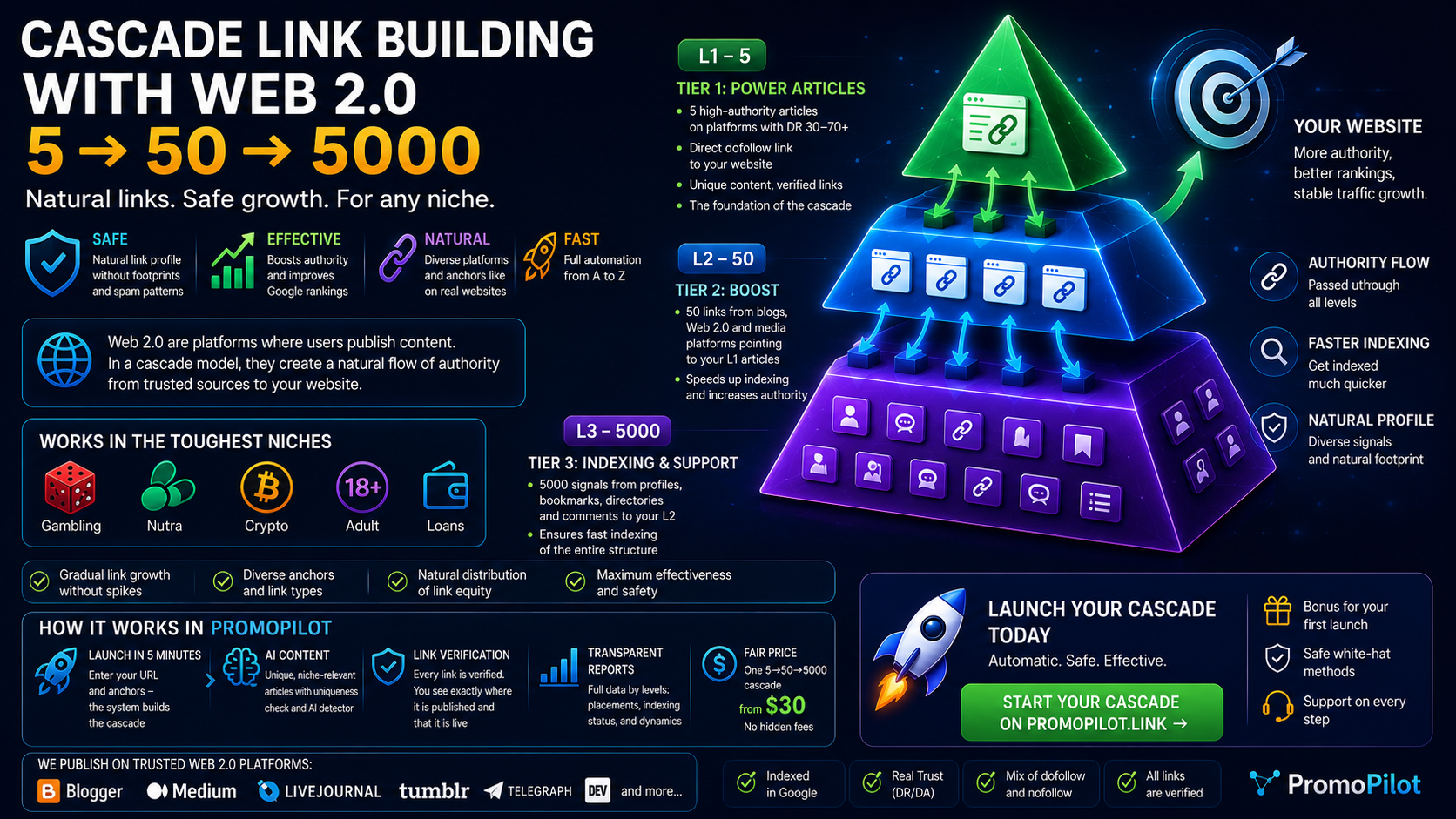
A cascade is a three-tier link pyramid where each next tier reinforces the previous one. The rough formula 5 → 50 → 5000 reflects the ratio: a few strong anchor publications, dozens of reinforcing links and thousands of supporting indexation signals.
Tier 1 (L1): anchor articles
The foundation of the cascade — publications on trusted platforms with a Domain Rating of roughly 30 to 70+. This is where the direct link to your site sits. Each anchor article:
- is unique and written for your site's topic (in PromoPilot — with AI, plus a uniqueness and AI-detector check);
- contains an organically woven link with a relevant anchor — not "buy here", but a natural mention in context;
- is published on a platform that is already indexed and trusted;
- passes verification: the system confirms the link is actually placed and reachable.
Tier 2 (L2): reinforcement
A link from a trusted platform is good. But its weight grows many times over when the L1 article itself has links pointing to it. Tier two is publications on blogs and Web 2.0 resources that point to your L1 articles. What that gives:
- speeds up indexation of the L1 articles;
- raises the authority of the donor page — so more "link weight" reaches your site;
- creates the picture of natural content spread, as if the article is genuinely being cited.
Tier 3 (L3): indexation and support
The third tier is profiles, social bookmarks, comments and directories that link to L2 resources. Their job is not to pass weight but to ensure fast indexation of the whole chain and add background signals. L3 is what "brings the cascade to life": without indexation no tier works.
Where exactly links are published
One of the most common questions: "So where exactly do you put the links?" We don't reveal the full list of platforms and the selection algorithm — that's part of the know-how. But the principles can be explained honestly.
Publications are distributed across platform types depending on the cascade tier:
| Tier | Platform type | Role |
|---|---|---|
| L1 | Trusted article and blog platforms, quality Web 2.0 | Direct link + trust transfer |
| L2 | Blogs, site builders, microblogs, media platforms | Reinforcing L1, speeding up indexation |
| L3 | Profiles, social bookmarks, directories, comments | Indexation and background signals |
Platforms are selected by several criteria: real trust (DR/DA), presence in Google's index, the "liveness" of the resource (is it updated), link type (dofollow/nofollow) and topical fit. Only vetted platforms are used, and every placed link is verified automatically — you get confirmation it's actually there.
Why a cascade is safer and more effective
- Gradualness. Link volume grows in stages, not as a "wall" — without sharp spikes that trigger filters.
- Anchor diversity. Anchors vary naturally within the ones the client sets, without spamming a single commercial keyword.
- A balance of link types. A mix of dofollow and nofollow, different formats (article, mention, profile) — like a real site.
- Topicality. Content is written for the niche, not filler with a glued-in link.
- Weight transfer across tiers. Even relatively weak platforms reinforce each other in a chain, and the final weight to your site is higher than with flat placement.
Cascades in difficult niches: gambling, nutra, crypto
A separate matter is "grey" and highly competitive niches: gambling (casinos, betting), nutra (supplements, physical products), crypto, adult, loans. Classic link building stalls here:
- link exchanges and webmasters often refuse to place such topics;
- PBN networks in these niches get burned by moderation and algorithms the fastest;
- direct buys leave obvious traces, and platforms ban the accounts.
The cascade model has performed especially well in these niches — here's why:
- Live platforms accept the content. A publication looks like an ordinary article or note, not an ad.
- Naturalness instead of a network. The multi-tier structure leaves no obvious PBN "fingerprint" that gets caught so easily in the grey segment.
- AI content for the niche. Texts are written for the specific niche and language, lowering moderation risk.
- Controlled speed. In aggressive niches gradualness matters most — and a cascade delivers exactly that.
How it works in PromoPilot
We automated the whole chain so launching a cascade takes minutes, not weeks of manual work:
- Launch in 5 minutes. Enter the URL and anchors — the platform builds the pyramid itself.
- AI content. Unique articles for your topic, with a uniqueness and AI-detector check.
- Verification of every publication. You see where each link is placed and that it's reachable.
- Transparent reports. Per cascade tier — what was published, indexation status, dynamics.
- Fair pricing. One 5→50→5000 cascade from $30, no retainers or hidden fees. New clients get a bonus for the first launch.
🚀 Launch a cascade for your site
Frequently asked questions about cascades
What is cascade promotion in simple terms?
It's multi-tier link building: first articles with a direct link to your site (L1), then links to those articles (L2), then indexation signals to them (L3). Each tier reinforces the previous one, and the search engine sees natural growth rather than a one-off purchase.
Where are the links published?
On live, indexed Web 2.0 platforms of various types — article and blog platforms, site builders, microblogs, directories and profile resources. Platforms are selected by trust, indexation and topicality; every link is verified.
Is it safe for my site?
Yes, with gradualness and diversity — which is exactly what a cascade provides. Unlike bulk buys and PBNs, the multi-tier model mimics a natural link profile and leaves no obvious network trace.
How soon are results visible?
Links need to be indexed and "settle" — usually the first changes show within a few weeks, and a stable effect accumulates over 1–3 months. Anyone promising top rankings in a couple of days is misleading you.
Do cascades work in gambling, nutra and crypto?
Yes. In difficult niches the cascade advantage is especially clear: live platforms accept the content, and the natural multi-tier structure isn't flagged by moderation the way PBNs and direct buys are.
How are your anchors different from bulk links?
We use only the anchors the client sets and weave them organically into topical content — without spamming a single commercial keyword. A diverse, natural anchor list is part of the safety.