AI Mode vs AI Overviews 2026: Searches Up ~7x, What Helps
Searches for "AI Mode" on Google grew about 7x in 11 months (from 1.83 million in Sep 2025 to 13.6 million in Aug 2026), while searches for "SEO" fell by a fifth (Oct 2025–Aug 2026 vs Oct 2024–Aug 2025, year over year). Caveat: Google Ads rounds search volumes, and "ai mode" is ambiguous (it is…
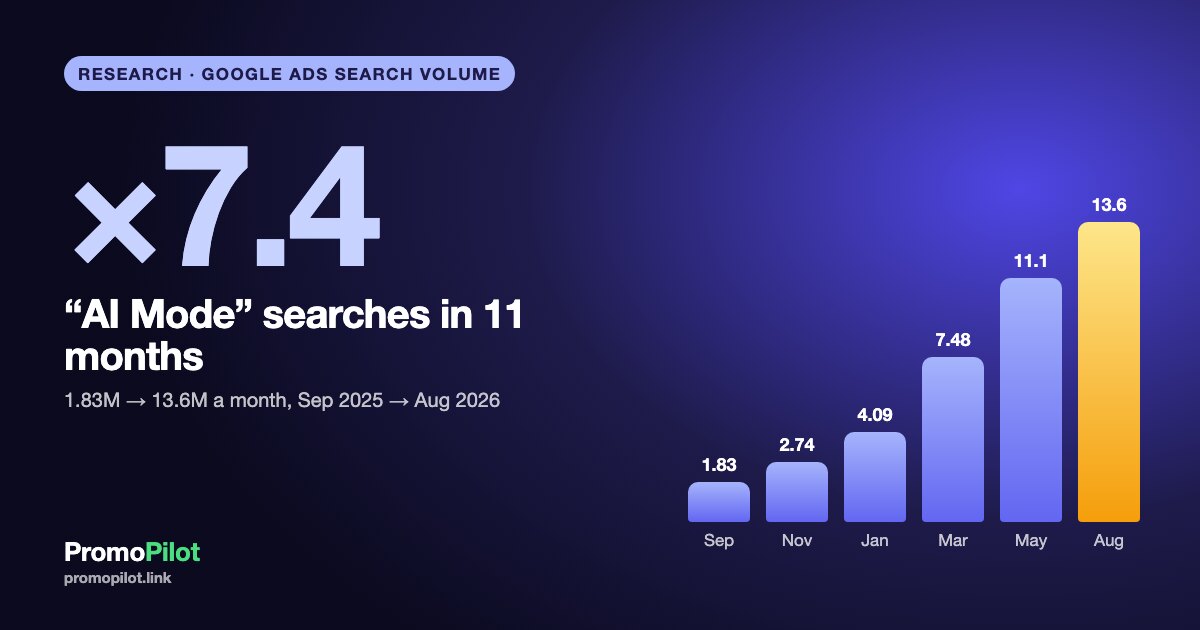
Searches for "AI Mode" on Google grew about 7x in 11 months (from 1.83 million in Sep 2025 to 13.6 million in Aug 2026), while searches for "SEO" fell by a fifth (Oct 2025–Aug 2026 vs Oct 2024–Aug 2025, year over year). Caveat: Google Ads rounds search volumes, and "ai mode" is ambiguous (it is also a camera or phone mode), so the direction is reliable and the exact figures are not. This guide explains the difference between AI Overviews and AI Mode, shows what people type into Google about them, and lists what Google's own documentation says can improve the chance that your pages are shown as links in these answers. Nothing here promises inclusion, and we say below what our data can and cannot show.
Data: PromoPilot keyword base, Google Ads monthly search volume, October 2024 – August 2026 (23 months), snapshot November 16, 2026
Key numbers
- "ai mode": 1.83 million searches a month in Sep 2025, 13.6 million in Aug 2026, ×7.4 in 11 months, growing month after month (Sep 2025 to Aug 2026, not year over year because the product is new). Google Ads monthly volume, worldwide. The July 2025 spike (16.6 million) is left out of the trend as a one-off.
- "ai overviews": ×2.39 (2.86 million searches over 11 months against 1.20 million a year earlier), "google ai search" ×1.73, "ai search" ×1.47. Year over year: sum of 11 months Oct 2025–Aug 2026 vs Oct 2024–Aug 2025, worldwide.
- "seo" fell by 21% worldwide (×0.79) and by 33% in the US (×0.67). "ai seo" stayed flat (×1.02). "generative engine optimization" in the US is ×1.50 over 11 months, but 45% below its August 2025 peak (6,600 to 3,600). Same sums and period (Oct 2025–Aug 2026 vs Oct 2024–Aug 2025).
- "google search console" grew ×1.24 worldwide, ×1.20 in Poland and ×1.08 in Ukraine: people look at data about their own site in Google more often, not less. Same sums and period (Oct 2025–Aug 2026 vs Oct 2024–Aug 2025).
- Our own check, 248 SEO and marketing queries, Google US, 16 Nov 2026, 07:27 and 10:03 Kyiv time: an AI Overview appeared for 68.8% of them, for 86.8% of tool queries and only 34.4% of agency, service and price queries. 59.7% of AI Overview links went to sites from the first 10 results.
AI Overviews and AI Mode: what is the difference
Google describes the two features separately in its documentation for site owners. AI Overviews gives a summary of a complex topic or question and links to pages for further reading. Google says it appears only when its systems determine that it is additive to classic Search, so for many queries it does not show at all. AI Mode is meant for queries that need deeper exploration, reasoning or comparison, and returns an AI-generated response with links to supporting websites.
They share one mechanism. Both may issue several related searches across subtopics and data sources (Google calls this query fan-out) to build a response, which lets them surface a wider and more varied set of links than a classic results page. They are also connected: Google said in May 2026 that a user can ask a follow-up from an AI Overview and move into a back-and-forth conversation in AI Mode, with the context carried over.
| Feature | AI Overviews | AI Mode |
|---|---|---|
| Where it lives | On the regular results page, above or among the results | A separate AI-generated response experience built into Search |
| When it appears | Only when Google's systems decide it adds value to classic Search | When the user asks in this mode, including by continuing from an AI Overview |
| Typical query | A complex topic or question that benefits from a summary | Queries needing deeper exploration, reasoning or comparison, with follow-ups |
| Query fan-out | Yes, several related searches | Yes, several related searches |
| Links to websites | Yes, for further reading | Yes, to supporting websites |
| Default model | Not stated in the Google posts we used | Gemini 3.5 Flash, default for everyone globally since May 2026 |
| Reach | 200+ countries and territories and all languages where it is available (Google Ads Help) | Over 200 countries and territories (Google, October 2025); Google reported over one billion monthly users in May 2026 |
| Ads | Standard ads above or below it in all those places; ads within it in a smaller list of English-language markets | Ads within and alongside responses, including follow-ups, in a smaller list of English-language markets |
| Search Console | Included in overall Performance data (Web search type) and in the Generative AI impressions view | Same as AI Overviews |
On ads, Google Ads Help currently lists the United States, Australia, Canada, India, Kenya, Malaysia, New Zealand, Nigeria, the Philippines and Singapore for ads within both features (Indonesia for AI Overviews only, Pakistan for text ads only), in English. Google also says the list is not exhaustive and is growing, so check the current page before planning anything around it.
How links are shown now
Google changed how links appear twice this year. On May 6, 2026 it announced five changes: an "explore new angles" section at the end of responses, subscription labels on links from a user's news subscriptions, previews of first-hand perspectives from forums and social media with the creator or community name, more inline links next to the relevant text, and hover previews with site name and page title on desktop. On October 15, 2026 it announced five more: inline links shown higher in responses more often, a test of a dedicated section with key official links at the top, timely article carousels in more locations and languages, related-article links with image thumbnails at the end of some responses, and a test of clickable creator and publisher names on video results in AI Mode. Google says these roll out gradually and some are tests, so you may not see all of them. It has not published click data for them in the posts we read.
What people actually search for
We checked Google Ads monthly search volume for 11 phrases around these features, from October 2024 to August 2026. Two points stand out. People search for the product itself, not for how to optimize for it. And the word "seo" is searched less, while tools that show data about your own site are searched more.

Before spring 2025 the phrase had a few thousand searches a month, because the product did not exist for most people yet. After that the line climbs without a single monthly dip from September 2025 to August 2026. The timing matches Google's rollout of AI Mode across countries, but this is a coincidence of dates we observed, not a measured cause. Next to it, "ai overviews" reached 368,000 searches a month in August 2026, so "ai mode" is searched roughly 37 times more. Treat that ratio with care: "ai mode" is also the name of modes in cameras, phones and laptops, so the absolute figure is overstated. Our reading, which we did not test, is that people open AI Overviews without searching for the name, while AI Mode is something they look for by name.

| Query | Market | Change, Oct 2025–Aug 2026 vs Oct 2024–Aug 2025 (year over year) | Searches in August 2026 |
|---|---|---|---|
| ai mode | World | ×7.4 (Sep 2025 to Aug 2026, not year over year) | 13,600,000 |
| ai overviews | World | ×2.39 | 368,000 |
| google ai search | World | ×1.73 | 40,500 |
| ai search | World | ×1.47 | 74,000 |
| generative engine optimization | US | ×1.50 (−45% from the August 2025 peak) | 3,600 |
| ai seo | World | ×1.02 | 22,200 |
| google search console | World | ×1.24 | 4,090,000 |
| google search console | Poland | ×1.20 | 90,500 |
| google search console | Ukraine | ×1.08 | 27,100 |
| seo | World | ×0.79 | 450,000 |
| seo | US | ×0.67 | 60,500 |

What the numbers say: interest in the new search experience keeps growing, interest in the generic word "seo" is shrinking, and the phrase "ai seo" did not take off (×1.02). The term "generative engine optimization" had a short rise in the US and then lost almost half of its peak. What they do not say: whether SEO works worse, or whether AI answers caused the fall of "seo". We did not test a cause. People may also have moved to more specific phrases, which these 11 queries do not cover.
The growth of "google search console" is the part we find most useful for site owners. Searches rose in the world, in Poland and in Ukraine. It fits with Google adding AI reporting to that tool in 2026, though we cannot show that one led to the other. If you want to look at demand for your own topic the same way, our free keyword research tool shows the monthly volume trend for a query. Earlier we looked at how demand changed across 75,960 keywords: half of them lost 20% or more in a year.
How often AI Overviews appear for SEO and marketing queries (our sample of 248 US queries)
To add our own measurement to the demand data, we checked Google results for 248 English queries about SEO, marketing and websites (picked at random from our keyword base, US, desktop). Each query was captured twice, 2.5 hours apart (16 Nov 2026, 07:27 and 10:03 Kyiv time). This is a snapshot on that date, not a trend, and it covers the US only.
- An AI Overview appeared for 68.8% of queries (average of the two captures: 70.2% / 67.3%; for 89.9% of queries the answer was the same both times).
- Queries about tools ("checker", "tool", "free", "generator") got an AI Overview in 86.8% of cases (57 queries), other informational queries in 69.2% (159), and queries about agencies, services and prices in only 34.4% (32).
- AI Overviews linked to a median of 5 sites; across the sample we counted 363 different domains. YouTube was cited in 49.9% of AI Overviews, Reddit in 27.9%, Semrush in 21.4%.
- 59.7% of links in AI Overviews went to sites from the first 10 organic results for the same query, the other 40.3% to sites outside the first 10. 91.5% of AI Overviews linked to at least one site from the first 10.

| Query type | Queries | With AI Overview |
|---|---|---|
| Tools (checker, tool, free, generator) | 57 | 86.8% |
| Other informational | 159 | 69.2% |
| Agencies, services, prices | 32 | 34.4% |
| All | 248 | 68.8% |

What it means in practice: for informational and "tool" queries the AI Overview is the norm, not the exception, so the first screen is shared with it. Ranking in the first 10 still matters (most citations come from there), but roughly four links in ten go to sites outside the first 10, often videos and forum threads. This is a correlation in one sample, not proof of how Google picks sources.
How to improve the chance of being cited or shown as a link in AI answers
This list comes from Google's documentation ("AI features and your website" and "Optimizing your website for generative AI features on Google Search"). Google's main message is that these features are rooted in its core Search ranking and quality systems, so ordinary good practice for Search is the base. Nothing here promises that a page will be shown or cited: Google itself says that meeting the requirements does not ensure crawling, indexing or serving.
- Be indexed and snippet-eligible. This is the only requirement Google states: the page must be indexed and eligible to appear in Search with a snippet. There are no additional technical requirements. Check it with the URL Inspection tool in Search Console.
- Do not block what you want shown. Googlebot rules in robots.txt control crawling for Search, including these features. The directives nosnippet, data-nosnippet, max-snippet and noindex limit what is shown. If you use them on a section, do not expect that section to be quoted.
- Check the Search Console setting. Google announced a control to choose whether your site appears in and helps ground AI Overviews and AI Mode, and says sites that opt out get no traffic or impressions from them. Make sure that nobody on your team switched it off by mistake.
- Offer something that is not already everywhere. Google asks for a unique point of view, such as first-hand experience, instead of restating what is already available, and says its test is whether visitors would find the content satisfying. Own data, tables with dates, and named methods are ways to do that. This is our reading of the guidance, not a Google rule.
- Keep the page easy to read. Use paragraphs, sections and clear headings, and semantic HTML where practical. Google says there is no ideal page length and no need to split text into small pieces for AI. A direct answer near the top is plain good writing for readers; do not do it only for machines.
- Keep pages crawlable and not duplicated. Follow JavaScript SEO practice if your site depends on it, and reduce duplicate content.
- Use structured data honestly, if you use it. It is not required for these features, and there is no special schema.org markup for them. If you use it for other reasons, keep it consistent with the text people see.
- Support the text. Relevant images and video help. Products and local businesses can use Merchant Center and Google Business Profile.
- Page experience. The page should display well on all devices, load without needless delay, and let people tell the main content from the rest.
What Google says not to do
Do not create llms.txt files, AI text files or special markup for Search: Google says it does not use them. Do not rewrite content only for AI systems, and do not seek inauthentic mentions across the web. Do not publish large numbers of pages aimed at query variations or fan-out queries to manipulate rankings, because that can violate the scaled content abuse policy. Be wary of tools that promise results or claim access to internal Google metrics.
How to measure
Google says traffic from AI Overviews and AI Mode is included in the Performance report under the Web search type. Since June 2026 Search Console also has a Generative AI performance view with impressions by page, country, device and date; Google's announcement names impressions only, not clicks. That announcement says the data is also included in the overall Performance report. Verify the view in your own property, because Google described a staged rollout and says more metrics will follow.
What is new compared with our earlier studies
We have written about Google’s AI answers five times before, so here is what it adds rather than repeats. First, it looks at demand: how many people search for AI Mode and AI Overviews themselves, not at traffic or clicks. Second, it is our largest results sample so far: 248 queries captured twice, against 37 results pages in October and 36 queries in 9 countries in November. Third, for the first time we count which domains the overviews link to and how many of them are in the first 10 results. The AI Overview share differs from our earlier checks (73% in October, 91% in November) because the samples differ: here the queries are random SEO and marketing searches, including commercial ones, where Google shows an overview less often.
Our earlier pieces on AI Overviews and AI Mode:
- AI Overviews and traffic in 2026: what 14 months of data show
- Google moves source links higher in AI Mode and AI Overviews: what changed on 15 October
- AI Overviews on 80% of Google Searches: What Trackers Show and Our Own Check
- How to opt out of AI Overviews: Google puts every control on one page
- AI Overviews in 9 Countries: 36 Queries Tested in 2026
Also on AI and text: Invisible Characters in ChatGPT Text: We Tested 8 AI Models (and the textGrain Watermark)
Methodology and limits
Source: the PromoPilot keyword base, with monthly Google Ads (Keyword Planner) search volume for 23 months, October 2024 – August 2026, snapshot November 16, 2026. We took 11 queries: ai mode, ai overviews, google ai search, ai search, ai seo, generative engine optimization (US), google search console (world, Poland, Ukraine), seo (world, US). "World" means no geographic targeting. The metric is the sum of 11 months, October 2025 – August 2026, against October 2024 – August 2025, which smooths seasonality and rounding. For "ai mode" we use two points instead, September 2025 and August 2026, because the product did not exist for most users before spring 2025. The July 2025 value of "ai mode" (16.6 million against 1.5 and 1.0 million in the neighbouring months) is left out of the chart as a one-off and kept in the CSV.
Limits. Google Ads rounds volumes into buckets and merges close variants, so the order and direction are reliable, the exact numbers are not. "ai mode" is ambiguous (camera, phone and laptop modes), so its absolute level is overstated. The data describes searches, not traffic to sites and not the share of clicks coming from AI Mode. The demand data does not show how often a site is cited; that is what our SERP sample below measures. The 11 demand queries were picked by hand, so they are not a random sample. Correlation of dates (for example growth after country rollouts) is not proof of a cause. No client data is used: the keyword base and the SERP sample are our own. Descriptions of Google features come from Google's pages listed below and may change.
SERP sample: 248 English queries about SEO, marketing and websites, picked at random from our keyword base (US or worldwide volume of at least 100 a month). Google US, English, desktop, captured via the Bright Data SERP API twice, 2.5 hours apart (16 Nov 2026, 07:27 and 10:03 Kyiv time). We recorded whether an AI Overview was shown, which domains it linked to and the first 10 organic results; some organic links come as google.com redirects, so for those we took the domain from the displayed URL. Query types were assigned by keywords in the query. What it shows: the share of queries with an AI Overview, the cited domains and their overlap with the first 10 in the US on that date. What it does not show: a trend over time, other countries or languages, AI Mode answers or clicks.
FAQ
What is the difference between AI Mode and AI Overviews?
AI Overviews is a summary that Google shows on the regular results page only when its systems decide it adds value to classic Search. AI Mode is a separate conversational experience for queries that need deeper exploration, reasoning or comparison, with follow-up questions. Both can run several related searches (query fan-out) and both show links to websites. Users can ask a follow-up from an AI Overview and continue in AI Mode.
Do I need special markup, llms.txt or a new schema to appear in AI Mode or AI Overviews?
No. Google's documentation says there are no additional technical requirements beyond being indexed and eligible to appear in Search with a snippet, and that no special schema.org markup, AI text files or llms.txt are needed. Structured data is still fine to use when it matches the visible text of the page.
Where can I see traffic from AI Overviews and AI Mode?
Google says sites appearing in these features are included in overall Search Console traffic, reported under the Web search type. Since June 2026 Search Console also has a dedicated Generative AI performance view that shows impressions by page, country, device and date. The Google announcement names impressions only, not clicks.
Can I opt out of AI features without leaving Google Search?
You can limit what is shown with nosnippet, data-nosnippet, max-snippet or noindex. Google also announced a Search Console control to choose whether your site appears in and helps ground AI Overviews and AI Mode. Google says sites that opt out receive no traffic or impressions from these features. Check the current state in your own property.
Are people searching for AI Mode more than for AI Overviews?
In our data, yes: Google Ads shows about 13.6 million monthly searches for "ai mode" in August 2026 against 368,000 for "ai overviews". The "ai mode" figure is overstated because the phrase also names camera and laptop modes, so trust the direction and the order of magnitude, not the exact number.
Does falling interest in "seo" mean SEO is dead?
We cannot say that from this data. Searches for the word "seo" fell 21% worldwide and 33% in the US over 11 months, while searches for "google search console" rose 24%. The data shows what people type into Google, not how well SEO works, and we did not test a cause.
Sources
- Google Search Central, AI features and your website: developers.google.com/search/docs/appearance/ai-features
- Google Search Central, Optimizing your website for generative AI features: developers.google.com/search/docs/fundamentals/ai-optimization-guide
- Google Search Central Blog, Search Generative AI performance reports, June 2026: developers.google.com/search/blog/2026/06/gen-ai-performance-reports
- Google blog, New opportunities, control and insights for website owners, June 3, 2026: blog.google
- Google blog, How AI Mode and AI Overviews help you explore the web, May 6, 2026: blog.google
- Google blog, More ways to connect with the web from Search, October 15, 2026: blog.google
- Google blog, Search at I/O 2026, May 19, 2026: blog.google
- Google blog, AI Mode expands to more languages and locations, October 7, 2025: blog.google
- Google Ads Help, About ads in AI-powered experiences in Google Search: support.google.com
How to cite
PromoPilot (2026). AI Mode vs AI Overviews in 2026: what is the difference and how to improve your chance of being cited. Data October 2024 – August 2026. CC BY 4.0: https://promopilot.link/uploads/blog/research/ai-mode-1711/ai-search-demand-2026-11.csv . Article: https://promopilot.link/en/blog/ai-mode-vs-ai-overviews-2026-difference-how-to-get-cited
Download the data
The table of monthly Google Ads search volume for the queries above (CSV, license CC BY 4.0): https://promopilot.link/uploads/blog/research/ai-mode-1711/ai-search-demand-2026-11.csv. It contains keyword aggregates only, no projects, domains or client data.