
Stylistic Fingerprint
Build an author's stylometric profile: sentence length, vocabulary richness, punctuation habits. Compare two texts by style or anonymize the style.
Key facts
Online stylometric analysis: paste text of 100+ characters and get a writing profile across 15 metrics, compare two texts by style or neutralise the style toward a chosen sample. Free, no sign-up. This is statistics, not expert forensics: authorship cannot be proven from the result.
- Price
- Free
- Sign-up
- Not required
- Processing
- On our server: a Python module of the TextHumanize library computes the style profile, similarity and anonymization
- Input
- Text from 100 to 50,000 characters (300+ words is better) or a page URL; a second text for comparison; a style preset for anonymization
- Limits
- 15 requests per minute per IP; minimum 100 characters, maximum 50,000; no sign-up; the result is a statistical profile, not proof of authorship
- Output
- A stylometric profile with 15 metrics; for comparison, the similarity percentage of two texts; for anonymization, the text rewritten to a preset, similarity to the target style before and after, and similarity to the original
- Last updated
See it in action
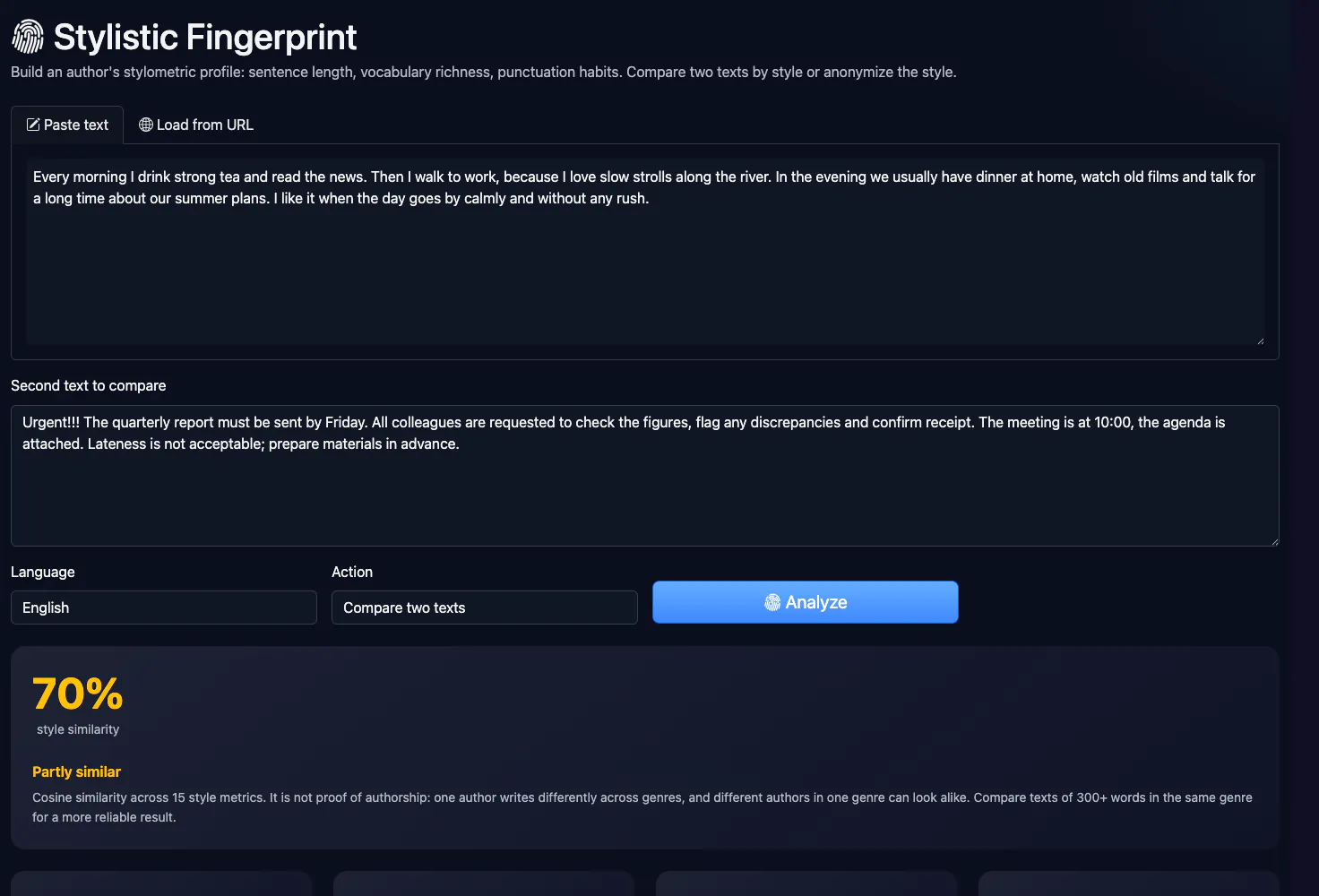
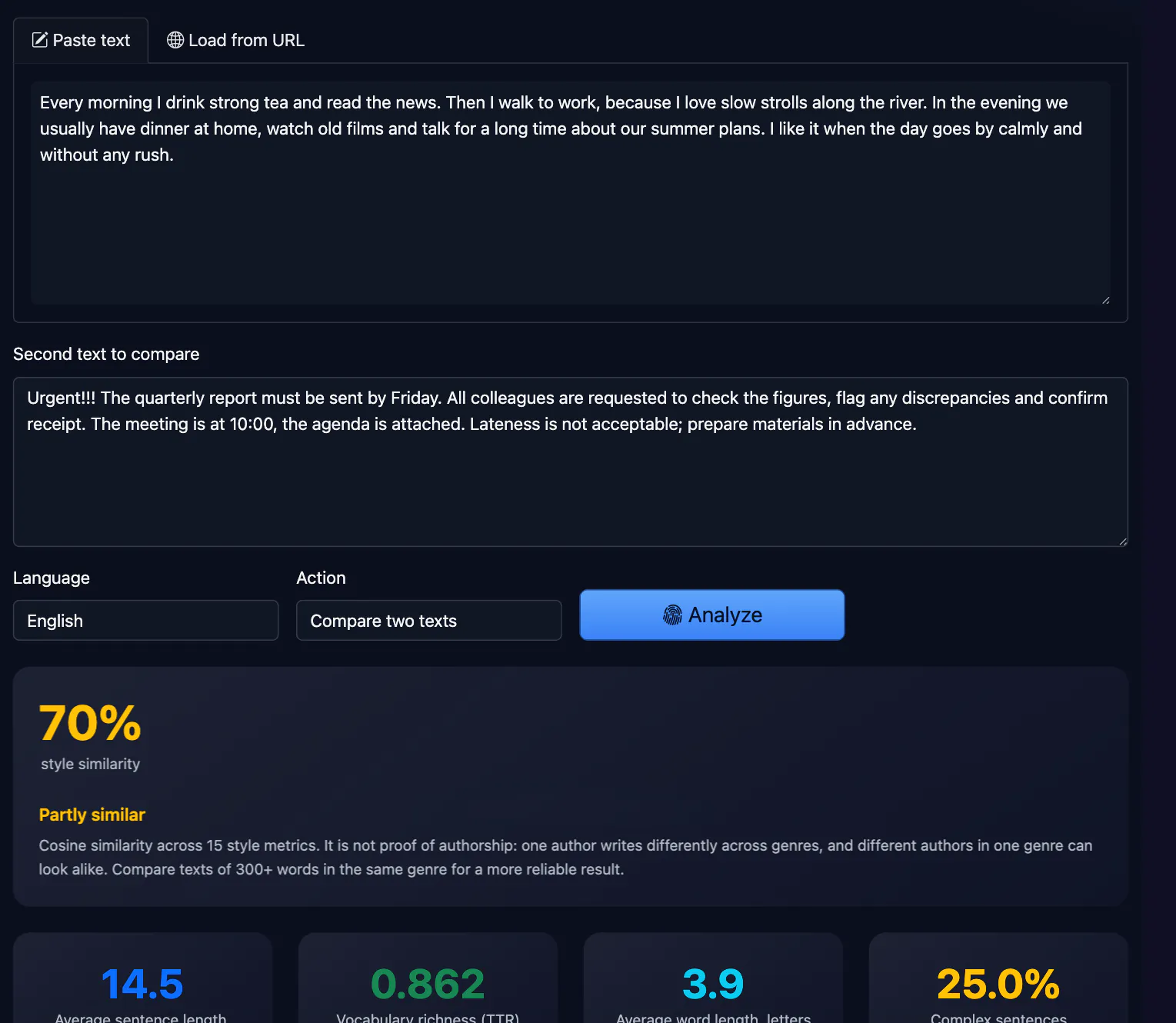
Text stylistic fingerprint — author profile
Build an author's stylometric profile across 15 metrics: sentence and word length, vocabulary richness, punctuation habits, sentence openings. Compare two texts by style or anonymize the style.
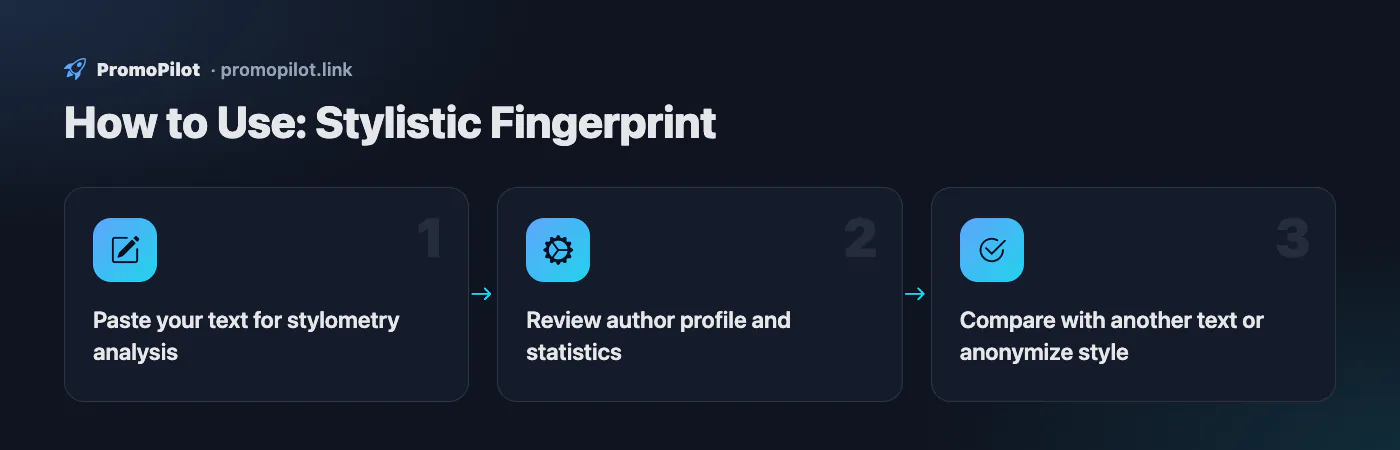
How to Use
- Paste your text for stylometry analysis
- Review author profile and statistics
- Compare with another text or anonymize style
FAQ
Who it is for and typical uses
- Editors and content teams. Compare texts by different authors or contractors to see how consistent the brand style is.
- Writers. A profile across 15 metrics shows how you write: sentence length, vocabulary variety, punctuation. It helps you refine your own style.
- “Was it written by one hand?” Similarity between two texts is a reason to look closer, not proof: different people can have close styles.
- Anonymization. To remove a recognisable manner of writing, the text is rewritten toward a preset (journalist, blogger, copywriter, student, scientist).
Honest limitations
- This is not forensic analysis. The similarity percentage is statistics over small samples. Serious authorship attribution needs large corpora and proven methods.
- Short texts are unreliable. The minimum is 100 characters, but a meaningful profile appears from roughly 300 words.
- Anonymization is automatic. It moves the metrics toward the preset but does not guarantee that the author cannot be identified by vocabulary, topics or facts. Reread the result.
- One language per run. Select the text's language; on mixed-language texts the metrics are distorted.
- The text is processed on a server. Do not upload confidential material.
Related: AI detector, plagiarism checker, readability analyzer, tone analyzer, text humanizer.
PromoPilot vs alternatives: comparison
We compare only what is confirmed on each service's own pages. Where we could not confirm a fact, the cell shows "—".
| Parameter | PromoPilot | stylo (пакет R) | JGAAP |
|---|---|---|---|
| Free and limits | Yes: 15 requests per minute, up to 50,000 characters | Free software, GPL (≥ 3); no price stated | Open source; no price stated on the page |
| Installation needed | No, in a browser | Yes: R (≥ 3.0) is required | Yes: a Java program, releases on GitHub |
| Large text corpora | ✗ | ✓ supervised and unsupervised multivariate methods, with a GUI | ✓ machine learning for text attribution problems |
| Style anonymization | ✓ | — | — |
| License | Online service | GPL (≥ 3) | AGPLv3.0 |
Scroll the table sideways
Where we are weaker: it compares at most two texts and cannot work with corpora, clustering or training on author samples; the result is a simplified profile, not scholarly attribution.
When to choose PromoPilot: When you want a quick estimate of how similar two texts are in manner of writing, to see your own style profile or to neutralise it toward a sample. For scholarly authorship attribution with large corpora, use specialised packages such as stylo or JGAAP.
Checked on: . "—" means not confirmed on the official page; terms and prices change, so check the services' own sites.
RankBotAI — AI SEO Optimization for WordPress
RankBotAI AI plugin automatically finds and fixes SEO issues in WordPress products and posts — no manual editing.