Key facts
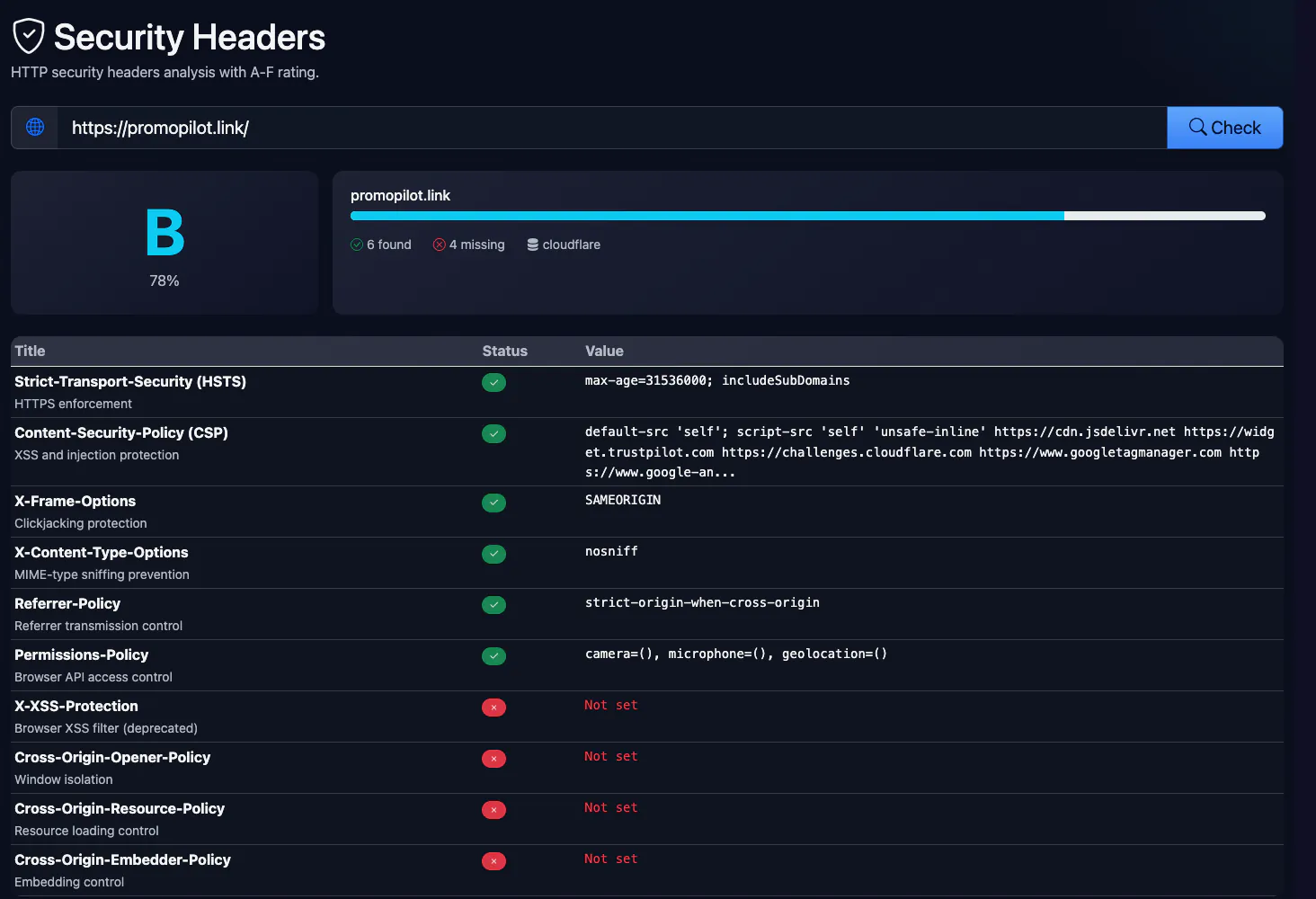
Security headers check: enter an address and see which of 10 headers (HSTS, CSP, X-Frame-Options and others) the site sends, with an A–F grade. Free. The tool checks only that a header is present, not the quality of its value: a weak CSP also scores points.
- Price
- Free
- Sign-up
- Not required
- Processing
- On our server: it sends a HEAD request to the page and checks whether the response contains 10 security headers
- Input
- A page address (http or https)
- Limits
- 20 checks per minute per IP, no sign-up and no daily limit
- Output
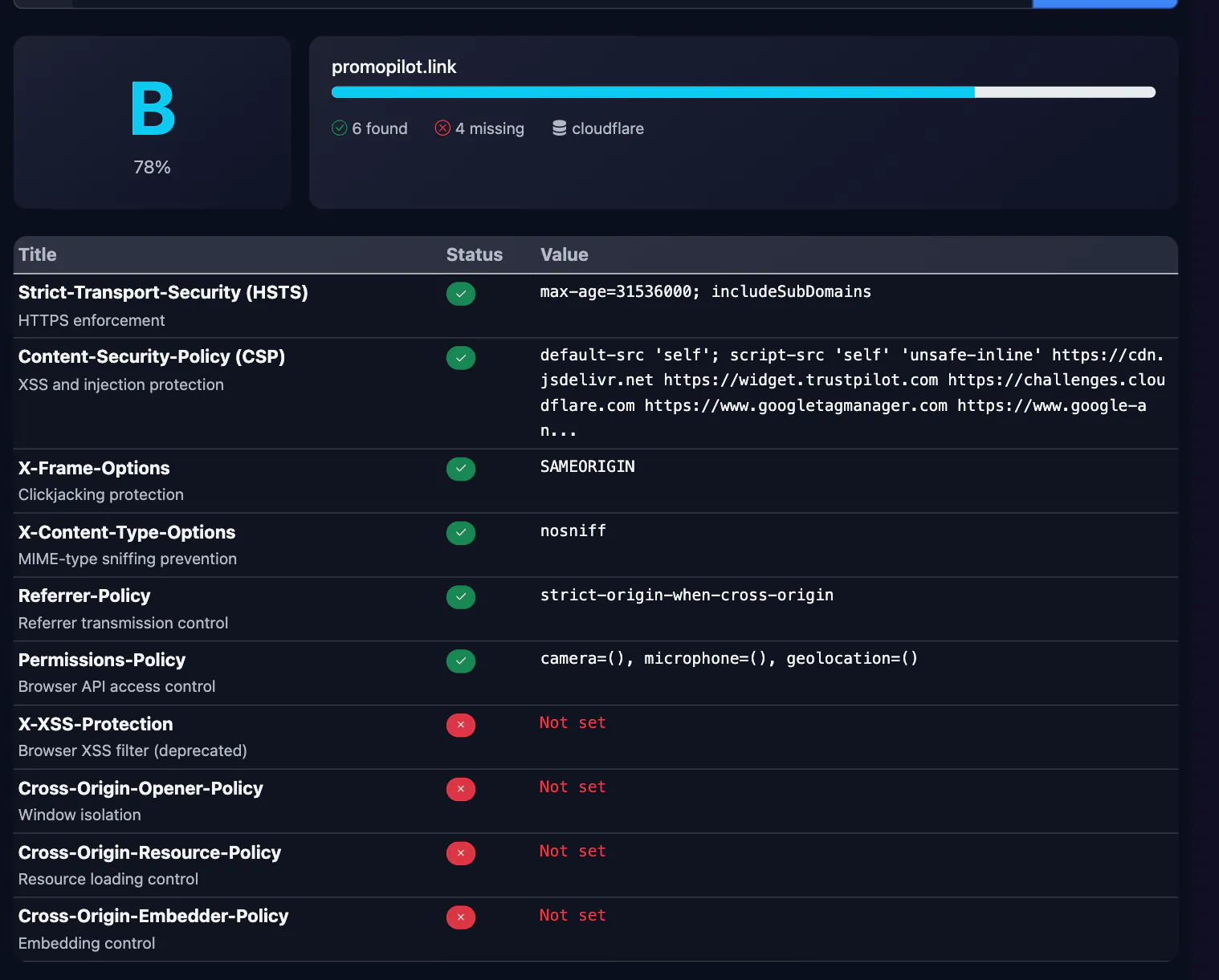
- A percentage and an A–F letter, a table of 10 headers (present / missing, value, purpose, weight) and the Server header value
- Last updated
Video walkthrough 0:42

Security Headers Checker Free: HSTS, CSP, X-Frame-Options Grade for Any Website
Check HTTP security headers for free: HSTS, Content-Security-Policy, X-Frame-Options and more, with a grade and values.
Video transcript
Does your website send the right security headers? Check it free. Enter a website address. Click Check. The site gets a grade B, with six headers found and four missing. The table lists every header, its status and its value, from strict transport security to content security policy. Headers are one layer. They do not replace updates or a firewall. Test a strict content policy first, because it can break scripts. Free, no sign-up. The link is in the description. Subscribe for more free tools.
See it in action
Open source on GitHub
Run the same check on your own machine: a Node.js command-line tool, a library and a GitHub Action. Open source under the MIT license.
Security Headers Check
Check HTTP security headers: Content-Security-Policy, X-Frame-Options, HSTS and others. Besides presence, key values count (HSTS max-age, unsafe-inline in CSP, X-Frame-Options), but this is not a full policy audit. Helps protect a site against XSS and clickjacking.
How to Use
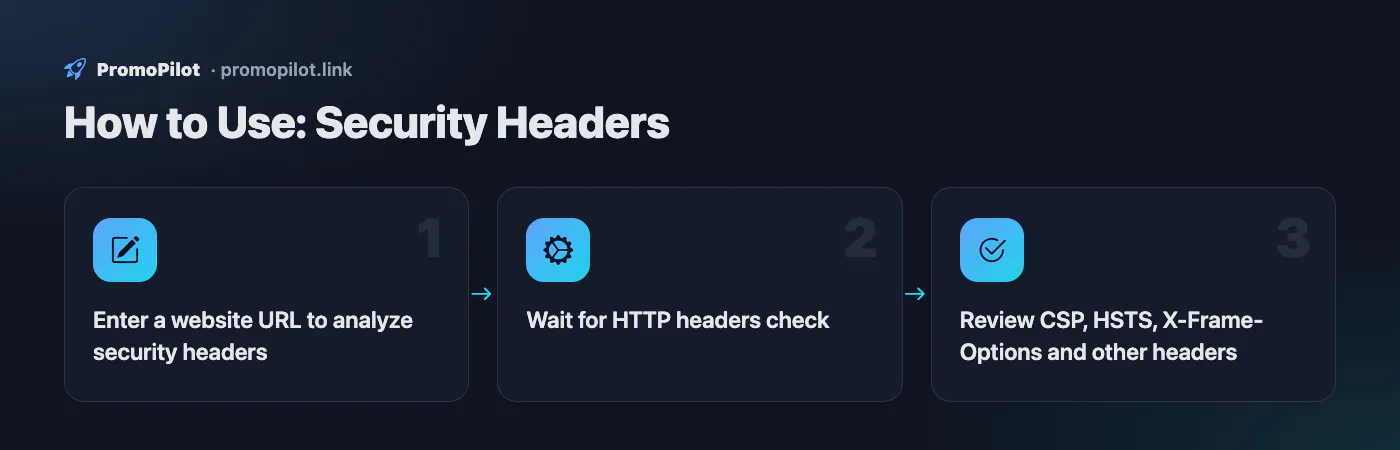
- Enter a website URL to analyze security headers
- Wait for HTTP headers check
- Review CSP, HSTS, X-Frame-Options and other headers
FAQ
Who it is for and typical uses
- A quick security audit. The table shows which protective headers exist and which to add in the Nginx, Apache or CDN configuration.
- Checking after configuration. Confirm that a new header is actually sent and not lost on a proxy.
- A client report. A percentage and a letter are easy to discuss; the details are in the HTTP headers checker and the security scanner.
Honest limitations
- Presence, not value. A CSP header with
unsafe-inlineor an HSTS with a very short lifetime scores in full; the value is displayed but not judged. - X-XSS-Protection is obsolete and labelled so in the table: it earns no points and its absence does not lower the grade.
- Only HEAD response headers. If the server answers HEAD and GET differently, or adds headers only on some pages, the result may differ from what a browser sees.
- No review of Set-Cookie, Cache-Control or TLS. Cookie attributes are covered by a separate tool, the certificate by the SSL checker.
- Not every header suits everyone. COOP, CORP and COEP matter for special cases (isolation, embedding), and lacking them is not always a problem.
PromoPilot vs alternatives: comparison
We compare only what is confirmed on each service's own pages. Where we could not confirm a fact, the cell shows "—".
| Parameter | PromoPilot | MDN HTTP Observatory | Hardenize | KeyCDN HTTP Header Checker |
|---|---|---|---|---|
| Header presence and grade | ✓ 10 headers, A–F grade | ✓ | — | Shows the HTTP response headers via curl |
| Quality assessment of values (CSP, HSTS) | ✗ | An “in-depth assessment of a site’s HTTP headers and other key security configurations” with actionable feedback | — | — |
| Other configuration checks | ✗ (separate tools) | Launched in 2016; the page cites 6.9 million sites and 47 million scans | A public report for a domain; advertises certificate and network-perimeter monitoring | — |
Scroll the table sideways
Where we are weaker: we judge values only selectively (HSTS max-age, unsafe-inline in CSP, X-Frame-Options), which is not a full policy audit; the request is a HEAD with a GET retry on 403/405/501.
When to choose PromoPilot: When you want to see quickly which security headers a site lacks. For judging policy quality (CSP, HSTS) and detailed advice use specialised scanners.
Checked on: . "—" means not confirmed on the official page; terms and prices change, so check the services' own sites.